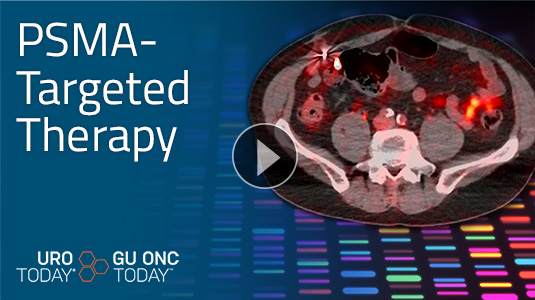
New PET Imaging Tracers and Targets for the Staging Biochemically Recurrent Prostate Cancer
Written by Rashid K. Sayyid, MD MSc, University of Southern California, Los Angeles, CA & Zachary Klaassen, MD, MSc, Wellstar MCG Health, Georgia Cancer Center, Augusta, GA
January 7, 2025
In December 2020, Gallium 68 PSMA-11 (
68Ga PSMA-11) was approved by the U.S. Food and Drug Administration (FDA) for the staging of prostate cancer patients with suspected recurrence based on elevated serum prostate-specific antigen (PSA) levels.
1 This was shortly followed by the FDA approval of
18F-DCFPyL (PYLARIFY®) in May 2021 for the same indication.
Read More
New PET Imaging Tracers for the Primary Staging of Unfavorable Intermediate and High-Risk Prostate Cancer
Written by Rashid K. Sayyid, MD, MSc, University of Southern California Los Angeles, CA and Zachary Klaassen, MD, MSc, Wellstar MCG Health Goergia Cancer Center Augusta, GA
January 6, 2025
In December 2020, Gallium 68 PSMA-11 (68Ga PSMA-11) was approved by the U.S. Food and Drug Administration (FDA) for the initial staging of prostate cancer patients at high risk of metastases,
1 and this was shortly followed by the FDA approval of 18F-DCFPyL (PYLARIFY®) in May 2021.
Read More
The Current Landscape of PSMA PET Imaging in Prostate Cancer: Evaluating Men with Biochemical Recurrence
Written by Rashid Sayyid, MD MSc, & Zachary Klaassen, MD MSc
October 19, 2022
Although definitive local therapy in the form of radical prostatectomy or radiation therapy with or without ADT offers excellent long-term outcomes for the majority of patients with clinically localized prostate cancer, patients with high-risk disease experience primary treatment failure rates approaching 65%.
1 Disease persistence/recurrence in such patients may be restricted to the prostatic fossa
Read More
PSMA PET Imaging in Prostate Cancer: Staging for Unfavorable Intermediate and High-Risk Disease
Written by Rashid Sayyid, MD MSc, & Zachary Klaassen, MD MSc
October 20, 2022
Conventional imaging using CT and bone scan has limited sensitivity when staging men with high-risk localized prostate cancer. Findings of extraprostatic spread in the form of extraprostatic extension and/or lymph node, visceral, or bone metastasis can influence treatment planning, and thus, potentially, patient outcomes.
Read More
The Current Landscape of PSMA PET Imaging in Prostate Cancer: Evolution of Next Generation Imaging & PSMA PET for Primary Tumor Evaluation
Written by Rashid Sayyid, MD MSc, & Zachary Klaassen, MD MSc
October 13, 2022
Imaging plays a significant role in the diagnosis and management of prostate cancer. While transrectal ultrasound and, subsequently, multiparametric magnetic resonance imaging (mpMRI) have become well-established modalities in the initial diagnosis of prostate cancer, numerous techniques for the distant staging of prostate cancer have all suffered from significant limitations.
Read More
Imaging in Prostate Cancer: An Update on a Rapidly Changing Space
Written by Zachary Klaassen, MD, MSc
June 22, 2021
An accurate assessment of the extent of disease is critical to the care of patients with cancer, across the natural history of disease including initial evaluation, following local treatment, and assessing response to systemic therapy. Thus, improvements in radiographic imaging may revolutionize
Read More
The Rapidly Evolving Role of PSMA In Prostate Cancer Diagnostics And Therapeutics
Written by Zachary Klaassen, MD MSc
April 15, 2021
Prostate-specific membrane antigen (PSMA) is a type II transmembrane glycoprotein which functions as a zinc metalloenzyme and is found on prostatic epithelium. In normal prostate tissue, PSMA expression and localization focuses on the cytoplasm and apical side of the epithelium surrounding prostatic ducts.
Read More
Appropriate Use Criteria for Imaging Evaluation of Biochemical Recurrence of Prostate Cancer After Definitive Primary Treatment
The purpose of this document is to describe the appropriate use of imaging in the diagnostic evaluation of patients with BCR after definitive primary treatment. The imaging modalities that were considered included CT, bone scan, and the U.S. Food and Drug Administration (FDA)–approved PET radiotracers that track malignancy-induced lipogenesis (
11C-choline) and amino acid metabolism (
18F-fluciclovine).
Read More