

(UroToday.com) The 2025 American Society of Clinical Oncology (ASCO) Annual Meeting held in Chicago, IL between May 30th and June 3rd, 2025, was host to a prostate, testicular, and penile cancers poster session. Dr. Koichiro Kimura presented an analysis from the U.S. Expanded-Access program assessing PSMA PET/CT-derived predictive markers for 177Lu-PSMA-617 treatment outcomes.
177Lu-PSMA-617 (Lu-PSMA) has demonstrated clinically meaningful survival benefits in patients with metastatic castration-resistant prostate cancer (mCRPC) in the post-taxane chemotherapy and androgen receptor pathway inhibitor setting, improving both progression-free survival (PFS) and overall survival (OS).1,2 However, response to Lu-PSMA varies widely, and predictive biomarkers are sorely needed to inform treatment decisions.
PSMA PET/CT imaging, a cornerstone for selecting patients for Lu-PSMA therapy, offers both qualitative and quantitative insights. While several parameters—such as tumor-to-salivary gland ratio (PSG), total tumor volume (TV), and intensity-based scores—have been proposed, their comparative prognostic utility in real-world populations remains unclear.
This study aimed to externally validate and benchmark proposed PSMA PET/CT–derived predictive models in patients treated within the U.S. Expanded-Access Program (EAP) for Lu-PSMA therapy.
This was a retrospective analysis of 88 patients with mCRPC treated with Lu-PSMA across three U.S. academic institutions between May 2021 and March 2022 as part of the EAP (NCT04825652). All patients had pre-treatment 68Ga-PSMA-11 PET/CT scans and clinical outcomes data available.
Tumor lesions were semi-automatically contoured to extract the following PSMA PET parameters:
- Total tumor volume (TV)
- Total tumor SUVmean
- Total tumor SUVmax
- Total lesion uptake (TLU = TV × SUVmean)
- Total lesion quotient (TLQ = TV / SUVmean)
- Quantitative PSMA tumor-to-salivary gland ratio (qPSG):
- High: ≥ 1.5
- Intermediate: 0.5–1.5
- Low: ≤ 0.5
The visual metrics assessed were:
- Visual PSG (vPSG):
- High: Most lesions > parotid uptake
- Intermediate: Neither clearly high nor low
- Low: Most lesions < parotid uptake
- HIT Score (Heterogeneity and Intensity of Tumor):
- Score 1: SUVmax < 15
- Score 2: SUVmax 15–79, heterogeneous
- Score 3: SUVmax 15–79, homogeneous
- Score 4: SUVmax ≥ 80
The study outcomes were PSA progression-free survival (PSA-PFS) and overall survival (OS). The associations between the PET parameters and the survival outcomes were assessed using Cox proportional hazards regression models. The concordance index (c-index) was used to evaluate model discrimination.
Overall, 88 patients who received Lu-PSMA within the EAP between May 2021 and March 2022 were eligible and included in this analysis. For PSA PFS, the highest c-index was achieved by the total tumor SUVmean (c-index: 0.678; HR: 0.91, p=0.004), followed by the total tumor SUVmax (c-index: 0.64; HR: 0.99, p=0.034).
For OS, the TLQ achieved the highest c-index (c-index: 0.658; HR: 1.01, p<0.001), followed by the total tumor SUVmean (c-index: 0.634; HR 0.89, p=0.004). The HIT score showed the third highest c-index of 0.632; however, when using score 1 as the reference, the HR did not exhibit a ‘dose-response’ relationship across the ordinal categories.
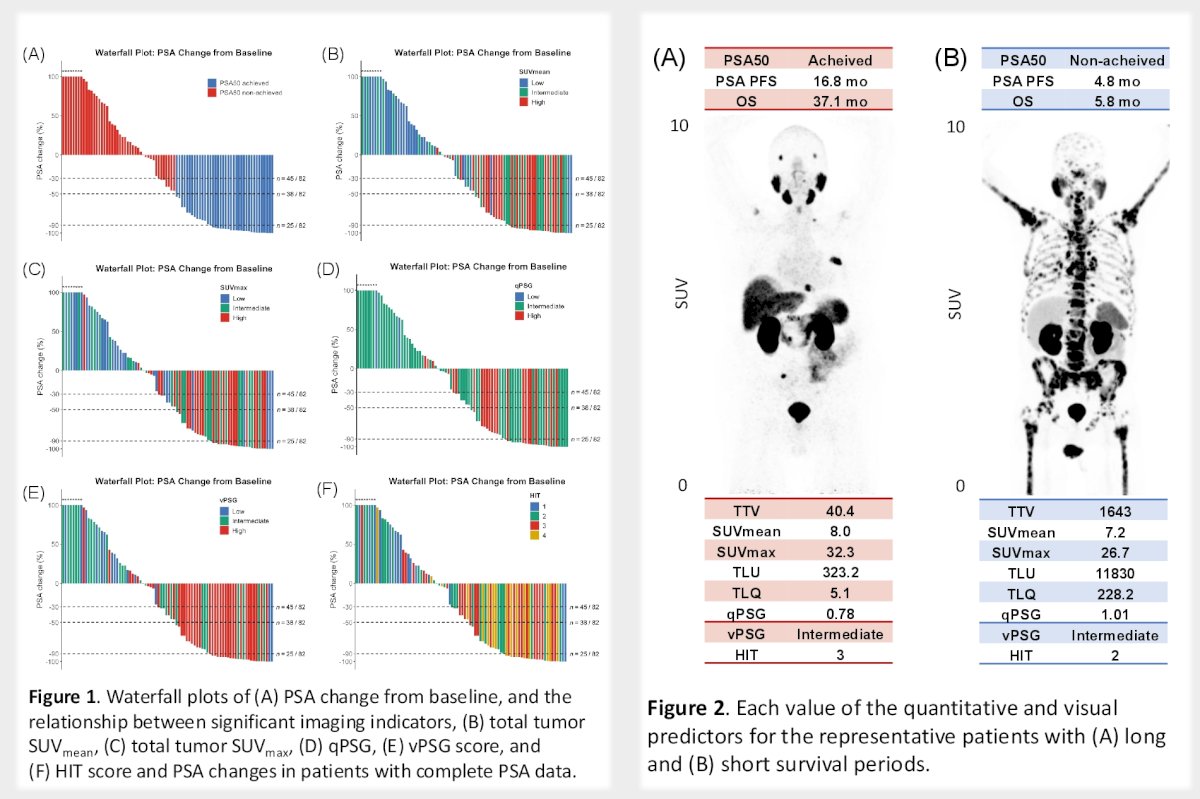
Dr. Kimura concluded as follows:
- Quantitative analysis outperformed visual analysis for predicting the outcome of mCRPC patients treated with Lu-PSMA therapy in the EAP cohort.
- Total tumor SUVmean was identified as the most robust predictor for PSA-PFS, while TLQ showed promise as a predictor for OS.
- Incorporating these predictors into clinical decision-making for pre-Lu-PSMA therapy could aid in patient selection and treatment planning.
Presented by: Koichiro Kimura, MD, PhD, Visiting Project Scientist, Ahmanson Translational Theranostics Division, Department of Molecular and Medical Pharmacology, David Geffen School of Medicine at UCLA
Written by: Rashid K. Sayyid, MD, MSc – Robotic Urologic Oncology Fellow at The University of Southern California, @rksayyid on Twitter during the American Society of Clinical Oncology (ASCO) 2025 Annual Meeting, Chicago, IL, Fri, May 30 – Tues, Jun 3, 2025.
Related content: SUVmean on PSMA PET Predicts Lutetium-PSMA Therapy Success in mCRPC - Koichiro Kimura
- Hofman MS, Emmett L, Sandhu S, et al. [(177)Lu]Lu-PSMA-617 versus cabazitaxel in patients with metastatic castration-resistant prostate cancer (TheraP): A randomized, open-label, phase 2 trial. Lancet. 2021; 397(10276): 797-804.
- Sartor O, de Bono J, Chi KN et al. Lutetium-177-PSMA-617 for Metastatic Castration-Resistant Prostate Cancer. N Engl J Med. 2021; 385(12):1091-1103.