

(UroToday.com) The 2025 American Society of Clinical Oncology (ASCO) Annual Meeting held in Chicago, IL, was host to the session Poster Session: Genitourinary Cancer - Prostate, Testicular, and Penile Cancer. Wolfgang Peter Fendler, MD, presented Poster 5045: Updated prostate cancer risk groups by PSMA-PET PROMISE (PPP2): Results from an international multi-centre registry study.
PSMA PET imaging was first introduced in 2012, marking a significant advancement in prostate cancer diagnostics. In 2018, Dr. Fendler and colleagues developed the first prognostic nomograms using PSMA PET data standardized by the Prostate Cancer Molecular Imaging Standardized Evaluation (PROMISE) criteria in a large single-center cohort.1 In 2024, the initial PSMA PET-PROMISE nomograms (PPP1) were formally published using single-center data. Dr. Fendler presented a validated three-tier risk stratification model, PSMA-PET PROMISE (PPP2) in a large international multi-center registry study assessing prostate cancer-specific survival.
The investigators included prostate cancer patients with at least 36 months of overall survival follow-up who underwent PSMA-PET at 20 hospitals across Europe, the United States, and Australia between 2014 and 2021. Imaging was standardized using PROMISE version 2 (V2), and data were collected on total lesion count, total tumor volume, PSMA expression score, and overall survival. Sites were split into development and validation cohorts in a 2:1 ratio based on institutional characteristics.
In the development cohort, predictors for PSMA-PET PROMISE version 2 (PPP2) were assessed, and visual and quantitative nomograms were generated using Cox regression models with least absolute shrinkage and selection operator (LASSO) penalty for overall survival. Performance was evaluated in the validation cohort using Harrell’s C-index and calibration plots. A head-to-head comparison with the National Comprehensive Cancer Network (NCCN) risk score was performed using ROC curve analysis.

A total of 6,128 male patients were analyzed across all disease stages, with 4,044 in the development cohort and 2,084 in the validation cohort. Median follow-up was 4.8 years (IQR 3.4–6.4), during which 1,915 deaths (31.2%) were recorded. In the visual PPP2 nomogram, key predictors included the presence of distant metastases (M1a: extrapelvic nodal, M1b: bone—oligometastatic, disseminated, or diffuse marrow involvement, and M1c: visceral), PSMA expression score, and total lesion count. The quantitative PPP2 nomogram incorporated similar metastatic categories, total tumor volume, and PSMA expression score.
In the validation cohort, both nomograms demonstrated strong prognostic accuracy, with C-indices of 0.80 (95% CI: 0.78–0.82) for the visual model and 0.80 (95% CI: 0.79–0.82) for the quantitative model.

When stratified into three risk groups (low, intermediate, high), both PPP2 nomograms outperformed the NCCN risk classification (n=1,034) with an AUC of 0.84 vs. 0.76 (p<0.0001). Similarly both PPP2 nomograms outperformed the EAU biochemical recurrence risk classification (p-value for the visual PPP2 nomogram 0.016 and for the quantitative PPP2 nomogram 0.00050) as illustrated in the table below.

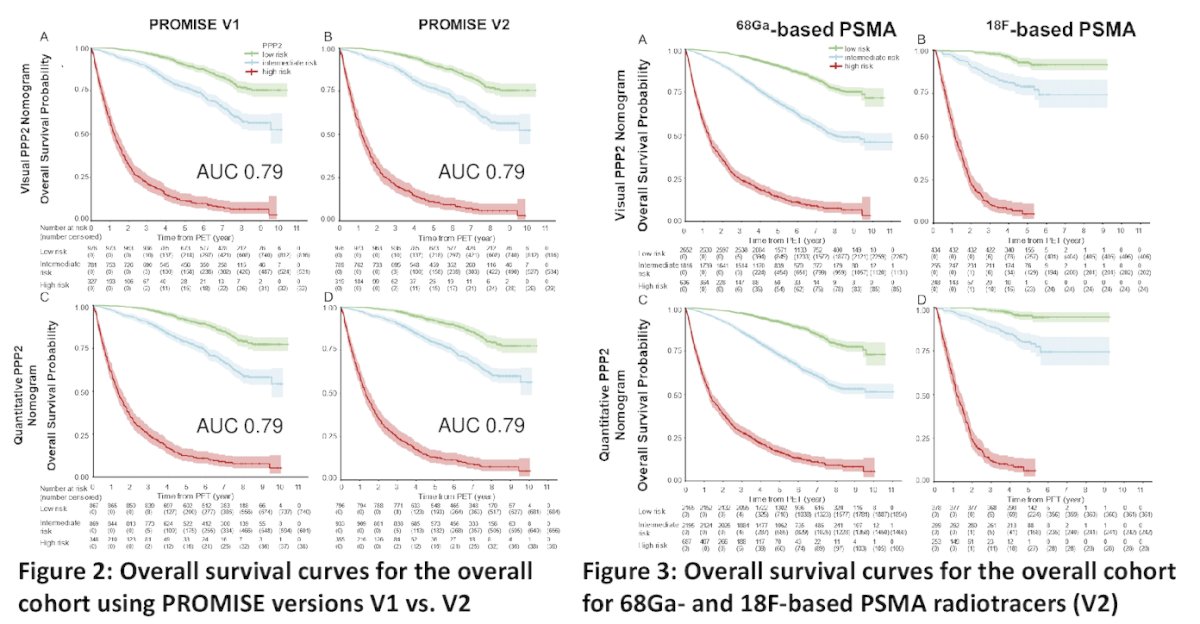
Notably, their performance remained consistent regardless of the radiopharmaceutical used (68Ga vs. 18F) or PROMISE version (V1 vs. V2), with AUCs of 0.79 across subgroups (visual: p=0.11; quantitative: p=0.56) as illustrated below
Dr. Fendler concluded by emphasizing:
- PSMA-PET PROMISE nomograms were updated and validated in a large international multi-center study.
- The refined PPP2 nomograms provide accurate three-tier risk stratification (high, intermediate, low) for overall survival across all stages of prostate cancer.
- PPP2 demonstrated superior prognostic accuracy compared to the NCCN risk classification (AUC 0.84 vs. 0.76; p<0.0001) or EAU BCR risk groups
- The performance of the nomograms was consistent regardless of radiopharmaceutical (68Ga vs. 18F) or PROMISE version used.
- Ongoing follow-up and validation are being conducted through the PROMISE Registry (NCT06320223, promise-pet.org).
Presented by: Wolfgang Peter Fendler, MD, Department of Nuclear Medicine, University of Duisburg-Essen, and German Cancer Consortium (DKTK), University Hospital Essen. Germany.
Written by: Julian Chavarriaga, MD – Urologic Oncologist at Cancer Treatment and Research Center (CTIC) via Society of Urologic Oncology (SUO) Fellow at The University of Toronto. @chavarriagaj on Twitter during the American Society of Clinical Oncology (ASCO) 2025 Annual Meeting, Chicago, IL, Fri, May 30 – Tues, Jun 3, 2025.
Related content: Emerging Prognostic Value of Molecular Imaging in Prostate Oncology - Wolfgang Fendler