

(UroToday.com) The 2025 European Association of Urology (EAU) Annual Meeting held in Madrid, Spain between March 21st and 24th 2025, was host to the Abstract Session 05: On the Horizon: Ongoing Trials in Urology. Dr. Sia Daneshmand presented A0082: Trial in Progress: PIVOT-006- A Phase 3, Randomized Study of Adjuvant Intravesical Cretostimogene Grenadenorepvec versus Surveillance for the Treatment of Intermediate-Risk Non-Muscle Invasive Bladder Cancer.
Cretostimogene grenadenorepvec is a conditionally replicating, highly immunogenic adenovirus regulated by the human E2F-1 promoter, making it highly selective for RB-E2F pathway alterations. This oncolytic immunotherapy encodes a GM-CSF transgene and exerts a dual mechanism of action: viral replication leads to tumor lysis, while GM-CSF stimulates an immune response, enhancing antitumor activity. The mechanism of action is illustrated in the figure below.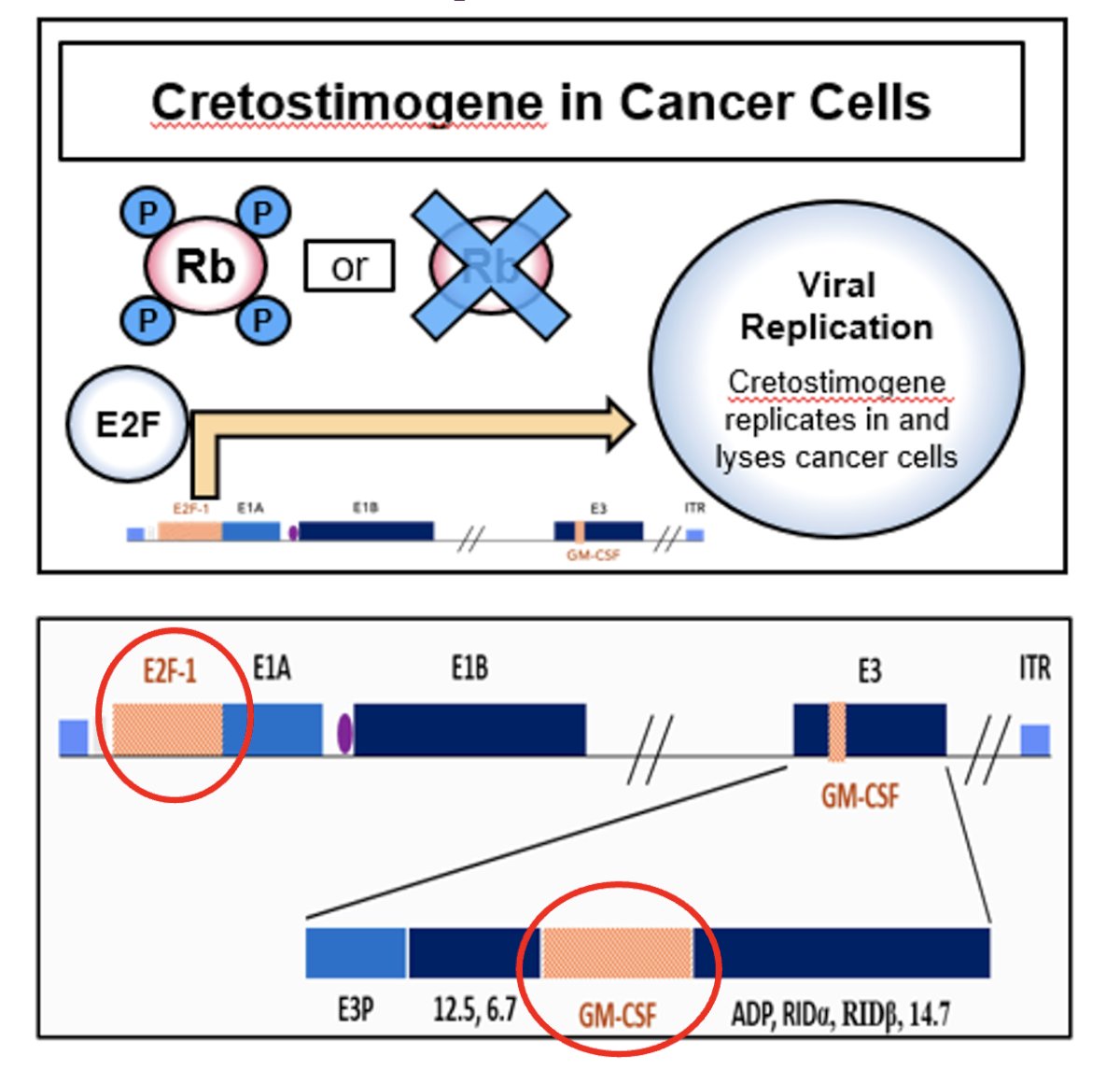
Key considerations for study design in intermediate-risk non-muscle invasive bladder cancer (IR-NMIBCC). These include a significant risk of recurrence and the absence of an FDA-approved standard of care for IR-NMIBC.1 Dr. Daneshmand emphasized that surveillance is an appropriate control arm, serving as the best comparator to assess the benefit of adjuvant treatment while being aligned with guideline-directed care and associated with a low risk of progression. In real-world practice, intravesical therapy is underutilized for IR-NMIBC, and prior randomized controlled trials support surveillance as a valid comparator.2-3
PIVOT-006 (NCT06111235) is a Phase 3, randomized study evaluating adjuvant intravesical cretostimogene grenadenorepvec versus surveillance for the treatment of intermediate-risk NMIBC. The trial utilizes the AUA definition of IR-NMIBC and randomizes patients 1:1 into two arms: Arm A receives intravesical cretostimogene following TURBT, while Arm B undergoes surveillance post-TURBT. Notably, patients in Arm B who experience disease recurrence are eligible to receive cretostimogene. The primary endpoint is recurrence-free survival, with the study design detailed below.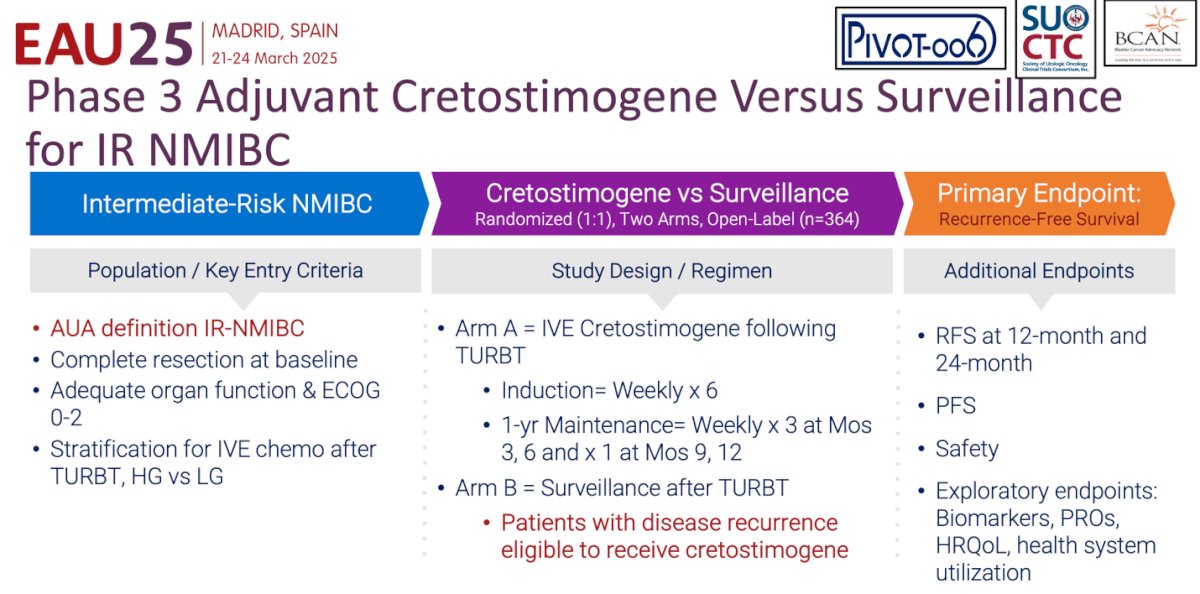
PIVOT-006 is an SUO-CTC trial in progress, with participation from over 90 sites across North America. Enrollment began in January 2024, with an expected enrollment period of 30 months and a minimum follow-up of one year per patient. To date, approximately one-third of the target enrollment has been achieved.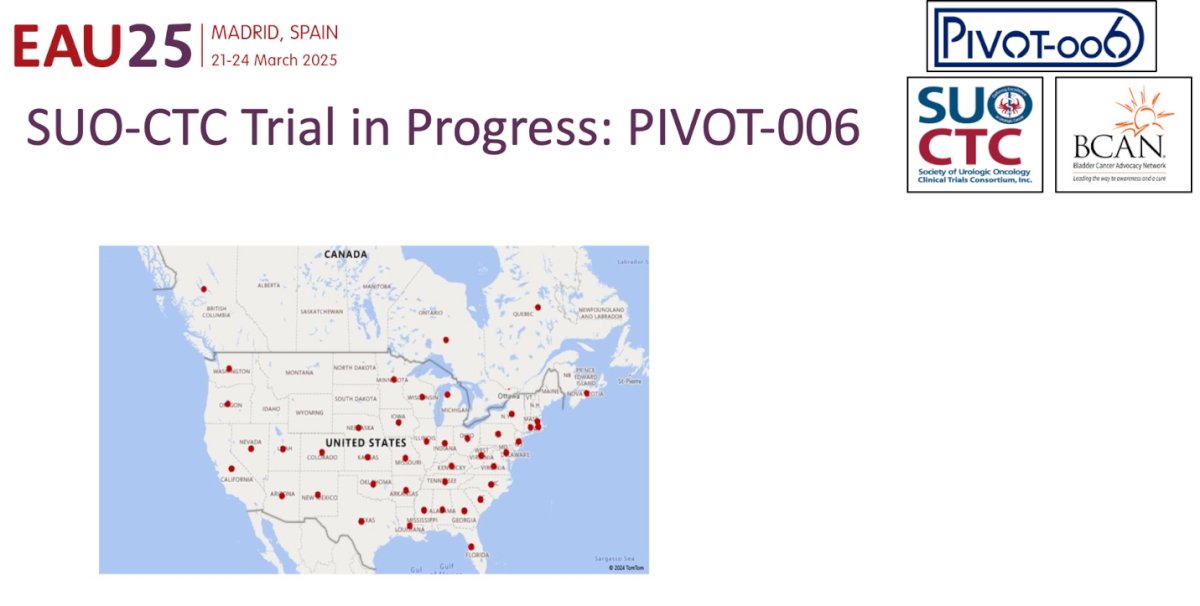
Presented by: Sia Daneshmand, MD, Urologic Oncologist, Professor of Urology and Medicine at the University of Southern California (USC) in Los Angeles, CA.
Written by: Julian Chavarriaga, MD – Urologic Oncologist at Cancer Treatment and Research Center (CTIC) via Society of Urologic Oncology (SUO) Fellow at The University of Toronto. @chavarriagaj on Twitter during the 2025 European Association of Urology (EAU) Annual Meeting held in Madrid, Spain between March 21st and 24th 2025
References:- Sylvester RJ, van der Meijden AP, Oosterlinck W, Witjes JA, Bouffioux C, Denis L, Newling DW, Kurth K. Predicting recurrence and progression in individual patients with stage Ta T1 bladder cancer using EORTC risk tables: a combined analysis of 2596 patients from seven EORTC trials. Eur Urol. 2006 Mar;49(3):466-5; discussion 475-7. doi: 10.1016/j.eururo.2005.12.031. Epub 2006 Jan 17. PMID: 16442208.EAU NMIBC Guideline.
- Holzbeierlein J, Bixler BR, Buckley DI, et al. Diagnosis and treatment of non-muscle invasive bladder cancer: AUA/SUO guideline: 2024 amendment. J Urol. 2024;10.1097/JU.0000000000003846.
- NCCN Clinical Practice Guidelines in Oncology. Bladder Cancer. Version 6. 2024. 8 7