

(UroToday.com) The 2025 GU ASCO annual meeting featured a prostate cancer trials in progress session and a presentation by Alicia K. Morgans, MD, MPH, discussing ARASTEP, a phase 3, randomized, double-blind, placebo-controlled study assessing darolutamide + ADT in patients with high-risk biochemical recurrence of prostate cancer. Patients with prostate cancer treated with radiotherapy or radical prostatectomy as primary therapy may develop biochemical recurrence of prostate cancer, defined by a PSA increase with no evidence of metastases on conventional imaging.
However, PSMA PET/CT may detect lesions in patients with biochemical recurrence of prostate cancer. Patients with biochemical recurrence of prostate cancer are at high risk of disease progression, and lesions identified by PSMA PET/CT need effective treatment to delay progression. Darolutamide, a structurally distinct and highly potent androgen receptor inhibitor, significantly improved metastasis free survival and overall survival in patients with nonmetastatic castration-resistant prostate cancer (CRPC).1,2 ARASTEP (NCT05794906) will evaluate whether darolutamide when added to ADT improves radiologic progression free survival by PSMA PET/CT versus placebo + ADT in patients with biochemical recurrence of prostate cancer following primary therapy and PSMA PET/CT-positive lesions.
Eligible patients were treated by primary radiotherapy or radical prostatectomy +/- adjuvant radiotherapy or salvage radiotherapy, present with high-risk biochemical recurrence of prostate cancer (PSA doubling time <12 months and PSA ≥0.2 ng/mL after primary radical prostatectomy [± adjuvant radiotherapy/salvage radiotherapy], or PSA ≥2 ng/mL above nadir after primary radiotherapy only), and must have ≥1 PSMA PET/CT-positive lesion of prostate cancer without visible lesions on conventional imaging, and serum testosterone ≥150 ng/dL.
Approximately 750 patients from 221 global sites will be randomized 1:1 to oral darolutamide 600 mg twice daily or placebo, both with ADT, for 24 months or until disease progression, unacceptable toxicity, or withdrawal of consent. Patients with detectable PSA values (≥0.2 ng/mL) after 24 months will continue study treatment until PSMA PET/CT progression by blinded independent central review: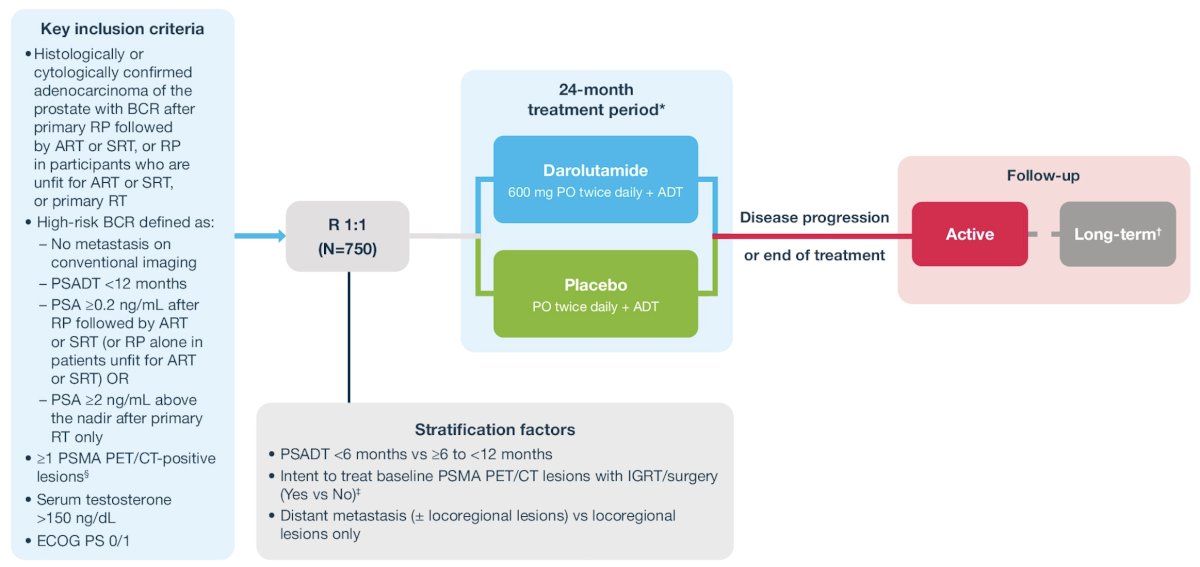
Stratification factors are PSA doubling time <6 versus ≥6–<12 months, intent to treat baseline PSMA PET/CT lesions with image-guided radiotherapy/surgery (yes versus no) and distant ± locoregional vs locoregional-only lesions. The primary endpoint is radiologic progression free survival by PSMA PET/CT assessed by blinded independent central review. Secondary endpoints include metastasis free survival on conventional imaging by blinded independent central review, time to CRPC, overall survival, quality of life, and safety. The study will comprise four consecutive periods: screening/baseline, treatment, active follow-up, and long-term follow-up: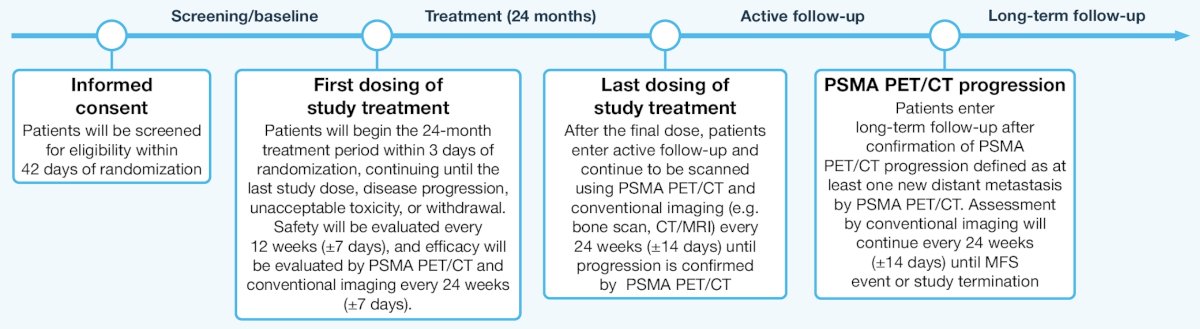
As of January 2025, 458 patients have been randomized at 220 sites:
Presented by: Alicia K. Morgans, MD, MPH, Dana Farber Cancer Institute, Boston, MA
Written by: Zachary Klaassen, MD, MSc – Urologic Oncologist, Associate Professor of Urology, Georgia Cancer Center, Wellstar MCG Health, @zklaassen_md on Twitter during the 2025 Genitourinary (GU) American Society of Clinical Oncology (ASCO) Annual Meeting, San Francisco, CA, Thurs, Feb 13 – Sat, Feb 15, 2025.
Related content: ARASTEP Trial Tests Darolutamide and ADT in High-Risk Biochemically Recurrent Prostate Cancer - Alicia Morgans
References:
- Fizazi K, Shore N, Tammela TL, et al. Darolutamide in nonmetastatic castration-resistant prostate cancer. N Engl J Med. 2019;380(13):1235-1246.
- Fizazi K, Shore N, Tammela TL, et al. Nonmetastatic, Castration-Resistant Prostate Cancer and Survival with Darolutamide. N Engl J Med. 2020 Sep 10;383(11):1040-1049.