

(UroToday.com) The 2026 GU ASCO annual meeting featured a prostate cancer session and a presentation by Dr. Brigida Anna Maiorano discussing an analysis of quality-adjusted time without symptoms or toxicity (Q-TWIST) in patients with metastatic hormone-sensitive prostate cancer (mHSPC) from the ARASENS trial. Triplet combination of darolutamide with ADT and docetaxel significantly improved overall survival (HR 0.68, 95% CI 0.57–0.80; p < 0.001) in patients with mHSPC in the ARASENS trial.1 Darolutamide also showed benefit of intensified therapy in maximizing efficacy while minimizing toxicity. Potential adverse events may be a concern with triplet therapy, and there is a pressing need to identify which patients are most likely to benefit from intensified treatment to maximize effectiveness while minimizing unnecessary adverse events. Q-TWiST is an approach that compares variation in efficacy and toxicity between treatment arms. This study assessed quality of life-adjusted survival of patients with mHSPC using darolutamide triplet therapy compared with doublet therapy (ADT and docetaxel).
The Q-TWiST method assumes patients progress through a set of three health states:
- Time without symptoms or toxicity
- Time in relapse or disease progression
- Time with toxicity: with grade 3/4 symptoms or toxic effects
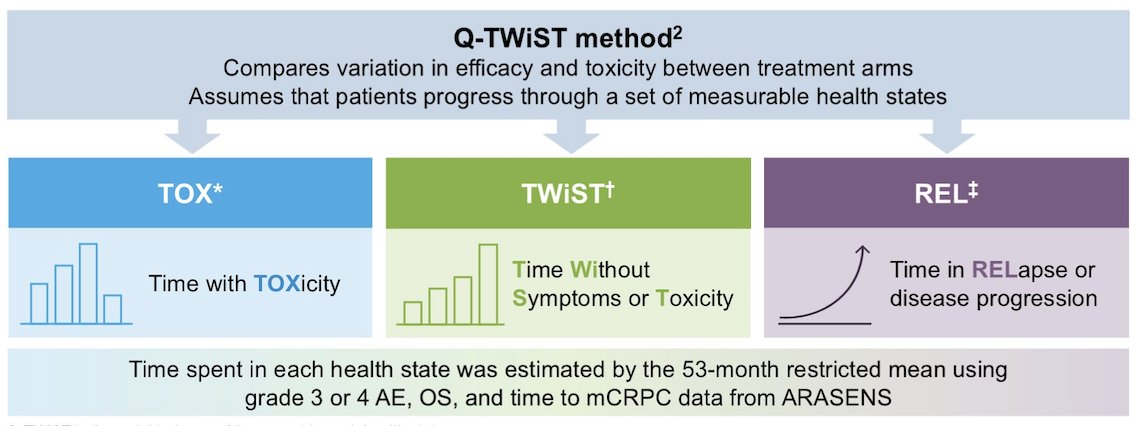
These were estimated by the 53-month restricted mean using grade 3/4 adverse event, overall survival, and time to castration resistant prostate cancer (CRPC) data from ARASENS. Q-TWiST was calculated as the weighted sum of time spent in each health state for each treatment arm (darolutamide versus placebo), adjusted by corresponding utility scores obtained from published sources. Differences in mean Q-TWiST between treatment arms were calculated for utility weights. For each health state, 95% CIs and mean standard errors of time without symptoms or toxicity, time in relapse or disease progression, time with toxicity, and Q-TWiST were calculated based on 1000 bootstrap samples. Relative gain in Q-TWiST was calculated by dividing the mean Q-TWiST difference between treatment arms by the restricted mean overall survival of the placebo arm.
The full analysis set included 651 and 654 patients in the darolutamide and placebo arms, respectively, with well balanced baseline characteristics between the two groups:

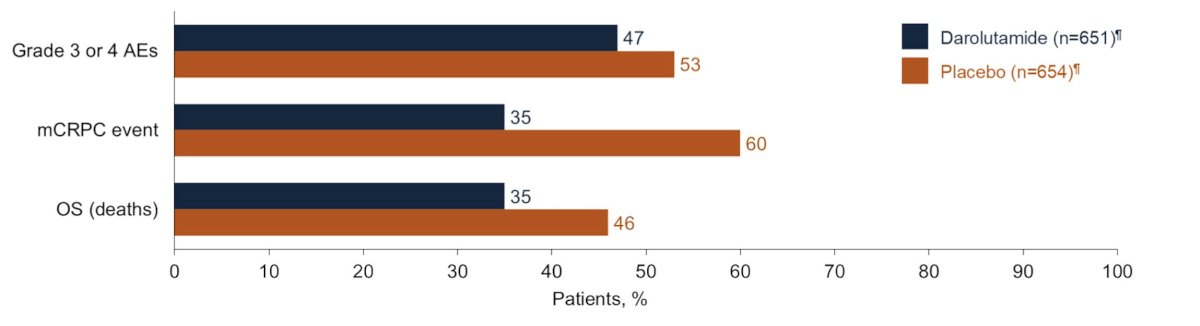
Patients had a similar incidence of grade 3/4 adverse events prior to disease progression (47.5% versus 53.2%), lower incidence of CRPC (34.6% versus 59.8%), and improved overall survival (deaths: 35.2% versus 46.5%) with darolutamide versus placebo:
Significantly, patients had 6.3 months more Q-TWiST with darolutamide versus placebo (p < 0.001) driven by an increase in time without symptoms or toxicity (mean 17.6 months [standard error 0.9] versus 10.9 months [standard error 0.7]), and less time in relapse or disease progression (2.4 months [standard error 0.3] versus 8.7 months [standard error 0.4]). Due to the long treatment duration, there was more time with toxicity (17.2 months [standard error 0.9] versus 11.3 months [standard error 0.7]) at 53 months (all p < 0.001):
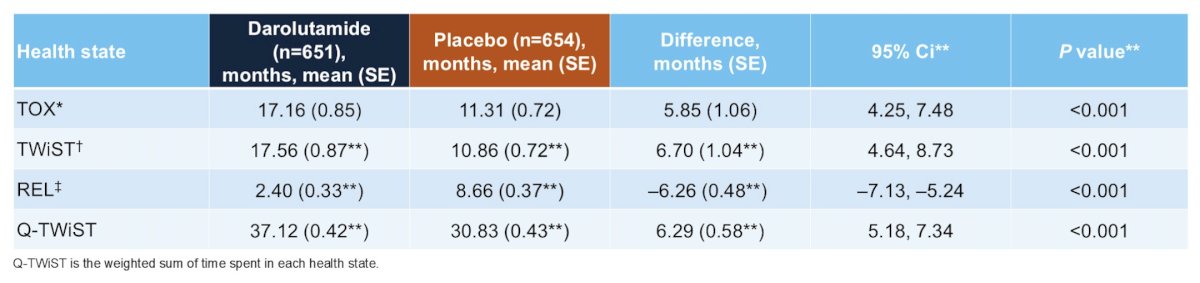
Partitioned Kaplan–Meier survival curves showed significantly persistent time without symptoms or toxicity with darolutamide versus placebo indicating patients spent more time without grade 3/4 adverse events before disease progression (p < 0.001). The darolutamide Q-TWiST relative gain was 16.0% (deemed clinically important):

Dr. Maiorano concluded her presentation discussing an analysis of Q-TWIST in patients with mHSPC from the ARASENS trial with the following take-home points:
- In ARASENS, darolutamide triplet therapy provided an additional 6.3 months of overall survival without symptoms or toxicity and a Q-TWiST relative gain of 16.0% corresponding to higher overall quality-adjusted survival versus doublet therapy at 53 months
- This highlights the benefit of the standard of care ARASENS regimen for patients with mHSPC
Presented by: Brigida Anna Maiorano, MD, PhD, IRCCS Ospedale Casa Sollievo della Sofferenza, San Giovanni Rotondo, Italy
Written by: Zachary Klaassen, MD, MSc – Urologic Oncologist, Associate Professor of Urology, Georgia Cancer Center, Wellstar MCG Health, @zklaassen_md on Twitter during the 2026 American Society of Clinical Oncology Genitourinary (ASCO GU) cancers symposium held in San Francisco, CA, between February 26th and 28th, 2026.
Related content: Q-TWIST Analysis Applied to ARASENS Trial in Metastatic Hormone-Sensitive Prostate Cancer - Brigida Maiorano
References: