

(UroToday.com) The 2025 ASCO annual meeting featured a prostate cancer rapid oral abstract session and a presentation by Dr. Stefanie Zschaebitz discussing exploratory analyses of homologous recombination repair alterations by gene subgroup and potential associations with efficacy in the HRR-deficient population from TALAPRO-2.
HRR mutations are associated with poor survival outcomes in patients with mCRPC. In TALAPRO-2, talazoparib + enzalutamide significantly improved radiographic progression-free survival and overall survival versus enzalutamide + placebo in patients with mCRPC harboring HRR mutations assessed prospectively.1 At the 2025 ASCO annual meeting, Dr. Zschaebitz reported exploratory biomarker analyses which assessed HRR by gene subgroup and potential associations with efficacy in patients enrolled in the HRR-deficient cohort from TALAPRO-2.
Patients were randomized 1:1 to talazoparib 0.5 mg (n = 200) or placebo (n = 199) + enzalutamide 160 mg QD:
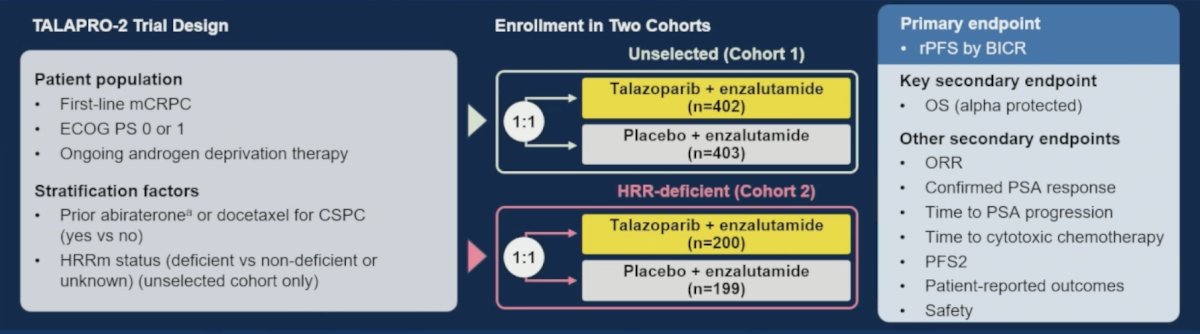
HRR mutation testing used a 12-gene HRR panel (clinical trial assays based on FoundationOne CDx and FoundationOne Liquid CDx). HRR mutation status categorization by gene incorporated all available tumor and prescreening/screening ctDNA records using an algorithm similar to that previously used by others.2 For non-BRCA gene analyses, patients with co-occurring BRCA1/2 alterations were excluded, and for BRCA1, patients with co-occurring BRCA2 alterations were excluded. The key efficacy endpoints assessed were overall response rate, radiographic progression-free survival, and overall survival, in addition to PSA response and time to PSA progression. The data cutoff was September 3, 2024 (the time of the final overall survival analysis).
For all HRR mutation patients, talazoparib + enzalutamide was superior to enzalutamide + placebo across all efficacy endpoints:
- Overall response rate, 69.4% versus 39.1% (OR 0.28, 95% CI, 0.13–0.61)
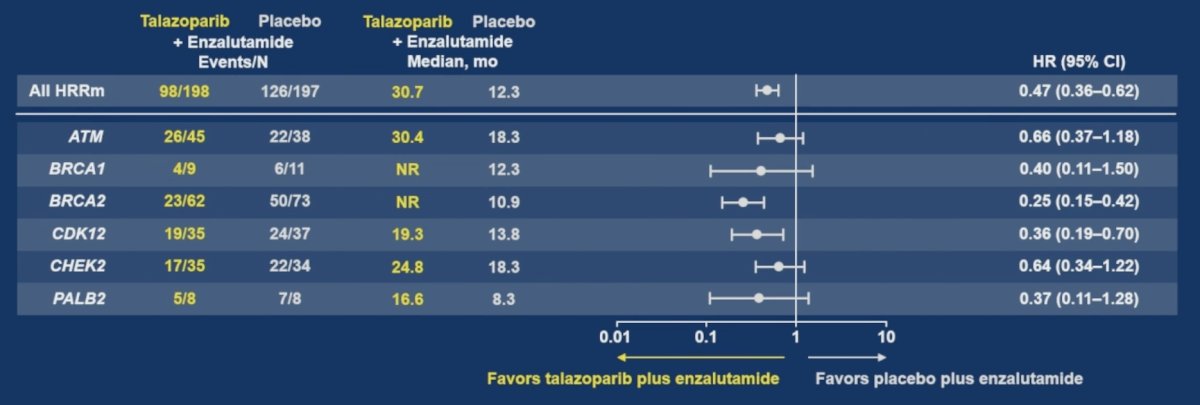
- Radiographic progression-free survival, median 30.7 versus 12.3 months (HR 0.47, 95% CI 0.36–0.62)
- Overall survival, median 45.1 versus 30.8 months (HR 0.60, 95% CI 0.46–0.78)
Talazoparib + enzalutamide versus enzalutamide + placebo demonstrated benefit for BRCA2 mutations across endpoints:
- Overall response rate, 86.4% versus 31.0% (OR 0.07, 95% CI, 0.01–0.35)
- Radiographic progression-free survival, median not reached (NR) versus 10.9 months (HR 0.25, 95% CI 0.15–0.42)
- Overall survival, median NR versus 28.5 months (HR 0.47, 95% CI 0.29–0.76)
Similar radiographic progression-free survival and overall survival benefits were seen for BRCA1 mutations and PALB2 mutations (allowing for small numbers in the groups). Benefit for talazoparib + enzalutamide was also evident for CDK12 mutations:
- Overall response rate, 63.6% versus 22.2% (OR 0.16, 95% CI, 0.01–1.61)
- Radiographic progression-free survival, 19.3 versus 13.8 months (HR 0.36, 95% CI 0.19–0.70)
- Overall survival, 36.4 versus 22.8 months (HR 0.41, 95% CI 0.23–0.74)
ATM mutations also showed benefit for talazoparib + enzalutamide:
- Overall response rate, 75.0% versus 33.3% (OR 0.17, 95% CI, 0.02–1.32)
- Radiographic progression-free survival, 30.4 versus 18.3 months (HR 0.66, 95% CI 0.37–1.18)
- Overall survival, 45.1 versus 39.5 months (HR 0.70, 95% CI 0.38–1.29)
CHEK2 mutations showed modest overall benefit for talazoparib + enzalutamide:
- Overall response rate, 53.3% versus 42.9% (OR 0.66, 95% CI, 0.07–5.59)
- Radiographic progression-free survival, 24.8 versus 18.3 months (HR 0.65, 95% CI 0.34–1.22)
- Overall survival, 34.2 versus 39.5 months (HR 0.96, 95% CI 0.51–1.81)
The remaining six 12-gene HRR panel genes could not be meaningfully assessed for efficacy benefit by gene with talazoparib + enzalutamide versus enzalutamide + placebo due to low mutational prevalence.
A summary of the radiographic progression free survival by HRR gene alteration is as follows:
A summary of the overall survival by HRR gene alteration is as follows: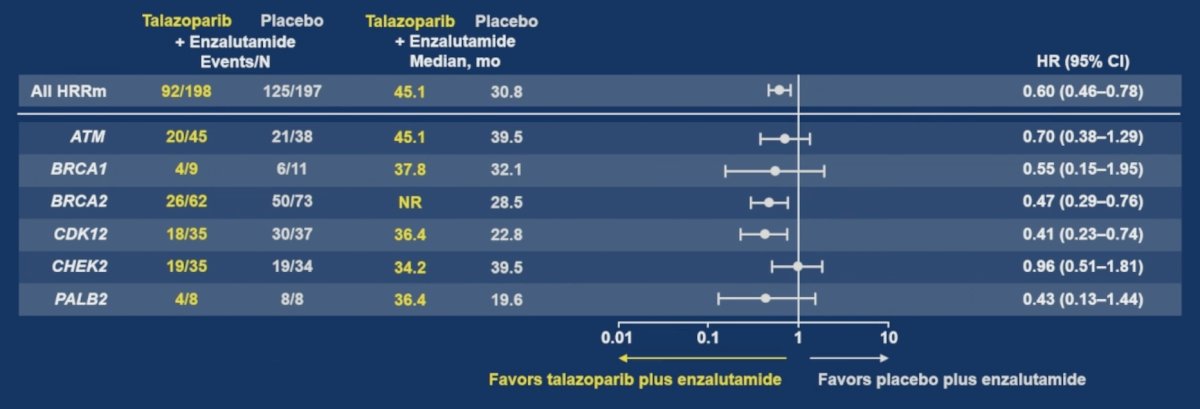
A summary of objective response rate by HRR gene alteration is as follows: 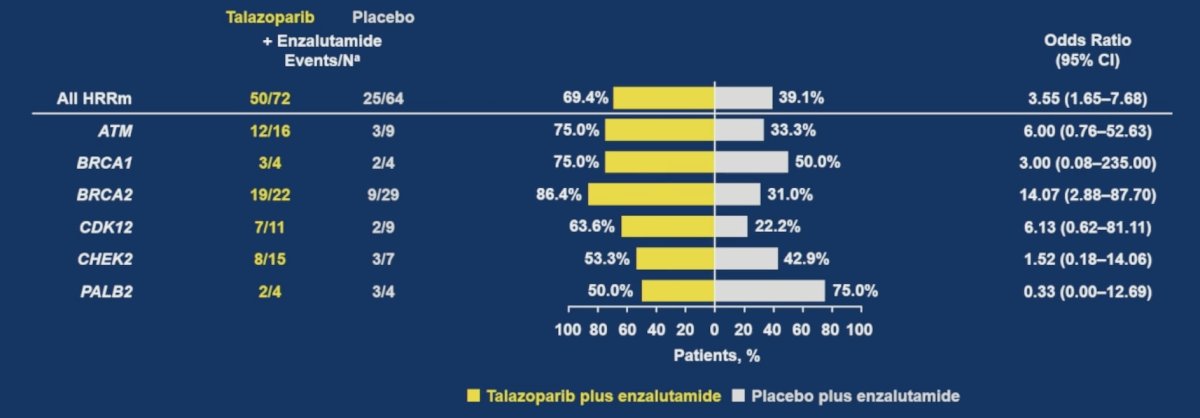
A summary of PSA response by HRR gene alteration is as follows: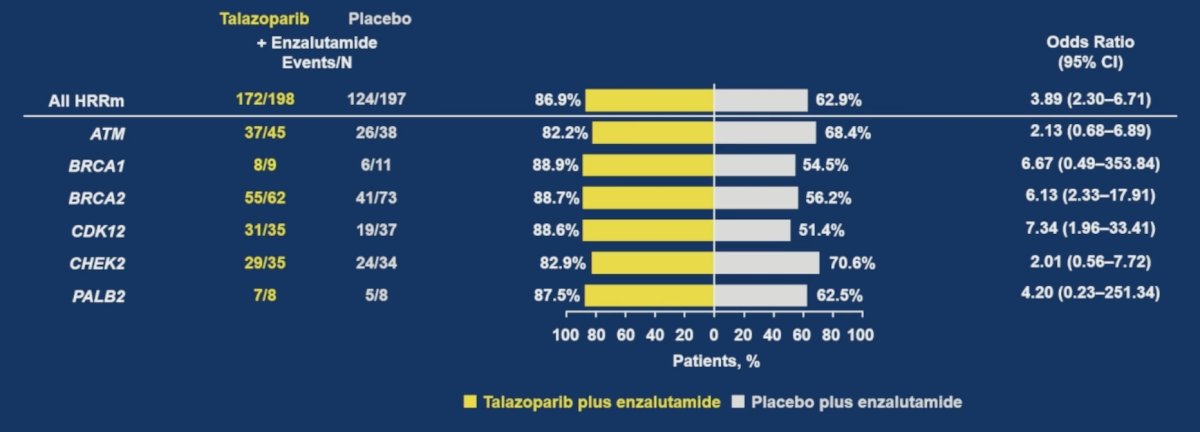
Finally, a summary of PSA progression by HRR gene alteration is as follows: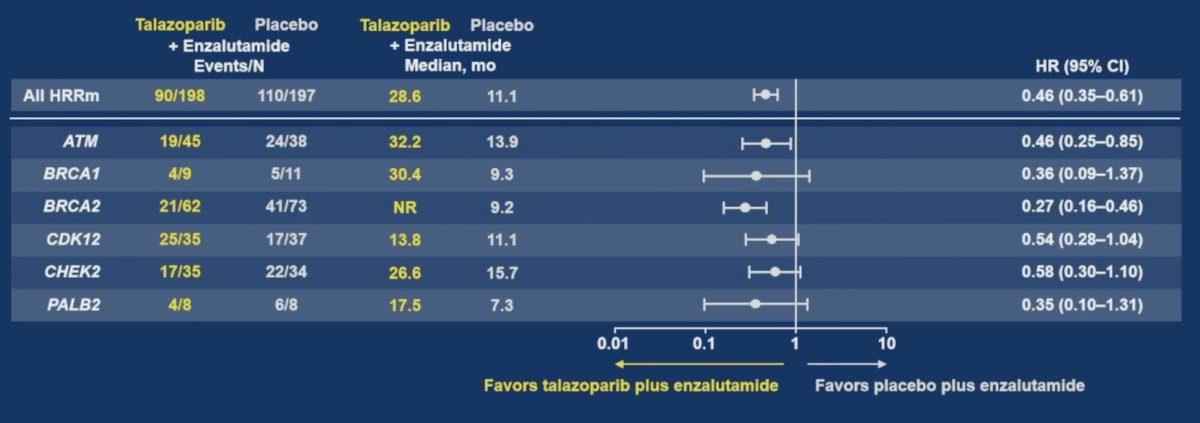
Dr. Zschaebitz concluded her presentation discussing exploratory analyses of homologous recombination repair alterations by gene subgroup and potential associations with efficacy in the HRR-deficient population from TALAPRO-2 with the following take-home points:
- An efficacy benefit was evident for talazoparib + enzalutamide versus placebo + enzalutamide across multiple mutational subgroups assessed by gene, and was most pronounced for the BRCA1/2, PALB2 and CDK12, with benefit also apparent for ATM
- This retrospective exploratory analysis is intended for hypothesis generation only
- These results are consistent with dual targeting of PARP and the androgen receptor by talazoparib + enzalutamide inducing and exploiting tumor vulnerabilities, to extend efficacy well beyond BRCA mutations
Presented by: Stefanie Zschaebitz, MD, National Center for Tumor Diseases, Heidelberg, Germany
Written by: Zachary Klaassen, MD, MSc – Urologic Oncologist, Associate Professor of Urology, Georgia Cancer Center, Wellstar MCG Health, @zklaassen_md on Twitter during the American Society of Clinical Oncology (ASCO) 2025 Annual Meeting, Chicago, IL, Fri, May 30 – Tues, Jun 3, 2025.
Related content: Differential Treatment Responses Across HRR Gene Alterations in Prostate Cancer - Stefanie Zschäbitz
References:
- Agarwal N, Azad AA, Carles J, et al. Talazoparib plus enzalutamide in men with first-line metastatic castration-resistant prostate cancer (TALAPRO-2): A randomized, placebo-controlled, phase 3 trial. Lancet. 2023 Jul 22;402(10398):291-303.
- Fallah J, Xu J, Weinstock C, et al. Efficacy of Poly(ADP-ribose) Polymerase Inhibitors by Individual Genes in Homologous Recombination Repair Gene-Mutated Metastatic Castration Resistant Prostate Cancer: A US Food and Drug Administration Pooled Analysis. J Clin Oncol. 2024 May 10;42(14):1687-1698.