

(UroToday.com) The 2023 American Society of Clinical Oncology (ASCO) annual meeting held in Chicago, IL between June 2nd and June 6th was host to a prostate, testicular, and penile cancers poster session. Dr. Arun Azad presented the results of an exploratory analysis from TALAPRO-2, evaluating the use of circulating tumor DNA (ctDNA) as a complement to tumor tissue homologous recombination repair (HRR) gene alteration testing.
Presented at ASCO GU 2023, TALAPRO-2 is a phase III randomized, double-blind, placebo-controlled trial that evaluated the combination of talazoparib and enzalutamide in the 1st line treatment setting for mCRPC patients. Patients were randomized 1:1 to talazoparib 0.5 mg once daily (reduced dose from standard of 1.0 mg) plus enzalutamide 160 mg once daily versus placebo + enzalutamide. Notably, this was a biomarker unselected cohort of ‘all comers’ (i.e., irrespective of HRR mutational status). 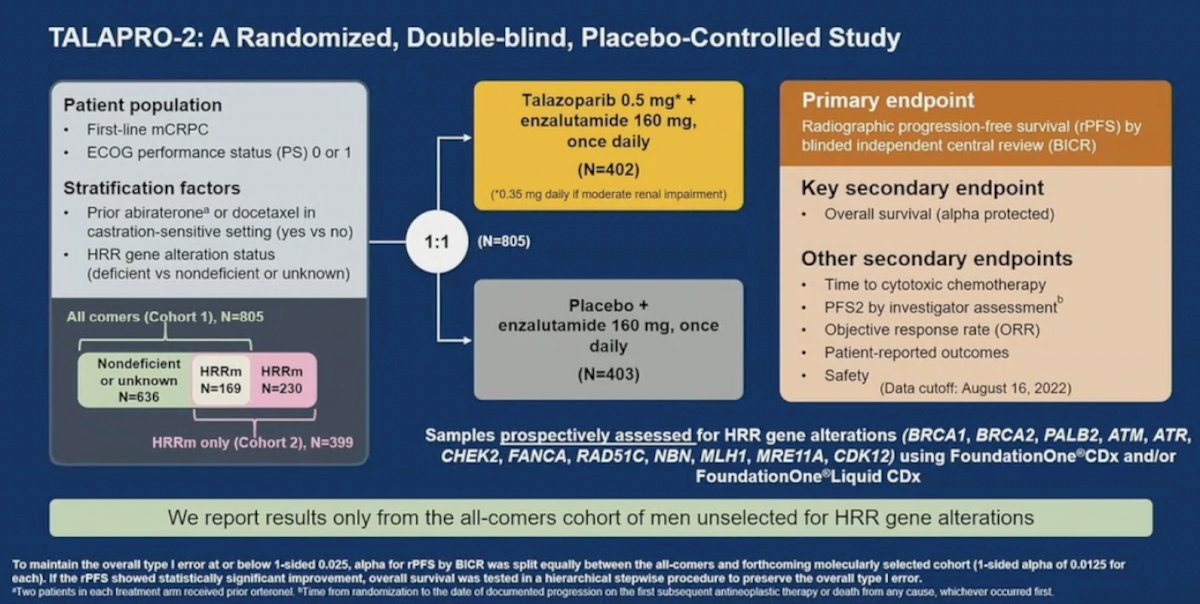
The combination of talazoparib/enzalutamide was associated with a 37% decrease in the rPFS hazard (primary outcome), compared to placebo/enzalutamide (median: not reached versus 22 months; HR: 0.63, 95% CI: 0.51 – 0.78, p<0.001).
Significantly, rPFS benefits were observed in both the HRR mutated and non-mutated subgroups. As expected, the magnitude of effect was larger in the HRR mutated (median rPFS: 28 versus 16 months; HR: 0.46, 95% CI: 0.30 – 0.70, p<0.001) versus non-mutated subgroup (HR: 0.66, 95% CI: 0.49 – 0.91, p=0.009).
In TALAPRO-2, HRR mutational status was informed by tumor tissue for 804 pts (99.9%), tumor tissue and ctDNA for 114 (14.2%), and ctDNA only for 1 (0.1%) patient. In this report, the investigators evaluated the overall agreement of solid tissue versus ctDNA-based testing for assessing tumor HRR gene alteration status.
The HRR mutational status for the TALAPRO-2 patient cohort was prospectively determined by testing for the presence of HRR gene alterations using FoundationOne CDx® and/or FoundationOne Liquid CDx®. Patients were considered HRR-deficient if they had ≥1 alteration in ≥1 of 12 HRR genes, detected via either test. Plasma samples collected at screening were retrospectively tested using FoundationOne Liquid CDx® to examine retrospective test performance and to support exploratory resolution of patients with unknown prospective HRR status. Results were reported as HRR-deficient, non-HRR-deficient, or unknown.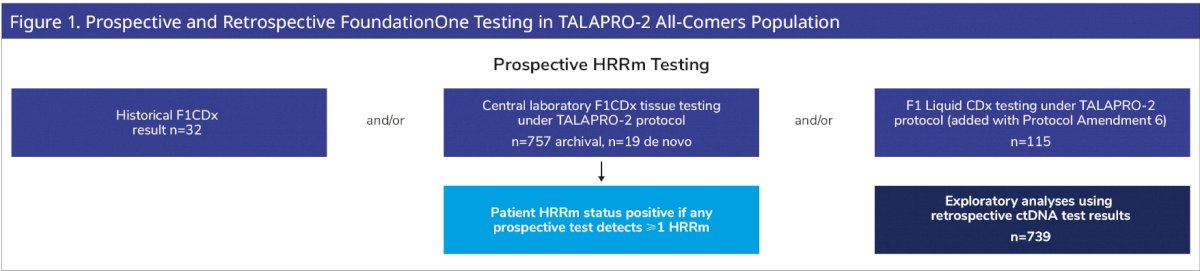
In prospective testing, high concordance in HRR status was observed between ctDNA and tumor tissue sample results: a 96% agreement (90/95) between tests was observed in patients evaluable as either HRR-deficient or non-HRR-deficient by both tests. 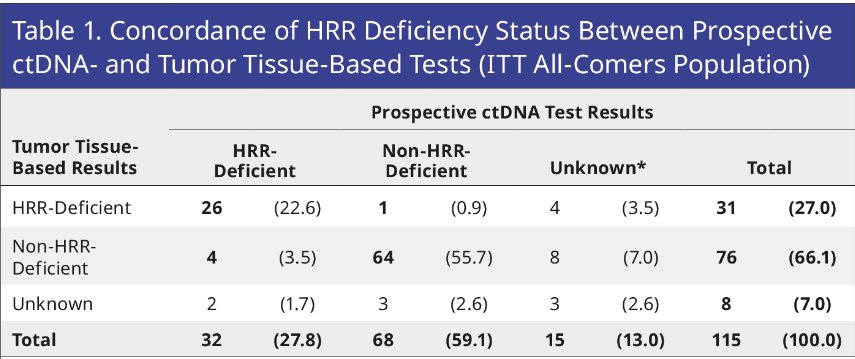
Retrospective ctDNA test results were reported for 739 pts (207 [28%] with a status of HRR-deficient, 480 [65%] non-HRR-deficient, and 52 [7%] unknown; 66 pts had samples not collected or reported). There was high concordance in patient-level alteration status between prospective molecular profiling (mainly based on solid tumor tissue) and retrospective ctDNA testing (from plasma samples collected at screening): the agreement was 84% (438/519) between tests for patients evaluable as HRR-deficient or non-HRR-deficient both prospectively and retrospectively (421/501 [84%] for prospective tumor tissue only vs retrospective ctDNA).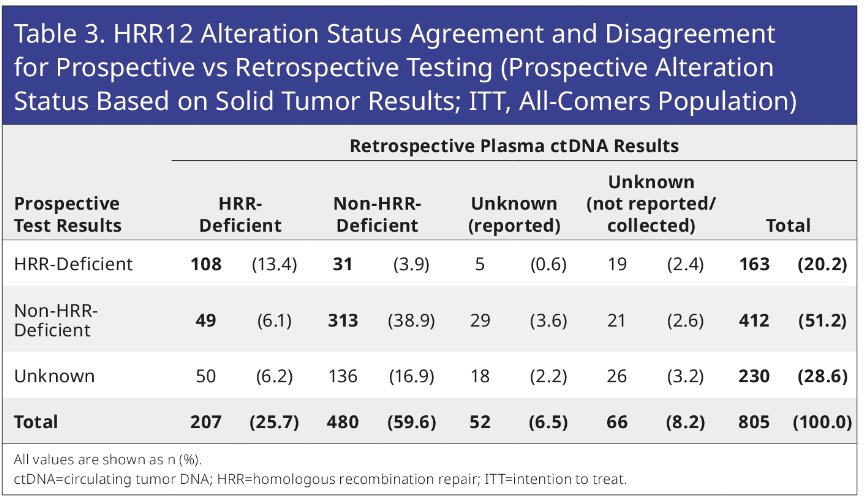
Dr. Azad and colleagues concluded that there appears to be an almost perfect (96%) agreement between prospective tissue and ctDNA-based HRR mutational status testing using FoundationOne®, consistent with results reported in the literature. The high agreement between prospective test results based primarily on tumor tissue and retrospectively assessed ctDNA collected at screening is supportive of exploratory retrospective testing of ctDNA to inform the HRR mutational status of patients whose alteration status is unknown based on prospective testing.
Presented by: Arun Azad, PhD, MBBS, FRACP, Associate Professor, Department of Medicine, Peter MacCallum Cancer Centre, Melbourne, Victoria, Australia
Written by: Rashid Sayyid, MD, MSc – Society of Urologic Oncology (SUO) Clinical Fellow at The University of Toronto, @rksayyid on Twitter during the 2023 American Society of Clinical Oncology (ASCO) Annual Meeting, Chicago, IL, Fri, June 2 – Tues, June 6, 2023.