

Written by: Alok Tewari, MD, PhD, Medical Oncologist at the Dana-Farber Cancer Institute, at the 2020 European Society for Medical Oncology Virtual Congress (#ESMO20), September 19th-September 21st, 2020.
ESMO 2020
ESMO 2020
ESMO Virtual Congress 2020: Complex Biomarkers in Drug Development
- Details
529MO: Activity, safety and circulating tumour DNA (ctDNA) dynamics of paradox breaker BRAF inhibitor PLX8394 in patients with advanced cancer
Inhibition of the MAPK signaling pathway via RAF inhibition, particularly BRAF inhibition, is a high priority in cancer drug development given aberrant MAPK activation across cancers. Innate and adaptive resistance to first generation of BRAF inhibitors is a significant problem, and adaptive resistance can occur by paradoxical activation of MEK/ERK signaling through various mechanisms. PLX8394 is a next generation RAF inhibitor designed to prevent paradoxical mechanisms of adaptive resistance. In presentation 529MO, the authors presented clinical outcome data from PLX8394 treatment with or without the CYP3A4 inhibitor cobicistat (to increase systemic exposure) across multiple cancer histologies and discussed molecular data from circulating tumor DNA (ctDNA) analyses to explore the molecular heterogeneity surrounding response to PLX8394.
With regards to clinical outcome, the administration of cobicistat increased systemic exposure to PLX8394 by 2-3 fold. Severe side effects were rare (<5% of patients) and included liver chemistry abnormalities and diarrhea. Fatigue was the most common adverse effect (19% of patients). The overall response rate was 19% (10/52 evaluable patients), intriguingly including a complete response in a patient with stage IV melanoma harboring a AGK-BRAF fusion. Focused gene sequencing of circulating tumor DNA either by digital droplet PCR (ddPCR) or targeted next generation sequencing in 12 patients (all either stable or progressive disease) was performed. This revealed multiple clones present prior to treatment, higher variant allele frequency of BRAF mutations upon disease progression in a subset of progressors (including shorter PFS in patients with persistent detection of BRAF mutation throughout therapy), and changes in the variant allele frequency in other putative oncogenes with disease progression.
Dr. Desai concluded that (1) the co-administration of cobicistat is an intriguing therapeutic strategy to increasee systemic exposure to drug, and (2) ctDNA analyses may be useful for assessing efficacy and heterogeneity of response to RAF inhibitors.
530MO: Clinical Benefit in Biomarker-Positive Patients (pts) With Locally Advanced or Metastatic Solid Tumors Treated With the PARP1/2 Inhibitor Pamiparib in Combination With Low-Dose (LD) Temozolomide (TMZ)
Quantification of deficiency in DNA repair by homologous recombination (HRD) is of interest clinically as a potential predictive biomarker for response to PARP inhibitor therapy. Multiple assays are available to do this, as shown in the figure below. These generally involve targeted sequencing of selected genes including those involved in DNA damage repair to identify patterns (mutational signatures, copy number alterations, mutations in specific genes) that are suggestive of HRD.

This presentation presented data from utilizing the Myriad myChoice CDx platform as a possible biomarker for response to combination treatment with the PARP inhibitor ramiparib in combination with temozolomide. This platform generates a numerical genomic instability score using targeted sequencing information. Across a variety of tumor types, a GIS score of 33 was utilized to identify HRD positive tumors. Tumors with GIS score of 33 tended to respond to treatment relative to tumors with GIS score less than 33. This trend held true regardless of BRCA mutation status. In contrast, individual mutations in the pre-selected list of HRD-related genes did not clearly identify responders from non-responders with the exception of BRCA1/2 mutation. Dr. Desai concluded that the myChoice CDx platform is an interesting potential predictive biomarker for response, but further work is required to understand the appropriate cutoff for HRD positivity and PARP inhibitor response, and whether the threshold will need to be different for other PARP inhibitors or specific cancer types.
531MO: VHIO immune gene-expression signature (VIGex) to enrich patient selection in immunotherapy (IT) Phase 1 clinical trials
Modulation of immune checkpoints as cancer therapy has emerged as a powerful treatment option across many cancer types, but responses are limited to a subset of patients. Given the complexity of interplay between tumor cells and the microenvironment, the identification of biomarkers predictive of response across multiple cancer contexts has been challenging. One biomarker approach has been the generation of RNA expression profiles to identify immune “hot” versus “cold” tumors. These signatures show some promise as predictors of response but require additional optimization and prospective validation. Dr. Desai summarized the results from presentation 531MO, describing the generation of a gene expression profile termed VIGex to delineate immune “hot” versus “cold” tumors, with suggestion from a small retrospective patient cohort that immune “hot” tumors by VIGex have improved progression-free survival when treated with immunotherapy. Dr. Desai concluded that the VIGex is an important tool that may help identify both patients with tumors intrinsically resistant to immunotherapy in addition to those that might respond.
Presented by: Jayesh Desai, MBBS, Medical Oncologist and Associate Director of Clinical Research at the Peter MacCallum Cancer Centre, Melbourne, Australia
Written by: Alok Tewari, MD, PhD, Medical Oncologist at the Dana-Farber Cancer Institute, at the European Society for Medical Oncology Virtual Congress, ESMO Virtual Congress 2020 #ESMO20, 18 Sept - 21 Sept 2020.
ESMO Virtual Congress 2020: Clinical Factors That Are Prognostic for Survival Outcomes in Men with Metastatic Castration-Resistant Prostate Cancer Treated with Radium-223
- Details
In total, 150 patients were identified for analysis. Their demographics are shown below.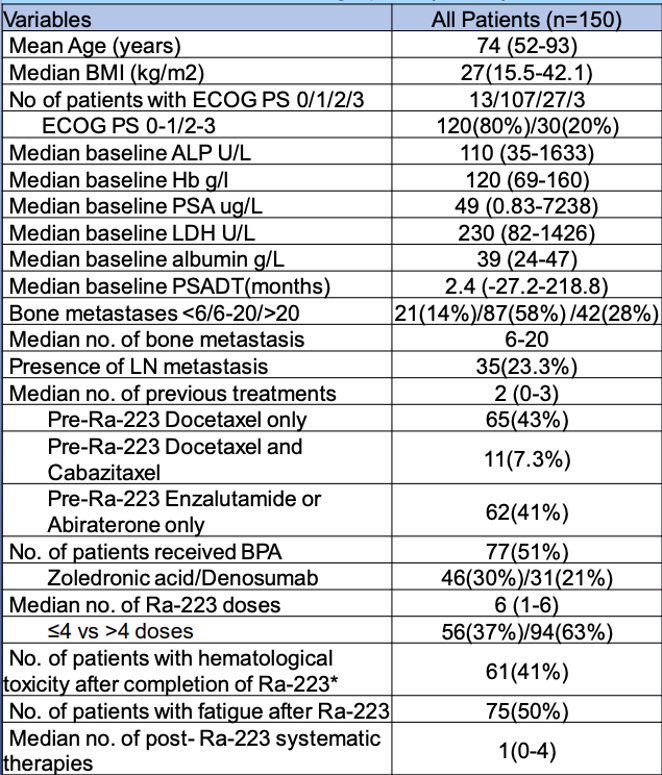
The median overall survival of patients in this cohort was 14.5 months, consistent with the ALSYMPCA results. Based on univariate and multivariate analyses, the authors identified four baseline variables: ECOG performance status, alkaline phosphatase level, PSA level, and albumin level as independently associated with survival. Using these factors, they created as prognostic index model score that stratified patients into risk groups that were associated with survival, as seen below.

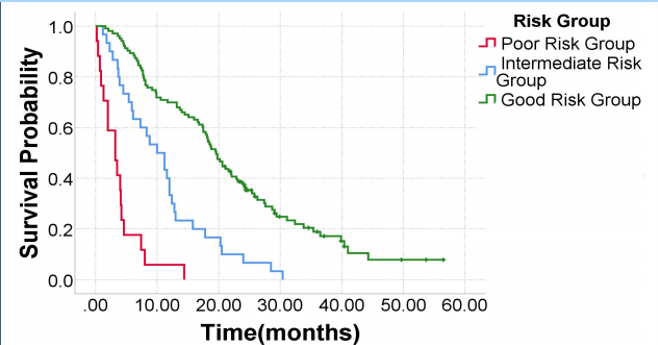
The prognostic index model had an AUC of 0.762. The authors identified several post-treatment factors as significantly associated with survival with Ra-223 therapy as well. Receiving 4 or more doses of radium, hematologic toxicity, receiving systemic therapy after Ra-223, and PSA responses due to therapy were associated with survival in both univariate and multivariate analyses with p-values less than 0.05.
In summary, the authors generated a prognostic index model to predict the chance of benefitting from Ra-223 therapy and identified several pre-treatment and treatment-related factors associated with survival in this context. External validation is required prior to potential incorporation of this model into clinical decision making.
Reference:
Presented by: Esmail Al-Ezzi, MD, Division of Medical Oncology and Hematology, Princess Margaret Cancer Centre, University Health Network, Toronto, ON, Canada
Written by: Alok Tewari, MD, Ph.D., Medical Oncologist at the Dana-Farber Cancer Institute, at the 2020 European Society for Medical Oncology Virtual Congress (#ESMO20), September 19th-September 21st, 2020
ESMO Virtual Congress 2020: Darolutamide, Enzalutamide and Apalutamide the Risk of Adverse Events in Patients with Nonmetastatic Castration-Resistant Prostate Cancer: Number Needed to Harm
- Details
ESMO Virtual Congress 2020: Quality of Life and Survival in Elderly Metastatic Castration-Resistant Prostate Cancer Patients Treated with Docetaxel
- Details
ESMO Virtual Congress 2020: Real-World Patterns of Genomic Testing in Patients with Metastatic Castration-Resistant Prostate Cancer
- Details
ESMO Virtual Congress 2020: Pembrolizumab plus Docetaxel and Prednisone in Patients with Abiraterone Acetate– or Enzalutamide–Pretreated Metastatic Castration-Resistant Prostate Cancer: KEYNOTE-365 Cohort B Update
- Details
ESMO Virtual Congress 2020: NRG Oncology’s GU007 (NADIR): Niraparib with Standard Combination with ADT and Radiotherapy in High-Risk Prostate Cancer
- Details
ESMO Virtual Congress 2020: DASL-HiCaP: Darolutamide Augments Standard Therapy for Localized Very High-Risk Cancer of the Prostate (ANZUP 1801)
- Details
The trial schema is shown below.
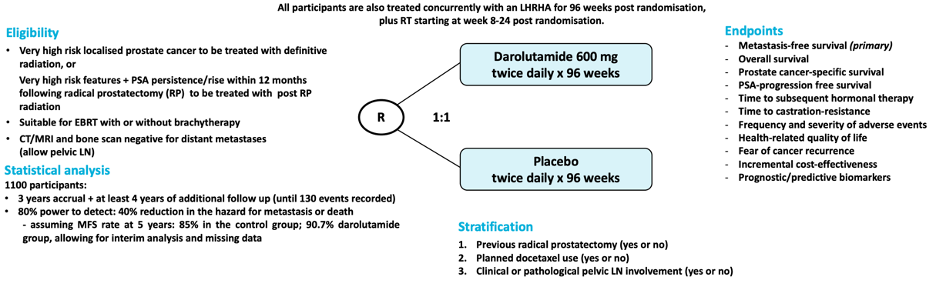
The study aims to recruit 1100 men across 100 sites in 6 countries. The primary endpoint is metastasis-free survival, with key secondary endpoints of overall survival, prostate cancer specific survival, PSA progression free survival, time to subsequent hormonal therapy and time to castration-resistance.
Presented by: Tamim Niazi, MDCM, Jewish General Hospital, Montreal, Canada
Written by: Alok Tewari, MD, PhD, Medical Oncologist at the Dana-Farber Cancer Institute, at the 2020 European Society for Medical Oncology Virtual Congress (#ESMO20), September 19th-September 21st, 2020.
Related Content:
DASL-HiCAP (ANZUP1801): The Impact of Darolutamide on Standard Therapy for Localized Very High-risk Cancer of the Prostate - Christopher Sweeney
Clinical Trial Information: NCT04136353
First Patient Enrolled in Sydney in Worldwide Prostate Cancer Trial (DASL-HiCaP)
Abstract: DASL-HiCAP (ANZUP1801): The Impact of Darolutamide on Standard Therapy for Localized Very High-risk Cancer of the Prostate - Christopher Sweeney
ESMO Virtual Congress 2020: Cabozantinib in Combination with Atezolizumab in Non-Clear Cell Renal Cell Carcinoma: Results from Cohort 10 of the COSMIC-021 Study
- Details
ESMO Virtual Congress 2020: Nivolumab Alone or in Combination with Ipilimumab in Patients with Platinum-Pretreated Metastatic Urothelial Carcinoma: Extended Follow-Up from CheckMate 032
- Details
(UroToday.com) The CheckMate 032 (NCT01928394) study is a multicenter open label phase ½ trial examining the efficacy of the anti-PD1 antibody nivolumab as monotherapy or in combination with the anti-CTLA4 antibody ipilimumab in several advanced tumor setting. The schema of the study is shown below:
ESMO Virtual Congress 2020: Molecular Profiling of Post-pembrolizumab Muscle-Invasive Bladder Cancer Reveals Unique Features That May Inspire New Sequential Therapies in Pathological Non-responders
- Details
ESMO Virtual Congress 2020: Real-World Evidence of the Impact of Prior Autoimmune Disease on Immune Checkpoint Inhibitor Outcomes in Patients with Metastatic Urothelial Cancer
- Details
ESMO Virtual Congress 2020: TROPHY-U-01 Cohort 3: Sacituzumab Govitecan and Pembrolizumab in Patients with Progression or Recurrence of Metastatic Urothelial Cancer after Platinum -Based Therapy
- Details
ESMO Virtual Congress 2020: EV-302: Enfortumab Vedotin plus Pembrolizumab and/or Chemotherapy, vs Chemotherapy Alone, in Untreated Locally Advanced or Metastatic Urothelial Cancer
- Details
ESMO Virtual Congress 2020: Tumour-Only Sequencing Led to Inflated Tumour Mutational Burden Estimation Especially in Under-Represented Ethnic Groups
- Details
(UroToday.com) Tumor-only sequencing panels can capture many relevant pathogenic somatic mutations in patient tumors but also detect germline variants that are not represented in population-level germline variant databases and likely over-estimate tumor mutational burden (TMB)1. As many ethnic groups are under-represented in these population-level germline databases, the authors of this presentation hypothesized that TMB estimates in these patients would also be inflated.
ESMO Virtual Congress 2020: Treatment in CARD Eligible Metastatic Castration Resistant Prostate Cancer Patients According to the Status of Germline HRR Mutations: Cabazitaxel vs Enzalutamide/Abiraterone
- Details
ESMO Virtual Congress 2020: Pan-Cancer Analysis of Homologous Recombination Associated Alterations and Genome-Wide Loss of Heterozygosity
- Details
(UroToday.com) While alterations in the homologous recombination repair (HRR) genes BRCA1 and BRCA2 are associated with response to PARP inhibitors and certain chemotherapies, the relevance of alterations in other HRR genes for treatment response is less well understood. In this presentation, Dr. Westphalen presented analysis of alterations in homologous recombination repair denes across a pan-cancer cohort of 160,674 tumors. The pan-cancer cohort is described below:
ESMO Virtual Congress 2020: Invited Discussant: (617MO) Repurposing Metformin as Anticancer Drug (MANSMED) and (618MO) Local Therapy to the Primary Tumour for Newly Diagnosed, Oligo-Metastatic Prostate Cancer
- Details
(UroToday.com) Dr. Noel Clarke first discussed presentation 617, the MANSMED trial. He reviewed the trial schemia, which randomized 124 high-risk prostate cancer patients 1:1 to either standard of care or standard of care plus metformin.
ESMO Virtual Congress 2020: PROREPAIR-A Study Results: Clinical Impact of Somatic Alterations in Prostate Cancer Patients with and without Previously Known Germline BRCA1/2 Mutations
- Details
ESMO Virtual Congress 2020: COSMIC-021, Cabozantinib in Combination with Atezolizumab as First-Line Therapy for Advanced Clear Cell Renal Cell Carcinoma
- Details
(UroToday.com) COSMIC-021 is a clinical trial platform testing the combination of the MET/VEGF/TAM kinase inhibitor cabozantinib in combination with the anti-PD-L1 drug atezolizumab. The rationale for this combination is based on data suggesting that cabozantinib promotes an immune-permissive environment that may enhance responses to immune checkpoint blockade, and clinical data showing promising combination activity in multiple tumor types. In this presentation, Dr. Pal shared data from a cohort of COSMIC-021 (NCT03170960) examining the efficacy (by objective response rate) and safety of this drug combination in previously untreated patients with advanced clear-cell renal cell carcinoma (ccRCC).