

The PREDICT-Kidney tool was developed using a qualitative co-design process involving patients treated for kidney cancer, members of the public, and healthcare professionals involved in kidney cancer care. Through a series of workshops, in which the tool was showcased, participants provided feedback on the tool’s usability, clarity, visual presentation, and acceptability. The aim was to ensure that the final platform not only provides accurate information, but is also understandable, reassuring, and practical for use within follow-up consultations.
PREDICT-Kidney calculates an individual’s risk of recurrence over the ten years following surgery for clear cell RCC using the established Leibovich prognostic model, adapted to include the competing risk of death from other causes. Clinicians enter patient-specific tumour characteristics (including stage, grade, and necrosis) into the platform, and personalised risk predictions are displayed using a range of visual formats, including an icon array, bar chart, table, and written summary (Figure). The tool also generates a printable report for patients to take home after their consultation.
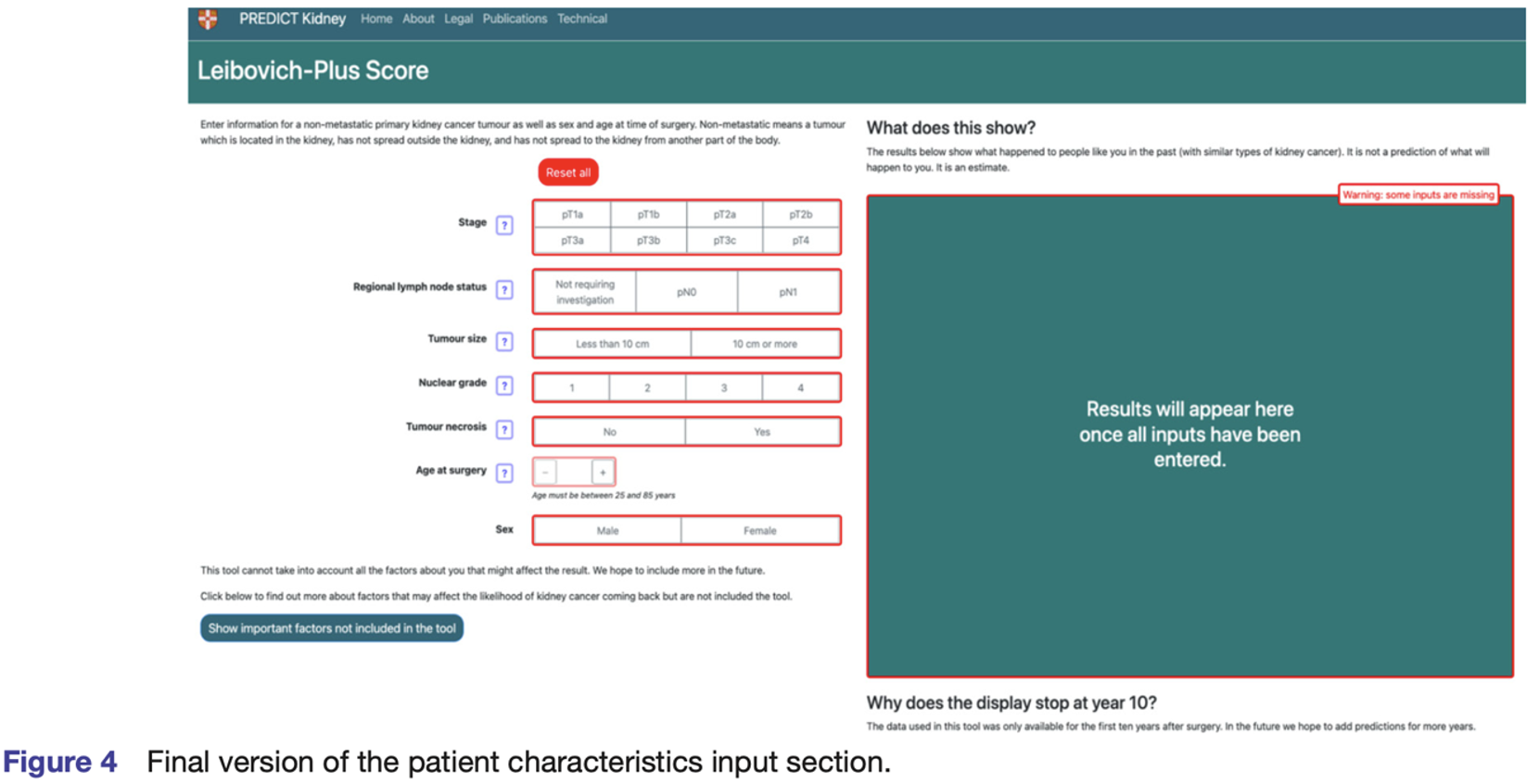
Between February and November 2024, eighteen participants took part across nine workshops. Overall, 99 discrete items of feedback were identified, leading to 71 actionable modifications to the original prototype. Feedback highlighted important differences in perspective between patients and clinicians about the communication of prognostic information. The research team prioritised the feedback by volume and ease of implementation to determine changes made to the tool after each round of workshops. This iterative process led to substantial refinement of the initial prototype tool, with changes made to terminology, visual design, and content.
The study demonstrates the importance of co-design when developing digital health tools that communicate complex prognostic information. Collaboration between patients, the public, and clinicians, and the iterative process used to solicit feedback and modify the tool, allowed the research team to identify areas of misunderstanding, emotional sensitivity, and logistical barriers to use that may otherwise have been overlooked. The project also highlights broader challenges in risk communication to cancer patients, particularly around balancing transparency with patient reassurance.
The PREDICT-Kidney tool has the potential to improve follow-up care after kidney cancer by improving communication of personalised recurrence risk, as part of the delivery of risk-stratified surveillance. In the future, the platform could be expanded to include information about the benefits and risks of adjuvant treatment, to support shared decision-making about this treatment option. Feasibility testing in real-world clinical settings is now needed to evaluate the acceptability and impact of using the tool in urology clinics.

Written by: Chiara Re,1,2 Georgia Stimpson,3 Grant D. Stewart,1,4 Jack Bromley,3 Stephanie Archer,3,5 Carley Batley,4,6 Angela Godoy,4,6 Juliet Usher-Smith,3,4 Hannah Harrison,3
- Department of Surgery, University of Cambridge, Cambridge, UK
- IRCCS San Raffaele Hospital, Unit of Urology, Vita-Salute San Raffaele University, Milan, Italy.
- Department of Public Health and Primary Care, University of Cambridge, Cambridge, UK.
- CRUK Cambridge Centre, Cambridge Biomedical Campus, Cambridge, UK.
- Department of Psychology, University of Cambridge, Cambridge, UK.
- Department of Oncology, University of Cambridge, Cambridge, UK.