

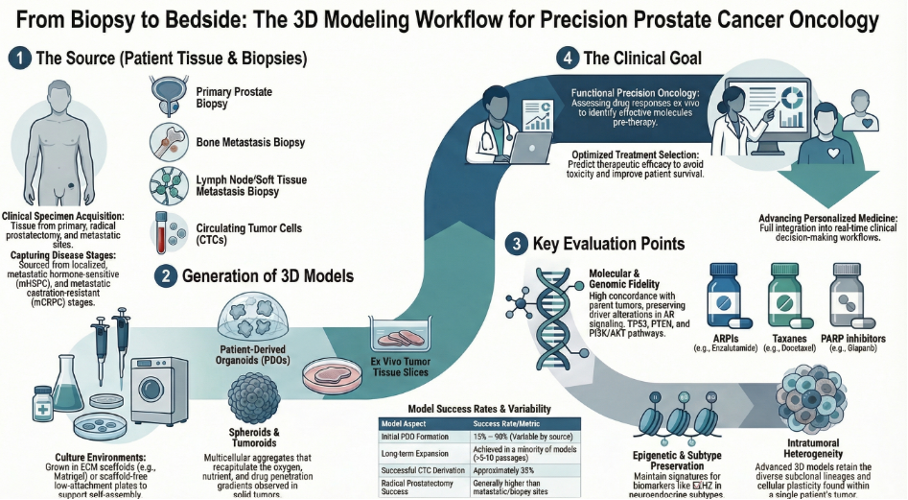
Prostate cancer remains a highly heterogeneous disease, making the prediction of therapeutic response a major clinical challenge. While traditional 2D cell cultures often fail to replicate the complex spatial architecture and biochemical gradients of real tumors, patient-derived 3D models—such as organoids and tumoroids—have emerged as a more relevant alternative.
In this study, the researchers synthesized data from 55 original reports to assess the feasibility and fidelity of these platforms. Their analysis reveals that these "mini-tumors" maintain a high degree of genomic, transcriptomic, and epigenetic concordance with the original patient tumors, preserving critical driver alterations in androgen receptor signaling and DNA repair pathways.
The review highlights how these models serve as powerful engines for functional precision oncology. By testing standard-of-care treatments—such as enzalutamide, taxanes, and PARP inhibitors—directly on patient-derived organoids, researchers can accurately recapitulate clinical responses and identify novel biomarkers like EZH2 or HER3 for targeted therapies.
Beyond their biological relevance, these 3D systems align with the 3R principles (Replace, Reduce, Refine) by providing a scalable alternative to labor-intensive animal models. While challenges in standardization and the integration of the tumor microenvironment remain, this work provides a strategic framework for clinicians to optimize treatment selection and improve outcomes for patients with advanced or treatment-resistant disease.
Written by: Charles Dariane and Norbert de Brek
- Department of Urology, Hôpital Européen Georges Pompidou, AP-HP, Université Paris Cité, Paris, France