

However, it remains unknown whether changes in health behaviors after diagnosis modify metabolic or inflammation pathways to impact prostate cancer progression. Physical activity after diagnosis of PCa has been associated with reduced risk of PCa progression and death, and low physical activity is a component of lifestyle indices reflecting hyperinsulinemia and inflammation.1–4 This study examined whether an at-home walking exercise program impacts insulin resistance and inflammation profiles in men with localized PCa.
The Active Surveillance Exercise (ASX) randomized controlled trial examined whether a 16-week, exercise intervention (home-based walking program) affects insulin-related and inflammatory biomarkers in men with localized, low-risk PCa undergoing active surveillance (AS), compared to printed physical activity recommendations and standard of care for AS (control). The intervention walking program was designed to increase cardiorespiratory fitness and varied in intensity from 45-80% VO2 peak, with sessions ranging from 20-60 minutes, 3-4 times per week. Previous results reported that the exercise group showed fitness improvement compared to the control group.5
For this analysis, the primary outcomes included changes in biomarkers of insulin sensitivity (insulin, C-peptide, adiponectin) and inflammation (C-reactive protein (CRP)). Secondary outcomes included prostate-specific antigen (PSA), PSA doubling time (PSADT), and adherence to AS at 12 and 24 months. Fasting blood samples were collected at baseline and after 16-weeks.
No statistically significant changes within or between intervention and control groups were observed in insulin, c-peptide, adiponectin, CRP, or PSA (Figure 1). Average baseline biomarkers were all within expected ranges. Among participants with sufficient PSA values, there were no differences in PSA doubling time. Additionally, there were no differences between groups in adherence to AS at 12 or 24 months.
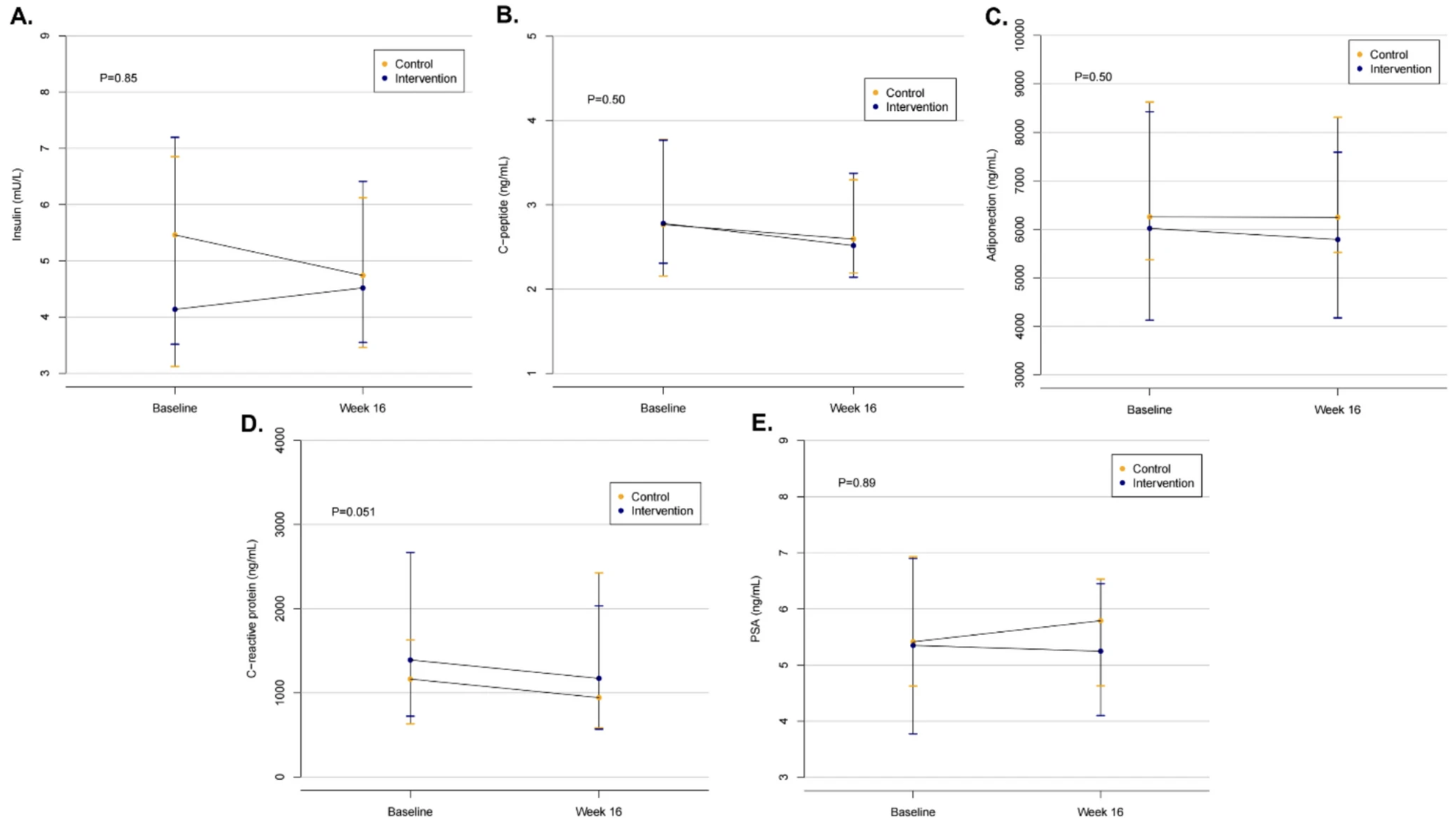
Effect of a 16-week home-based walking program versus usual care on blood-based insulin sensitivity (A. fasting insulin, B. C-peptide, C. adiponectin levels), inflammation (D. C-reactive protein levels), and plasma PSA (E.) in 45 men on active surveillance for prostate cancer. p-values for the difference in change between the control and exercise intervention group over the program duration are given on each graph. Dots indicate means, while bars indicate 95% confidence intervals.
Despite previously observing improvements in cardiorespiratory fitness, this study found no effect of a short-term aerobic exercise program on insulin sensitivity or inflammation biomarkers in otherwise healthy men with localized PCa.
These findings should be considered alongside results from other trials, which have demonstrated insulin and inflammation biomarker improvement in similar populations. The ERASE trial, for example, evaluated the effects of supervised 12-week high-intensity interval training (HIIT) vs. usual care. Their intervention group showed decreased PSA levels, decreased PSA velocity, and decreased insulin compared to the control group.6,7 Notably, ERASE used a supervised HIIT exercise program rather than an unsupervised home walking program, as was used in the ASX trial. Another trial using a two-year home-based endurance training intervention slowed PSADT, lowered BMI, and improved adiponectin, but did not affect insulin sensitivity or inflammatory markers.8 Compared to the ASX trial, this longer intervention indicates that extended exercise programs may influence tumor-related pathways not necessarily associated with insulin or inflammation. These studies’ different outcomes suggest that greater exercise intensity and duration may be necessary for altering biochemical markers in otherwise healthy patients with localized PCa.
Clinically, patient-specific exercises should consider feasibility and potential biological impact when advising men with low-risk disease. Further research should investigate longer duration interventions, higher intensity exercises, inclusion of a wider array of biomarkers, and larger sample sizes to clarify potential exercise effects on biological markers or mechanisms mediating PCa outcomes.
Written by: Blanca Morales Lugo,1 William A. Pace,1 June M. Chan1,2
- Department of Urology, UCSF, San Francisco, CA, USA
- Department of Epidemiology and Biostatistics, UCSF, San Francisco, CA, USA
- Langlais CS, Graff RE, Van Blarigan EL, et al. Postdiagnostic Inflammatory, Hyperinsulinemic, and Insulin-Resistant Diets and Lifestyles and the Risk of Prostate Cancer Progression and Mortality. Cancer Epidemiol Biomark Prev Publ Am Assoc Cancer Res Cosponsored Am Soc Prev Oncol. 2022;31(9):1760-1768. doi:10.1158/1055-9965.EPI-22-0147
- Richman EL, Kenfield SA, Stampfer MJ, Paciorek A, Carroll PR, Chan JM. Physical Activity after Diagnosis and Risk of Prostate Cancer Progression: Data from the Cancer of the Prostate Strategic Urologic Research Endeavor. Cancer Res. 2011;71(11):3889-3895. doi:10.1158/0008-5472.CAN-10-3932
- Kenfield SA, Stampfer MJ, Giovannucci E, Chan JM. Physical activity and survival after prostate cancer diagnosis in the health professionals follow-up study. J Clin Oncol Off J Am Soc Clin Oncol. 2011;29(6):726-732. doi:10.1200/JCO.2010.31.5226
- Ungvari Z, Fekete M, Varga P, et al. Exercise and survival benefit in cancer patients: evidence from a comprehensive meta-analysis. GeroScience. 2025;47(3):5235-5255. doi:10.1007/s11357-025-01647-0
- Van Blarigan EL, Kenfield SA, Olshen A, et al. Effect of a Home-based Walking Intervention on Cardiopulmonary Fitness and Quality of Life Among Men with Prostate Cancer on Active Surveillance: The Active Surveillance Exercise Randomized Controlled Trial. Eur Urol Oncol. Published online October 29, 2023. doi:10.1016/j.euo.2023.10.012
- Kang DW, Fairey AS, Boulé NG, Field CJ, Wharton SA, Courneya KS. Effects of Exercise on Cardiorespiratory Fitness and Biochemical Progression in Men With Localized Prostate Cancer Under Active Surveillance: The ERASE Randomized Clinical Trial. JAMA Oncol. 2021;7(10):1487-1495. doi:10.1001/jamaoncol.2021.3067
- Kang DW, Field CJ, Patel D, et al. Effects of high-intensity interval training on cardiometabolic biomarkers in patients with prostate cancer undergoing active surveillance: a randomized controlled trial. Prostate Cancer Prostatic Dis. Published online July 15, 2024. doi:10.1038/s41391-024-00867-3
- Hvid T, Lindegaard B, Winding K, et al. Effect of a 2-year home-based endurance training intervention on physiological function and PSA doubling time in prostate cancer patients. Cancer Causes Control CCC. 2016;27(2):165-174. doi:10.1007/s10552-015-0694-1