

Through analysis of histone post-translational modifications in matched benign and primary prostate cancer tissues, we found that both H2BNTac and p300/CBP levels were markedly elevated in tumors, and their expression showed a strong positive correlation. To investigate these observations further, we performed chromatin immunoprecipitation-sequencing (ChIP-seq) and assay for transposase-accessible chromatin sequencing (ATAC-seq) in prostate cancer cells to profile the histone modifications, transcription factor and coactivator occupancy, and chromatin accessibility across the genome. These analyses revealed that AR/p300 co-bound sites exhibited increased chromatin accessibility, elevated levels of H2BNTac, and enhanced recruitment of transcriptional cofactors compared to AR-only sites. AR/p300 co-bound sites also showed a higher frequency of enhancer-promoter looping events. Analysis of AR/ERG co-bound neo-enhanceosomes found that they were also associated with increased H2BNTac and p300 levels compared to AR-only or ERG-only enhancers. Combined, these analyses establish H2BNTac and p300/CBP as key determinants of active oncogenic enhanceosomes in prostate cancer.
Inhibitors targeting either the bromodomain (BRD) or histone acetyltransferase (HAT) domain of p300/CBP have been developed but possess limitations. To achieve full suppression of p300/CBP oncogenic activities, we developed CBPD-409, a potent, orally bioavailable proteolysis targeting chimera (PROTAC) degrader of p300 and CBP.2 Unlike the BRD inhibitors, CBPD-409 treatment abolished the histone acetylation program at AR enhanceosomes in prostate cancer cells. CBPD-409 also downregulated oncogenic gene expression programs, such as AR and MYC signaling, to a greater extent than BRD inhibitors. Interestingly, p300/CBP degradation, but not BRD inhibition, suppressed the expression of a unique set of genes, including those with known roles in prostate cancer progression (e.g., CCND1, CITED2, and NKX3-1). These findings suggest that p300/CBP degraders may have superior efficacy compared to inhibitors that only target the BRD domain, some of which are currently being tested in Phase II clinical trials.
Similar effects were observed in functional assays, whereby CBPD-409 markedly reduced the in vitro proliferation of AR-positive prostate cancer cells, outperforming both BRD and HAT inhibitors. Notably, CBPD-409 had no effect on the proliferation of AR-negative prostate cancer cells or non-neoplastic prostate cells, underscoring the selective dependence on p300/CBP in AR-driven malignancies. In a panel of CBPD-409 sensitive and resistant cell lines, H2BNTac levels consistently correlated with sensitivity to the degrader, highlighting H2BNTac as a promising biomarker of p300/CBP degrader therapeutic response.
Safety studies in various murine models confirmed that CBPD-409 degraded endogenous p300 and CBP across multiple organs without evident toxicity. Initial efficacy studies in a VCaP-CRPC xenograft model showed that oral administration of CBPD-409 significantly attenuated tumor growth. When combined with the AR antagonist enzalutamide, a synergistic response was achieved, with tumor regression in over 60% of treated mice. In AR-positive, enzalutamide-resistant patient-derived xenografts, combined CBPD-409 and enzalutamide treatment suppressed tumor growth and prolonged survival.
This study defines the central role of p300/CBP in shaping the chromatin landscape of AR-driven prostate cancer and positions p300/CBP PROTAC degraders as a promising new class of therapies for this disease, potentially achieving greater efficacy than BRD inhibitors through full suppression of p300/CBP activity. We further propose H2NTBac as a candidate biomarker for predicting response to p300/CBP-targeted therapeutics in any future clinical trials in CRPC. Beyond monotherapy, our findings suggest that dual inhibition of p300/CBP and AR may induce even stronger anti-tumor responses. In addition to AR-positive prostate cancer, p300/CBP PROTAC degraders may be effective in other enhancer-addicted malignancies, such as neuroblastoma, rhabdoid tumors, and acute myeloid leukemia, as indicated by our PRISM screening experiments. In summary, p300/CBP PROTAC degraders represent a novel targeted strategy for the treatment of enhancer-addicted cancers and merit further investigation to support their translation into the clinic.
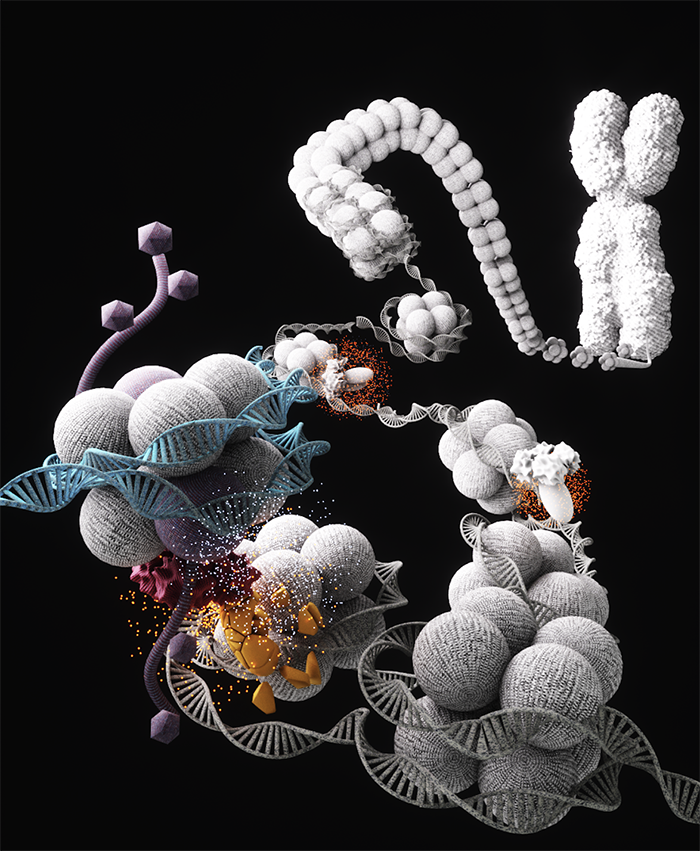
Ella Maru Studio, Inc. 2025. https://www.ellamarustudio.com/
Written by: Jie Luo,1,2 Stephanie J. Miner,1,2 Shaomeng Wang,3-6 Abhijit Parolia,1-3,7 and Arul M. Chinnaiyan1-3,7,8
- Michigan Center for Translational Pathology, University of Michigan, Ann Arbor, MI, USA
- Department of Pathology, University of Michigan, Ann Arbor, MI, USA
- Rogel Cancer Center, University of Michigan, Ann Arbor, MI, USA
- Department of Internal Medicine, University of Michigan, Ann Arbor, MI, USA
- Department of Pharmacology, University of Michigan, Ann Arbor, MI, USA
- Department of Medicinal Chemistry, University of Michigan, Ann Arbor, MI, USA
- Department of Urology, University of Michigan, Ann Arbor, MI, USA
- Howard Hughes Medical Institute, University of Michigan, Ann Arbor, MI, USA
- Luo, J., et al., Targeting histone H2B acetylated enhanceosomes via p300/CBP degradation in prostate cancer. Nat Genet, 2025. 57(10): p. 2468-2481.
- Chen, Z., et al., Discovery of CBPD-409 as a Highly Potent, Selective, and Orally Efficacious CBP/p300 PROTAC Degrader for the Treatment of Advanced Prostate Cancer. J Med Chem, 2024. 67(7): p. 5351-5372.