

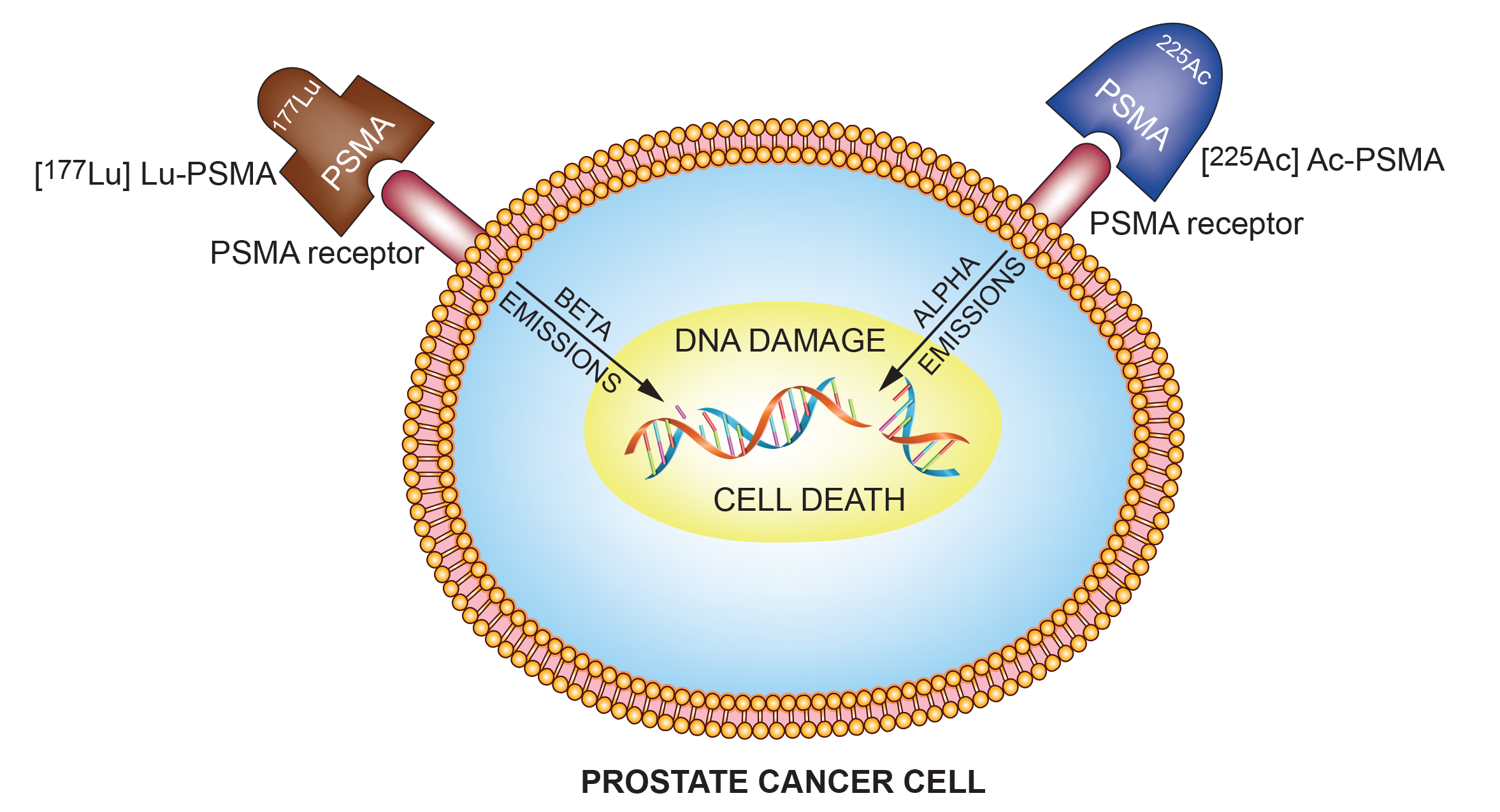
Overall, the treatment with [225Ac]Ac-PSMA is promising as more than 88% of patients experienced a decrease in PSA levels and approximately 70% of patients experienced a decrease in PSA levels of more than 50% without a significant increase in toxicity. Despite the sparse evidence, patients already treated with and refractory to [177Lu]Lu-PSMA still achieved a good PSA response after administration of [225Ac]Ac-PSMA, and the toxicity level remained acceptable. The results are encouraging given the context in which these findings were obtained, namely the use of [225Ac]Ac-PSMA after many lines of therapy. However, some areas of this topic require further investigation due to the heterogeneity and risk of bias observed in the included studies. In addition, the assessment of the efficacy of [225Ac]Ac-PSMA was based on the PSA response, a parameter known not to be predictive of prolonged OS or PFS. In particular, the following points should be carefully considered in future studies.
Activity selection and side effects
The dosimetric challenges associated with [225Ac]Ac-PSMA therapy are multifactorial. The complex decay chain of 225Ac, the short range of the alpha particles, and the low gamma emission along with several factors such as the low administered activities, the temporal variations of the activity ratios between the parent nuclides and the daughters, and the redistribution of the unlabeled daughters by various mechanisms make accurate dosimetry challenging. The situation becomes even more complicated when the relative biological effectiveness, which is largely uncharacterized for alpha emitters, is taken into account. These dosimetric uncertainties require the development and implementation of sophisticated temporal modeling approaches and microdosimetric techniques that often require careful extrapolation from preclinical studies to clinical applications. Dealing with cumulative radiation doses to critical organs remains a major concern. Vulnerable organs, particularly the salivary glands, kidneys, and bone marrow, must be carefully monitored to prevent exceeding tolerance thresholds. Alpha emissions from 225Ac can cause more severe and potentially irreversible damage than beta emissions, so careful monitoring of applied activities and cumulative doses is required. This is a particular challenge given the limitations in accurate dosimetry for alpha-emitting radiopharmaceuticals.
Therapy planning and timing
The administration of [225Ac]Ac-PSMA requires careful planning, considering the cumulative effects of previous treatments and possible damage to organs at risk. The timing between [177Lu]Lu-PSMA and subsequent [225Ac]Ac-PSMA treatment is challenging, as longer intervals between these therapies may favor faster recovery and potentially allow the administration of higher activity. This timing consideration is even more critical when dealing with patients who have undergone multiple cycles of therapy, as the cumulative effects may affect treatment tolerability and efficacy.
Cross-resistance and tumor microenvironment
The issue of cross-resistance between [177Lu]Lu-PSMA and [225Ac]Ac-PSMA therapies is another challenge that needs to be considered. Although both treatments target PSMA, tumor adaptation to the initial therapy might affect the subsequent treatment efficacy through different mechanisms. The development of resistance mechanisms, e.g. reduced PSMA expression or enhanced DNA repair capabilities, may affect the effectiveness of sequential treatments. The heterogeneity of prostate cancer cells is another challenge, as tumors often contain subpopulations of cells with different PSMA expression and radiosensitivity. Treatment with [177Lu]Lu-PSMA might impact specific subpopulations, potentially reducing sensitivity to subsequent [225Ac]Ac-PSMA therapy. However, alpha particles' high linear energy transfer and bystander effect might help to overcome some resistance mechanisms, which is a potential advantage in this context. The tumor microenvironment is another consideration in the context of sequential therapy. Prior treatment with [177Lu]Lu-PSMA may induce significant changes in the tumor microenvironment, including changes in blood supply, oxygenation, and immune cell infiltration. These changes may have substantial implications for the efficacy of subsequent [225Ac]Ac-PSMA therapy, either enhancing or potentially limiting its effectiveness. Understanding these complex interactions is important for optimizing treatment sequencing and maximizing therapeutic benefit.
Perspectives
There are several research priorities that require prompt attention. First, we believe that future research should focus on improving the quality of their methodological approach, paying more attention to some parameters that are more strongly associated with the patient’s prostate cancer history and that could significantly influence the patient's response to treatment with [225Ac]Ac-PSMA in terms of both efficacy and safety [Table 1].
Table 1. Needed studies on [225Ac]Ac-PSMA and relevant goals.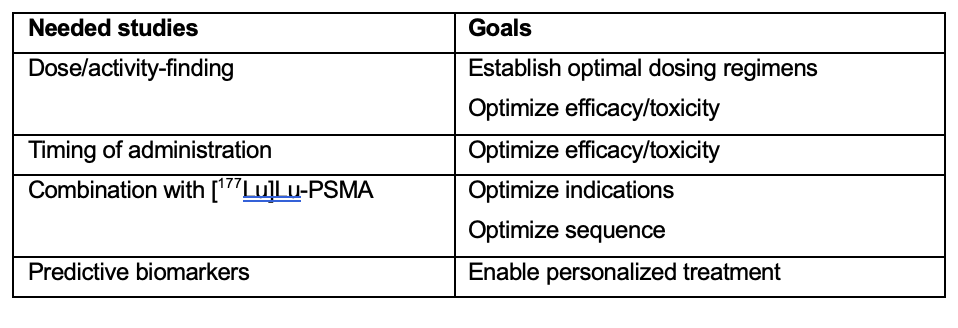
In summary, while [225Ac]Ac-PSMA therapy shows remarkable promise, especially in tandem with [177Lu]Lu-PSMA, its successful implementation requires careful consideration of multiple factors. Current limitations in dosimetry, potential cross-resistance, and the need for cautious activity selection emphasize the importance of further research and clinical trials. Larger randomized trials are needed to validate these findings and establish standardized protocols for clinical practice. We are aware of the difficulties associated with performing such studies. Still, we believe that a better assessment of the effectiveness and safety profile of [225Ac]-AcPSMA and, more importantly, the impact on OS and PFS should not be further delayed.
Written by: Maria Luisa Garo,1 Petra Petranović Ovčariček,2,3 and Luca Giovanella4,5
- Biostatistic Unit, Mathsly Research, Rome, Italy
- Oncology and Nuclear Medicine, University Hospital Center Sestre Milosrdnice, Zagreb, Croatia
- School of Medicine, University of Zagreb, Zagreb, Croatia
- Nuclear Medicine, Gruppo Ospedaliero Moncucco, Clinica Moncucco, Lugano, Switzerland
- Nuclear Medicine, University Hospital Zürich, Zürich, Switzerland