

In this Tissue and Cell publication (Durán et al., 2025), we developed and validated a multifunctional regenerative platform integrating a graphene oxide (GO)-based nanoscaffold functionalized with polyethylene glycol (PEG-NH₂) and poly(ε-caprolactone) (PCL), seeded with human adipose-derived mesenchymal stem cells (ADMSCs), and combined with oral sildenafil therapy (Figure 1). This combinatorial approach represents a translationally viable bioengineered strategy for functional urethral repair and fibrosis suppression.
A New Translational Paradigm in Regenerative Urology
Urethral stricture disease (USD) is characterized by progressive fibrotic narrowing of the urethral lumen, frequently resulting from iatrogenic trauma, pelvic injury, infection, or autoimmune disorders such as lichen sclerosus.1,2 Its prevalence rises sharply with age, affecting up to 0.6% of high-risk male populations.3 Conventional therapies—including urethroplasty, dilation, and internal urethrotomy—often fail to achieve long-term success in complex or long-segment strictures, where recurrence may exceed 15% despite technically successful repair.4–6 These limitations highlight the urgent need for regenerative strategies that not only reconstruct the lumen but also restore native histoarchitecture and function.7,8
The Bioengineered Platform: Nanoscaffold, Stem Cells, and Sildenafil
Our study introduces a multifunctional therapeutic system combining three synergistic components:
- A graphene oxide nanoscaffold functionalized with PEG-NH₂/PCL, providing mechanical stability, nanoscale topography, and bioactive cues to support cellular adhesion and proliferation;9,10
- Human adipose-derived mesenchymal stem cells (ADMSCs), acting as immunomodulatory and paracrine drivers of regeneration,12–14 and
- Oral sildenafil, a phosphodiesterase-5 inhibitor with antifibrotic and pro-angiogenic effects via cyclic GMP signaling.15
Mechanistic Insights and Regenerative Outcomes
In vitro assays confirmed that the GO nanoscaffold supported high ADMSC viability and spindle-shaped morphology at low GO concentrations (1 μg/μL), aligning with the biphasic cytotoxicity profile described by Akhavan et al.11 The functionalized GO/PEG-NH₂/PCL matrix offered a biocompatible and bioinductive microenvironment mimicking the extracellular matrix, while preventing oxidative stress and bacterial colonization.9,10,16
In a rabbit model of surgically induced urethral stricture, the Scaffold+ADMSCs+Sildenafil group achieved complete restoration of urethral patency, confirmed by retrograde urethrography and histological analysis. Quantitative scoring demonstrated fibrosis levels equivalent to those of healthy controls, with reduced inflammation and enhanced angiogenesis. Immunohistochemistry revealed upregulation of Uroplakin, Desmocollin, and CD117, indicating urothelial differentiation and progenitor activation, alongside significant downregulation of MMP-2, a marker of fibrotic remodeling (Figure 1).
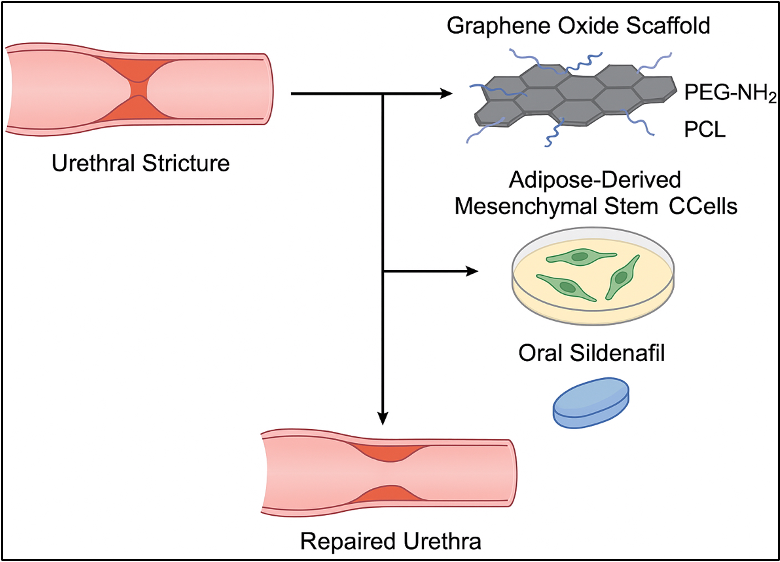
Figure 1. schematically illustrates the regenerative mechanism underlying the combined therapy. The diagram shows fibrotic urethra with collagen deposition and inflammatory infiltrate; implantation of the GO/PEG-NH₂/PCL nanoscaffold seeded with ADMSCs; sildenafil-induced angiogenesis and antifibrotic modulation; and full structural regeneration characterized by restored urothelium, organized smooth muscle, and vascular network.
Biological Synergy: From Scaffold to Cellular Reprogramming
The combined presence of ADMSCs and sildenafil produced a synergistic regenerative effect, modulating the microenvironment toward balanced epithelial and stromal remodeling. ADMSCs secreted trophic factors and exosomal miRNAs (e.g., miR-21, miR-146a) that suppressed fibrosis and enhanced neovascularization.13,14 Sildenafil further potentiated these effects by increasing nitric oxide–cGMP signaling, inhibiting myofibroblast activation, and promoting angiogenesis.15 Together, these mechanisms restored urothelial integrity and smooth muscle architecture, achieving a level of functional regeneration rarely observed in preclinical models.
Translational Potential and Future Perspectives
This multifunctional platform represents a translational leap in regenerative urology. The use of clinically accessible components—ADMSCs and sildenafil—enhances feasibility for near-term application in human studies. Moreover, the synthetic GO/PEG-NH₂/PCL scaffold offers reproducibility, scalability, and tunable biodegradability, circumventing the donor-site limitations associated with autologous grafts.
Future directions include validation in large-animal models with longer follow-up and integration of ADMSC-derived exosomes and controlled-release systems to sustain trophic factor delivery.17 Importantly, adopting green synthesis of graphene oxide, as proposed by Sharma et al. (18), could improve both biocompatibility and regulatory acceptance by avoiding cytotoxic reducing agents and aligning with sustainability principles.
Conclusion
The convergence of nanotechnology, stem cell biology, and pharmacological modulation defines a new era in functional tissue regeneration. The ADMSC-loaded GO/PEG-NH₂/PCL nanoscaffold combined with sildenafil achieved near-complete histological and functional recovery in a preclinical urethral stricture model—restoring urothelial differentiation, vascularization, and smooth muscle integrity while suppressing fibrosis to physiological levels. This integrative approach holds immense promise for clinical translation as a biologically active alternative to graft-based urethral reconstruction, potentially transforming the therapeutic landscape for complex and recurrent urethral strictures.
Written by: Wagner José Fávaro and João Carlos Cardoso Alonso
- Laboratory of Urogenital Carcinogenesis and Immunotherapy (LCURGIN), Universidade Estadual de Campinas (UNICAMP), Campinas City, São Paulo State, Brazil
- Paulínia Municipal Hospital, Paulínia City, São Paulo State, Brazil.
- Verla W, Oosterlinck W, Spinoit AF, Hoebeke P. A comprehensive review emphasizing anatomy, etiology, diagnosis, and treatment of male urethral stricture disease. Biomed Res Int. 2019;2019:9046430.
- Leng W, Li X, Dong L, Guo Z, Ji X, Cai T, Xu C, Zhu Z, Lin J. The Regenerative Microenvironment of the Tissue Engineering for Urethral Strictures. Stem Cell Rev Rep. 2024;20(3):672–687.
- Alwaal A, Blaschko SD, McAninch JW, Breyer BN. Epidemiology of urethral strictures. Transl Androl Urol. 2014;3(2):209–13.
- Chakraborty JN, Chawla A, Vyas N. Surgical interventions in female urethral strictures: a comprehensive literature review. Int Urogynecol J. 2022;33(3):459–85.
- Wessells H, Angermeier KW, Elliott SP, Gonzalez CM, Kodama RT, Peterson AC, et al. Male urethral stricture: American Urological Association guideline. J Urol. 2017;197(1):182–90.
- Lumen N, Oosterlinck W, Hoebeke P, Willemsen P, De Wachter S, Spinoit AF, et al. European Association of Urology guidelines on urethral stricture disease (part 1): management of male urethral stricture disease. Eur Urol. 2021;80(2):190–200.
- Chapple C. Tissue engineering of the urethra: where are we in 2019? World J Urol. 2020;38(9):2101–5.
- Versteegden LRM, Wolfs JTF, Bosman AW, Bank RA, Kluin J, Feitz WFJ. Tissue engineering of the urethra: a systematic review and meta-analysis of preclinical and clinical studies. Eur Urol. 2017;72(4):594–606.
- Durán M, Luzo ACM, Ceragioli HJ, Durán N, Fávaro WJ. Cytotoxicity and genotoxicity of graphene oxide scaffold: human adipose-derived mesenchymal stromal/stem cells (AT-MSCs) culture. SSRN Preprint. 2023. Available from: https://ssrn.com/abstract=4648166 or http://dx.doi.org/10.2139/ssrn.4648166
- Durán M, Durán N, Luzo ACM, Duarte ASS, Volpe BB, Ceragioli HJ, et al. Polymeric film of 6-arm-poly(ethylene glycol) amine graphene oxide with poly(ε-caprolactone): adherence and growth of adipose derived mesenchymal stromal cells culture on rat bladder. J Phys Conf Ser. 2017;838(1):012035.
- Akhavan O, Ghaderi E, Akhavan A. Size-dependent genotoxicity of graphene nanoplatelets in human stem cells. Biomaterials. 2012;33(32):8017–25.
- Jin Y, Zhao W, Yang M, Fang W, Gao G, Wang Y, et al. Cell-based therapy for urethral regeneration: a narrative review and future perspectives. Biomedicines. 2023;11(9):2366.
- Feng Z, Chen H, Fu T, Zhang L, Liu Y. miR-21 modification enhances the performance of adipose tissue-derived mesenchymal stem cells for counteracting urethral stricture formation. J Cell Mol Med. 2018;22(11):5607–16.
- Liang YC, Wu YP, Li XD, Chen SH, Ye XJ, Xue XY, et al. TNF-α-induced exosomal miR-146a mediates mesenchymal stem cell-dependent suppression of urethral stricture. J Cell Physiol. 2019;234(12):23243–55.
- Kurt O, Yesildag E, Yazici CM, Aktas C, Ozcaglayan O, Bozdemir Y. Effect of tadalafil on prevention of urethral stricture after urethral injury: an experimental study. Urology. 2016;91:243.e1–6.
- Durán M, Andrade PF, Durán N, Luzo ACM, Fávaro WJ. Graphene oxide sheets-based platform for induced pluripotent stem cells culture: toxicity, adherence, growth and application. J Phys Conf Ser. 2015;617:012020.
- Vahedi P, Moghaddamshahabi R, Webster TJ, Calikoglu Koyuncu AC, Ahmadian E, Khan WS, Mohamed AJ, Eftekhari A. The use of infrapatellar fat pad-derived mesenchymal stem cells in articular cartilage regeneration: A review. Int J Mol Sci. 2021;22(17):9215.
- Sharma A, Das A, Basak M, Ganguly M, Pal D. Green nanotechnology and nanomaterials for tissue engineering. In: Das A, Pal D, eds. Sustainable Materials in Tissue Engineering and Regenerative Medicine. Amsterdam: Elsevier; 2023:261–274.