

Key app features:
- Self-assessment questionnaire on PD symptoms, including penile curvature, penetration difficulty, and impact on sexual activity, including effects on a partner
- A guided scanning feature allows users to scan their erect penis and generate two-dimensional (2D) and three-dimensional (3D) representative images with curvature measurements (Figure 1)
- An instructional video demonstrates how to perform the scan accurately
- Users can align the scan to the points of maximum curvature
- A new feature added since the original publication allows users to choose between the front-facing (selfie) or rear camera to perform the scan, depending on preference and positioning needs
- Nodules or lumps can be marked directly on the images
- No photos or direct images are created or stored in the app or in the device’s photo gallery. Scans are saved to a secure in-app scan library, allowing users to view representations over time (no scans are saved outside the app).
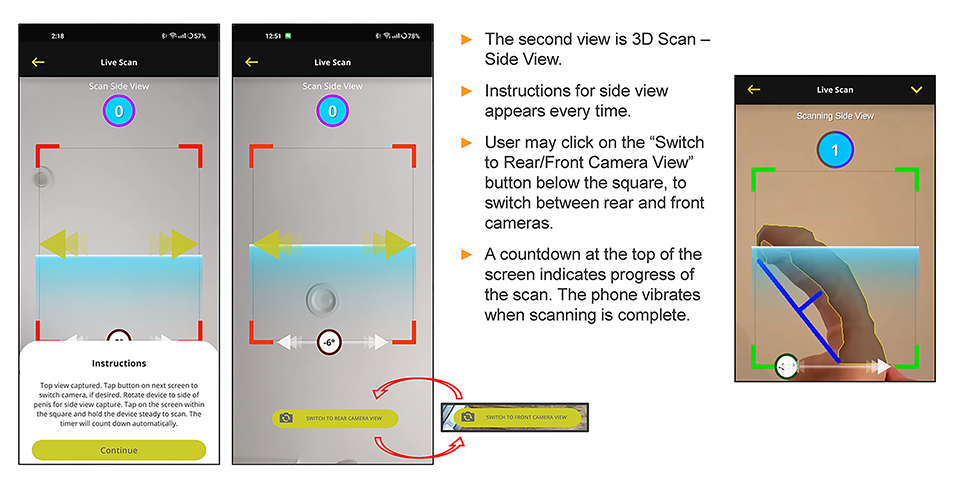
Figure 1. PD App Scanning Process
- Users can email scans and questionnaire responses directly to an HCP or to themselves
- Links to educational resources and a searchable provider directory are provided in partnership with the Sexual Medicine Society of North America (SMSNA), with European resources supported by the International Society for Sexual Medicine (ISSM)
- Protection of user privacy. All personal data (including scans, questionnaires, and results) is stored within the app on the user’s device. No account is required. No data is shared outside the app unless the user chooses to send information by email.
- Users can delete their scans manually within the app or completely remove all data by uninstalling the app, which erases all stored information permanently from the device
- The app operates without registration or cloud backup, so password resets and data recovery are not possible; deletion is definitive
- The app is freely available in English and Spanish across the United States, with international availability in France, Germany, Italy, Spain, and the United Kingdom added since the original publication
Written by: Gregory A. Broderick,1 Jesse N. Mills,2 Christopher Davis,3 and Mohit Khera4
- Department of Urology, Mayo Clinic, Jacksonville, FL, USA
- David Geffen School of Medicine, University of California, Los Angeles, CA, USA
- Research and Development, Keenova Therapeutics plc., Malvern, PA, USA
- Scott Department of Urology, Baylor College of Medicine Medical Center, Houston, TX, USA