

It seems that the deleterious impact of COVID-19 on erectile function could last for at least one year after COVID-19 recovery.4 Erectile function, apart from the sexual sphere, is a well-known marker of cardiovascular3,5 and general health.5 Therefore, it would be important to recognise those patients who are at risk of having long-lasting ED after COVID-19 recovery.
In our work, we aimed to develop a risk-predictive model for the identification of features involved in the prediction of ED 12 months after COVID-19 recovery, through a prospective multicentric study. 361 participants were divided into 2 cohorts: 1)Patients with a history of COVID-19 (n=166) and 2)Patients with no history of COVID-19 (n=195). We assessed ED in both groups using the 5-item International Index of Erectile Function (IIEF-5). While the individuals of the first cohort were assessed for ED at approximately 12 months after COVID-19 recovery, those of the second cohort were assessed within the same time window. To compare the differences in the proportions of ED for both cohorts, we performed a test of proportions. We used a binary logistic regression model for the selection of the variables involved in the prediction of ED in our sample.
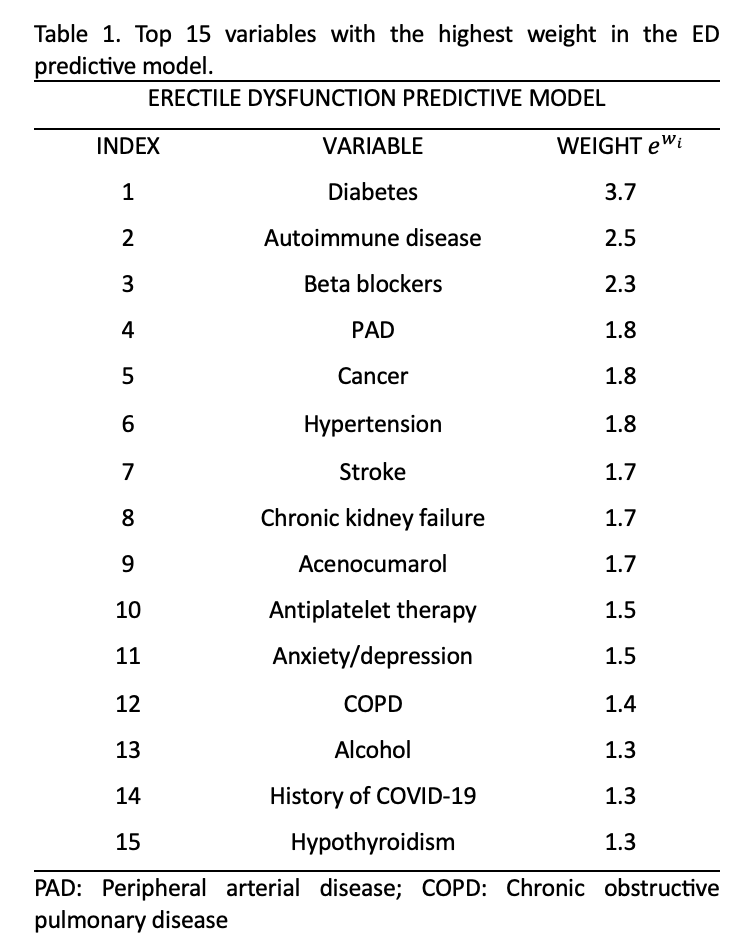
We found a higher prevalence of ED in the cohort of patients with a history of COVID-19 (55.9%) than in the non-COVID-19 cohort (44.1%), while the test of proportions showed statistical significance (p=7.4x10⁻⁵). We developed a regression model of 40 variables that showed an Area Under the Curve (AUC) of 0.8. The top 15 variables in the model are shown in Table 1. A history of COVID-19 behaved as an independent predictor of ED, which demonstrates the relationship between COVID-19 and ED, even 12 months after recovery.
Table 1. Top 15 variables with the highest weight in the ED predictive model.
Given that COVID-19 seems far from being eradicated, the application of post-COVID-19 ED predictive models in community settings could lead to the early diagnosis of this condition.6,7 These patients could then be subjected to a cardiovascular assessment that could avoid the onset of cardiovascular diseases and their adverse impact on healthcare systems. Future investigations should include a specific analysis of the effect of SARS-CoV-2 vaccination on the erectile function of recovered COVID-19 patients.
Written by: Fernando Natal Alvarez,1,2 Maria Consuelo Conde Redondo2 and Eduardo Tamayo Gomez3,4
- Urología Clínica Bilbao, Clínica IMQ Zorrotzaurre, 48014 Bilbao, Spain
- Department of Urology, Clinic University Hospital of Valladolid, 47003 Valladolid, Spain
- BioCritic, Group for Biomedical Research in Critical Care Medicine, 47003 Valladolid, Spain
- Centro de Investigación Biomédica en Red de Enfermedades Infecciosas (CIBERINFEC), Instituto de Salud Carlos III, 28029 Madrid, Spain
- Goldstein I, Goren A, Li VW, Tang WY, Hassan TA. Epidemiology update of erectile dysfunction in eight countries with high burden. Sex Med Rev. 2020 Jan;8(1):48-58. DOI: 10.1016/j.sxmr.2019.06.008.
- Lamers MM, Haagmans BL. SARS-CoV-2 pathogenesis. Nat Rev Microbiol. 2022 May;20(5):270-284. DOI: 10.1038/s41579-022-00713-0
- Sansone A, Mollaioli D, Ciocca G, Colonnello E, Limoncin E, Balercia G et al. “Mask up to keep it up”: Preliminary evidence of the association between erectile dysfunction and COVID‐19. Andrology. 2021;9(4):1053-1059. DOI: 10.1111/andr.13003.
- Gök A, Altan M, Dogan AE, Eraslan A, Uysal FS, Öztürk U et al. Does post-COVID-19 erectile dysfunction improve over time? J Clin Med. 2023;12(3):1241. DOI: 10.3390/jcm12031241.
- Jannini EA. SM = SM: The interface of systems medicine and sexual medicine for facing non-communicable diseases in a gender-dependent manner. Sex Med Rev. 2017 Jul;5(3):349-364. DOI: 10.1016/j.sxmr.2017.04.002.
- Ghasemiyeh P, Mohammadi-Samani S. Lessons we learned during the past four challenging years in the COVID-19 era: pharmacotherapy, long COVID complications, and vaccine development. Virol J. 2024 Apr 26;21(1):98. DOI: 10.1186/s12985-024-02370-6
- Hu X, Hu Z, Xu T, Zhang K, Lu HH, Zhao J et al. Equilibrium points and their stability of COVID-19 in US. Sci Rep. 2024; 14:1628. DOI: 10.1038/s41598-024-51729-w