

(Urotoday.com) The 2025 Western Section AUA annual meeting featured a prostate cancer session and a presentation by Austin W. Lee, MD, discussing the comparative performance of Unfold AI, PSMA-PET, and mpMRI for prostate cancer localization and pathologic staging. Over the last several years, there has been a wealth of data assessing the ability of artificial intelligence and new imaging modalities to improve prostate cancer risk stratification. As such, the objective of this study, presented at the 2025 Western Section AUA annual meeting, was to evaluate the diagnostic performance of Unfold AI compared to PSMA-PET and mpMRI in detecting clinically significant prostate cancer and extraprostatic extension, using whole-mount histopathology as ground truth.
In this study, 30 patients with intermediate- to high-risk prostate cancer underwent mpMRI, PSMA-PET, and radical prostatectomy. Unfold AI, an artificial intelligence-driven localization model, produced probabilistic cancer maps from mpMRI and clinical inputs. Each modality was evaluated for cancer localization and T-staging performance against histologic standards using ROC analysis.
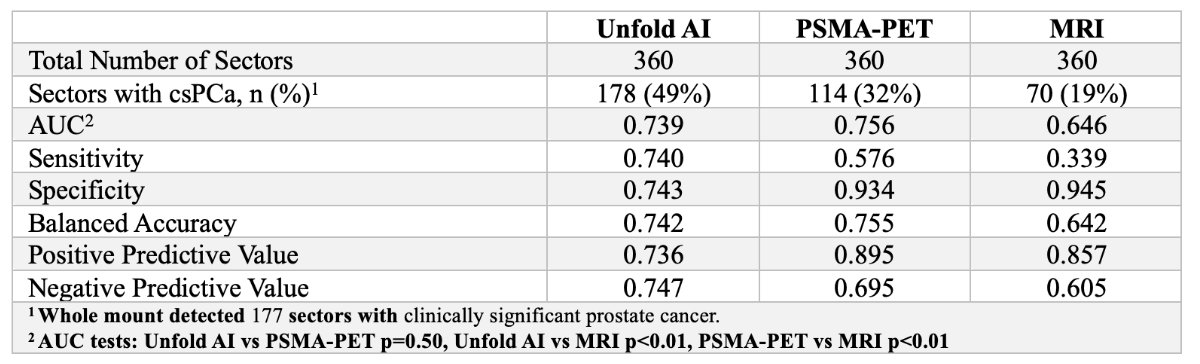
For clinically significant cancer, localization AUCs were: Unfold AI 0.7386, PSMA-PET 0.7562, and mpMRI 0.6461:
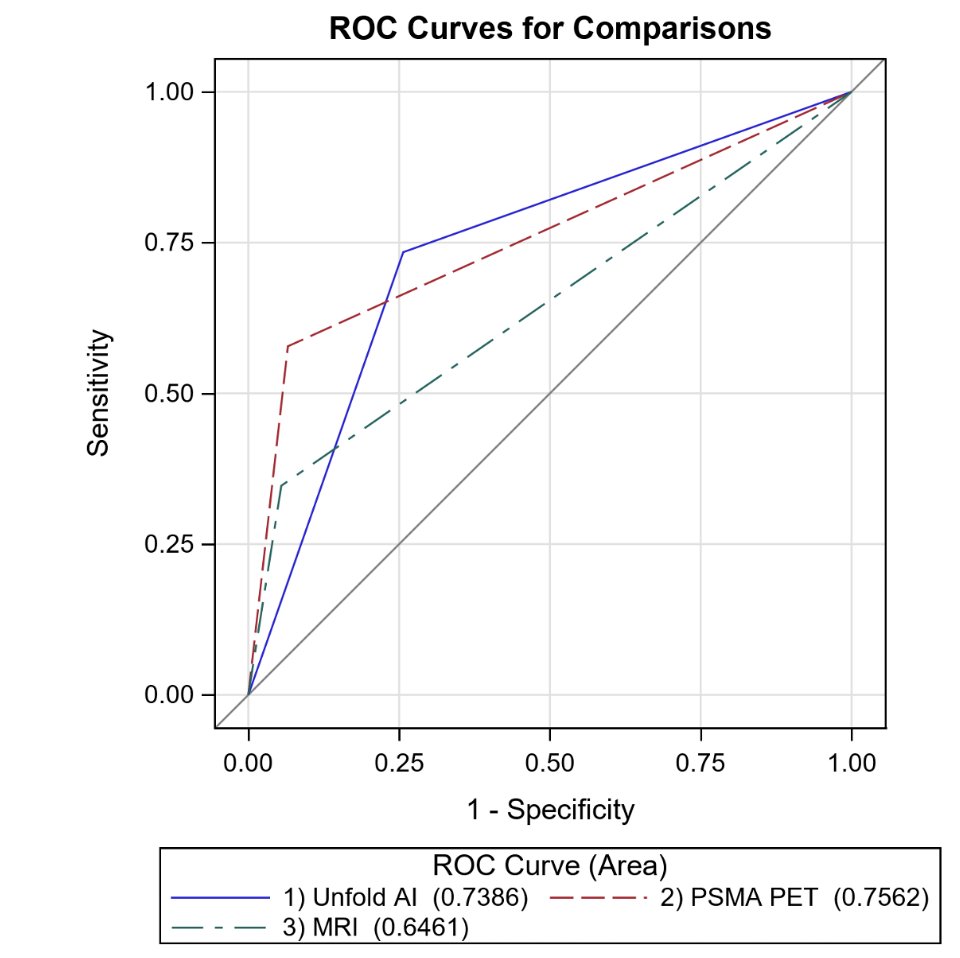
Unfold AI was not significantly different from PSMA-PET (p = 0.50), but significantly better than mpMRI (p < 0.01). Additionally, PSMA-PET outperformed mpMRI (p < 0.01):
For extraprostatic extension detection, Unfold AI (AUC 0.7476) outperformed both PSMA-PET (AUC 0.5681) and mpMRI (AUC 0.6490) (both p<0.01):

PSMA-PET was also inferior to mpMRI for T-staging (p = 0.05):
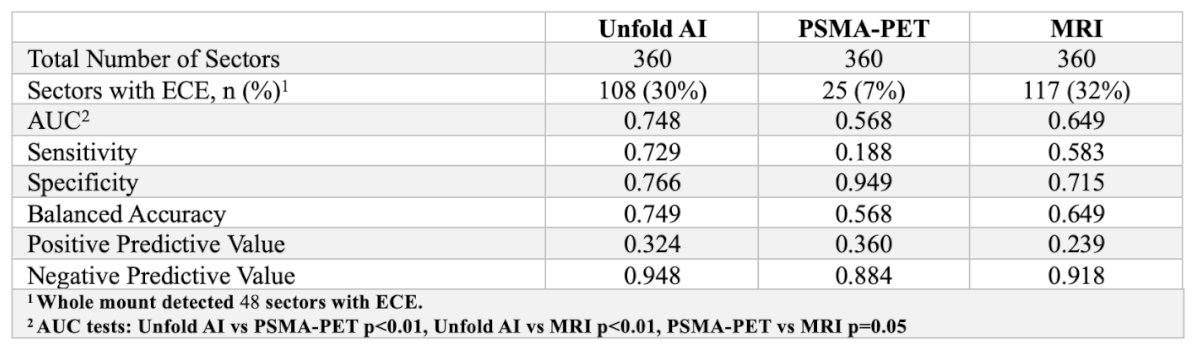
Unfold AI achieved high balanced accuracy for both tasks: localization (AUC 0.742) and extraprostatic extension (AUC 0.749).
Dr. Lee concluded his presentation discussing the comparative performance of UNFOLD AI, PSMA-PET, and mpMRI for prostate cancer localization and pathologic staging with the following take-home points:
- Unfold AI offers comparable accuracy to PSMA-PET and significantly outperforms mpMRI for clinically significant cancer localization
- Unfold AI also exceeded both modalities in detecting extraprostatic extension
- These findings highlight the potential of artificial intelligence-driven platforms to enhance prostate cancer staging and inform treatment planning
Presented by: Austin W. Lee, MD, UCLA, Los Angeles, CA
Written by: Zachary Klaassen, MD, MSc – Urologic Oncologist, Associate Professor of Urology, Georgia Cancer Center, Wellstar MCG Health, @zklaassen_md on Twitter during the 2025 Western Section American Urological Association (AUA) Annual Meeting, Napa Valley, CA, Sun, Nov 2 – Thurs, Nov 6, 2025.