

(Urotoday.com) The 2025 Western Section AUA annual meeting featured a prostate cancer session and a presentation by Wayne G. Brisbane, MD, discussing a head-to-head comparison of multimodal imaging in the detection of prostate cancer using whole-mount histopathology as a reference. Micro ultrasound is an emerging imaging modality with promising potential to identify and target suspicious prostate cancer. Recent studies indicate that micro ultrasound can complement mpMRI when compared to biopsy pathology results. Dr. Brisbane aimed to comprehensively evaluate and compare the performance of micro ultrasound, mpMRI, and PSMA PET/CT in the detection of prostate cancer and assessment of extraprostatic extension, using whole mount histopathology as a reference.
Patients with prostate cancer who underwent micro ultrasound, mpMRI, and PSMA PET/CT prior to radical prostatectomy were included in this study:
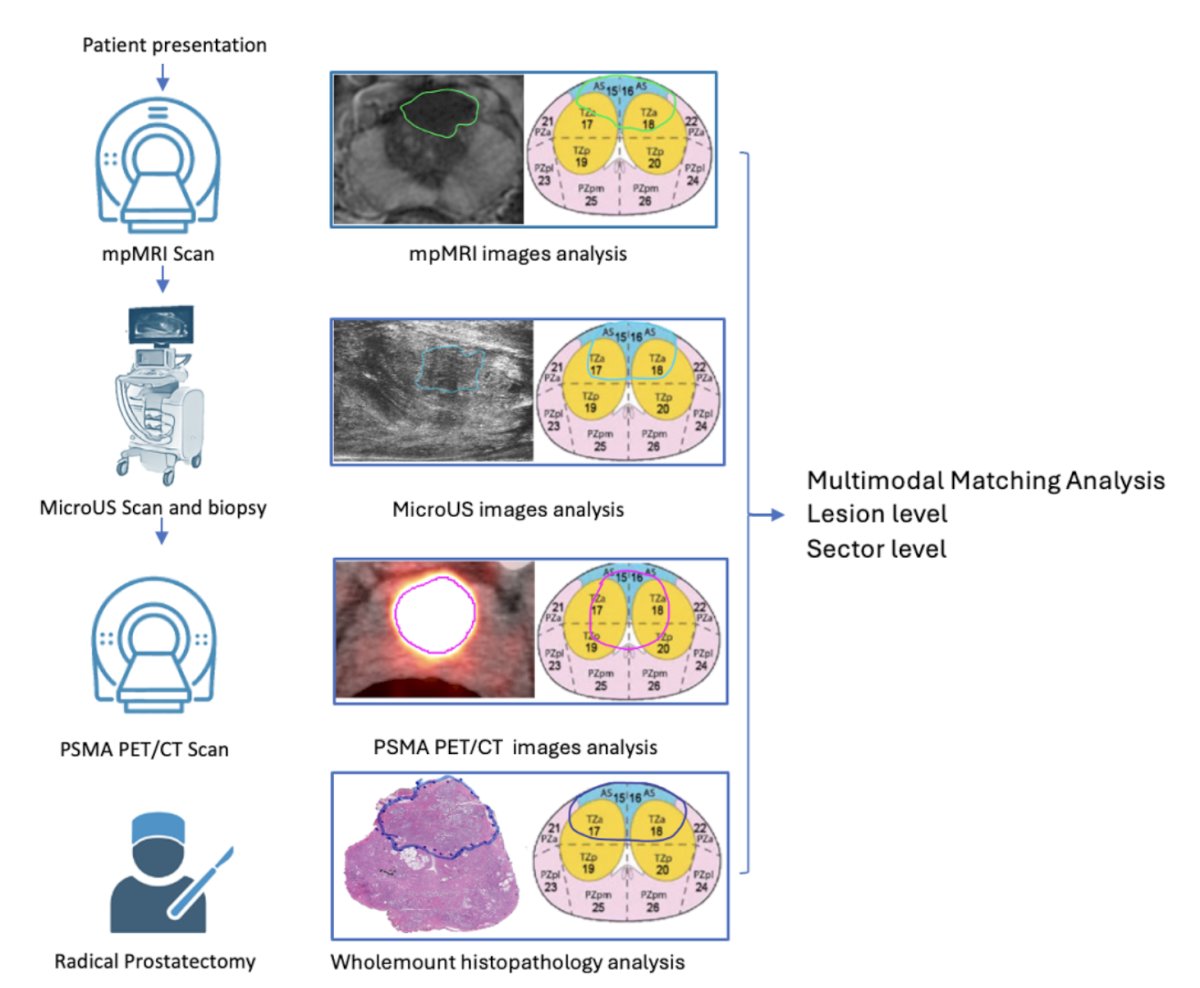
Whole-mount histopathology findings served as the reference standard. Imaging findings were mapped onto a standardized 36-sector map and correlated with whole-mount histopathology to assess prostate cancer involvement. Detection rates of prostate cancer and clinically significant prostate cancer were evaluated at both the lesion and sector levels. Diagnostic performance for detecting prostate cancer, clinically significant prostate cancer, and extraprostatic extension was assessed using receiver operating characteristic (ROC) analysis. The chi-square test and Delong test were used to compare the detection rates and area under the ROC curve (AUC) across different imaging modalities.
The study included 42 patients, of whom 20 patients (47.6%) had extraprostatic extension. Lesion-level detection rates for prostate cancer and clinically significant prostate cancer were 50% and 70% for micro ultrasound, 55% and 77% for mpMRI, and 50% and 74% for PSMA PET/CT, respectively:

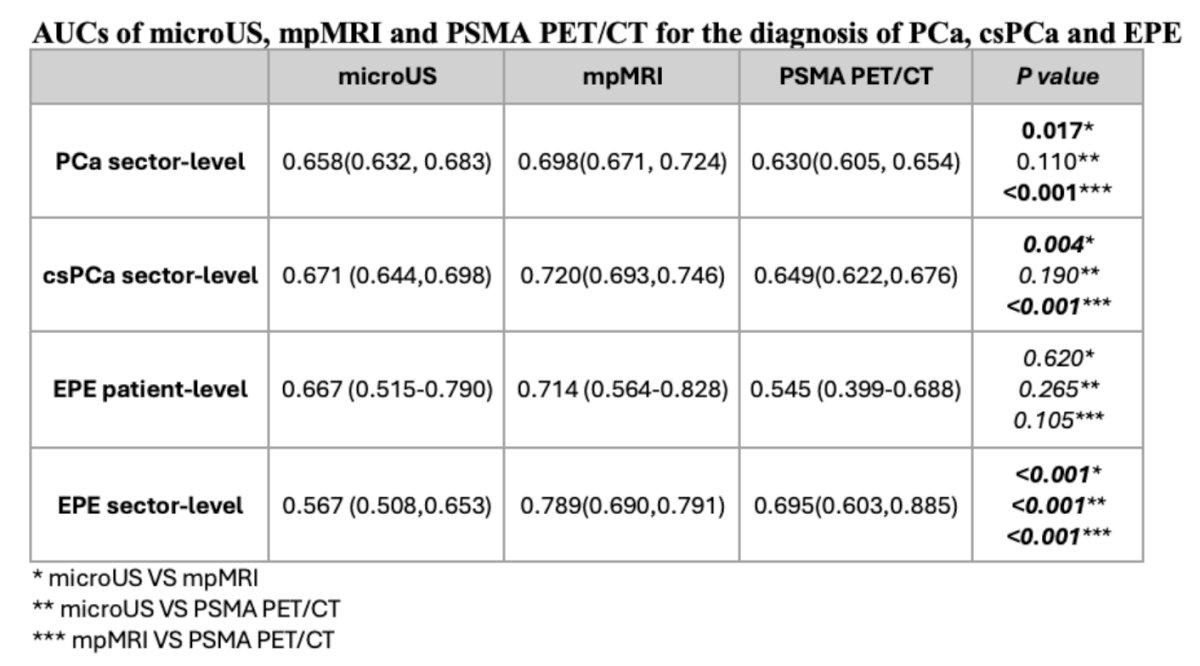
For predicting patient-level extraprostatic extension, AUCs were 0.667 (0.515-0.790) for micro ultrasound, 0.714 (0.564-0.828) for mpMRI, and 0.545 (0.399-0.688) for PSMA PET/CT. At the sector level, mpMRI outperformed micro ultrasound and PSMA PET/CT for detecting prostate cancer (AUC: 0.698 versus 0.658 and 0.630, p = 0.017/p < 0.001), clinically significant prostate cancer (AUC: 0.720 versus 0.671 and 0.649, p = 0.004/p < 0.001), and extraprostatic extension (AUC: 0.789 versus 0.567/0.695, p < 0.001/p < 0.001):
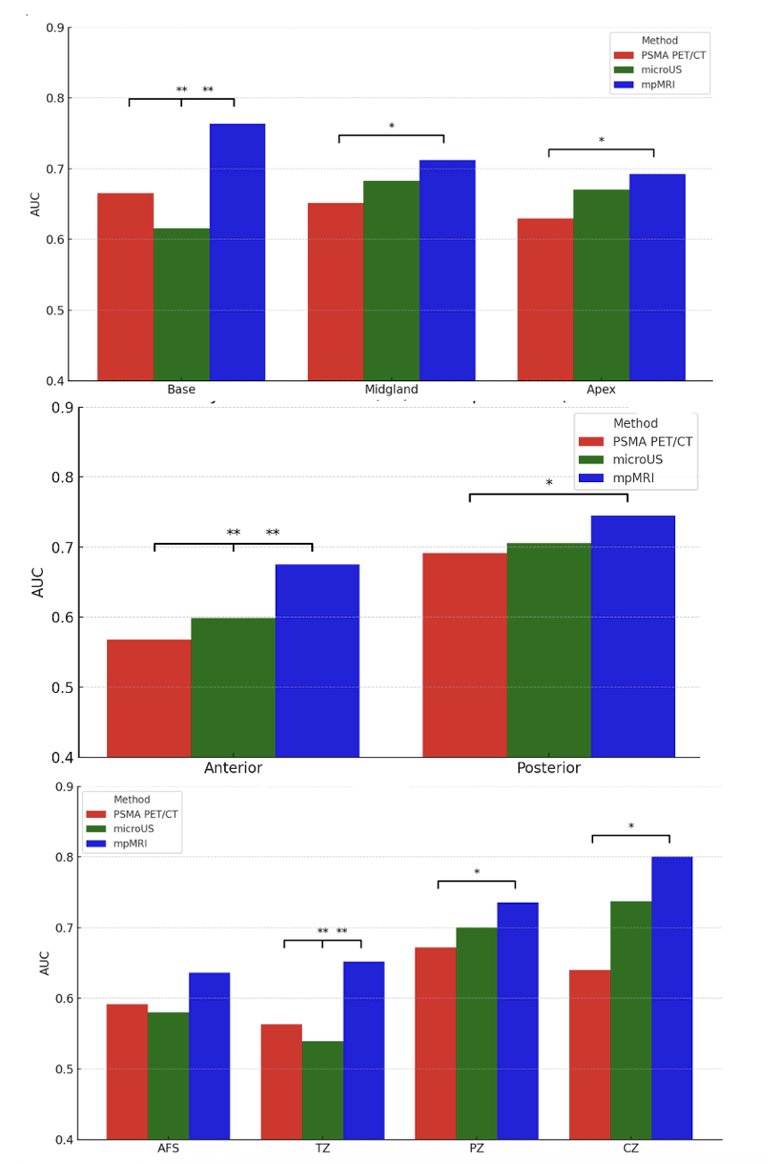
mpMRI performed better in detecting clinically significant prostate cancer in the base level, anterior part, and transition zones and in diagnosing extraprostatic extension in the base and midgland level (all p < 0.05):
Dr. Brisbane concluded his presentation discussing a head-to-head comparison of multimodal imaging in the detection of prostate cancer using whole mount histopathology as a reference, with the following take-home points:
- Micro ultrasound demonstrates comparable performance to mpMRI for detecting clinically significant prostate cancer at lesion-level and patient-level extraprostatic extension
- mpMRI is more accurate in the sector-level analysis
- Micro ultrasound can complement mpMRI, particularly where mpMRI access is limited
- Micro ultrasound’s comparable lesion-level accuracy supports its use in targeted biopsy to improve diagnosis
Presented by: Wayne G. Brisbane, MD, David Geffen School of Medicine, University of California, Los Angeles, Los Angeles, CA
Written by: Zachary Klaassen, MD, MSc – Urologic Oncologist, Associate Professor of Urology, Georgia Cancer Center, Wellstar MCG Health, @zklaassen_md on Twitter during the 2025 Western Section American Urological Association (AUA) Annual Meeting, Napa Valley, CA, Sun, Nov 2 – Thurs, Nov 6, 2025.