

(Urotoday.com) The 2025 Western Section AUA annual meeting featured a prostate cancer session and a presentation by Murilo de Almeida Luz, MD, discussing the impact of bone-protecting agents on outcomes with enzalutamide, with or without radium-223, in asymptomatic/mildly symptomatic patients with bone mCRPC from PEACE-3. PEACE-3 was an ethics-approved international study in 446 patients with mCRPC and bone metastases randomized 1:1 to a combination of enzalutamide + radium-223 versus enzalutamide alone:1

The trial demonstrated significant improvement in the radiological progression-free survival: HR 0.69 (95% CI 0.54–0.87; p = 0.0009). As of March 2018, an urgent safety letter made co-administration of zoledronic acid or denosumab obligatory. This analysis, presented at the 2025 Western Section AUA annual meeting, aimed to determine whether the use of a bone-protecting agent enhanced the therapeutic efficacy of treatment in patients who were treated with or without bone-protecting agents prior to the urgent safety letter.
This analysis included 115 patients who enrolled prior to the urgent safety letter and received protocol treatment. Of these, 59 (51%) received either no bone-protecting agents or only after a fracture had occurred, while 56 (49%) received bone-protecting agents prior and/or during study treatment. Efficacy outcomes included radiological progression-free survival, overall survival, and time to subsequent therapy.
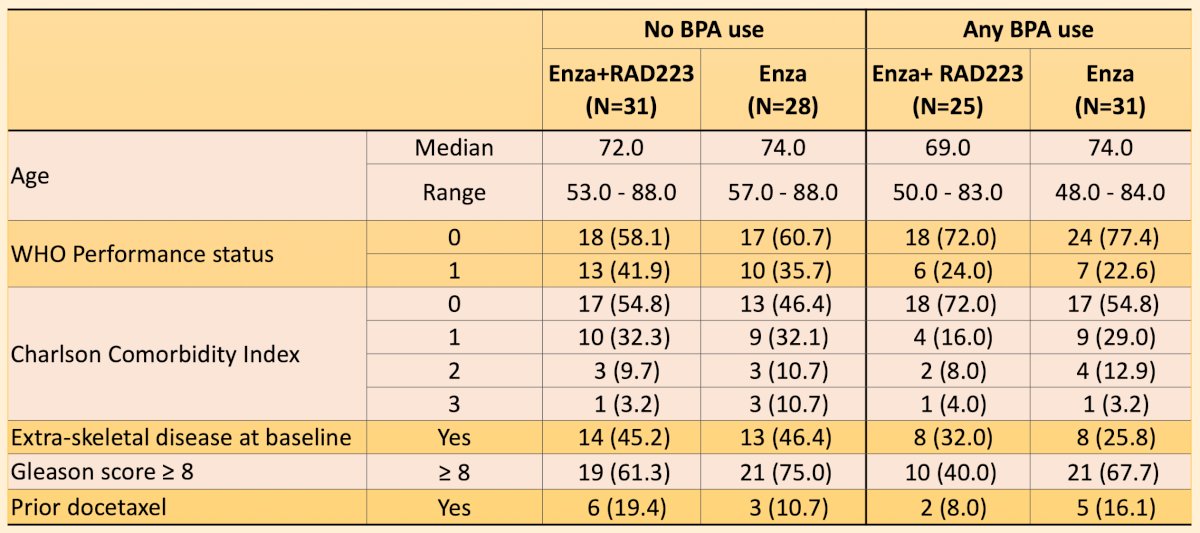
Patients with bone-protecting agent use versus no bone-protecting agent had similar baseline characteristics:
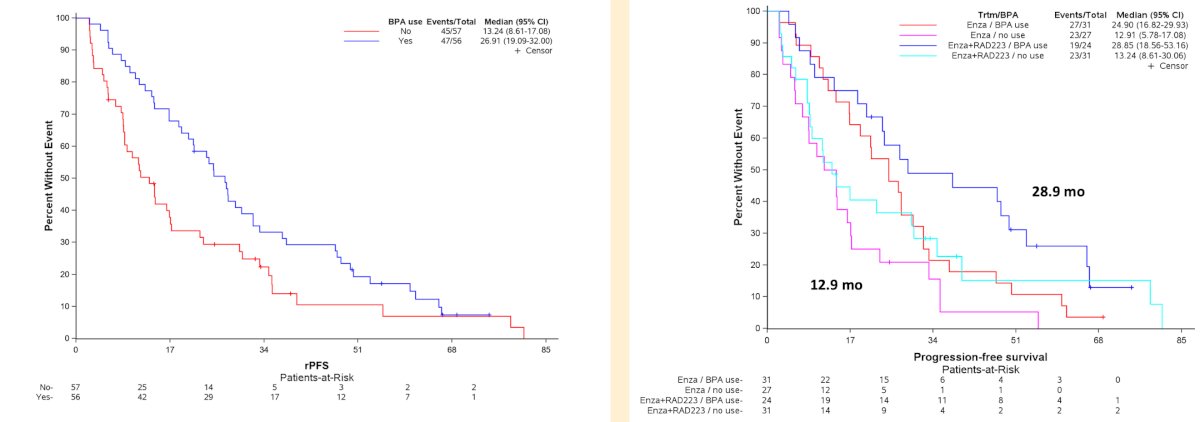
The median enzalutamide treatment duration was 12 months (IQR: 7–27) without and 26 months (IQR: 13–44) with bone-protecting agent use. The median radiological progression-free survival was longer by 14 months from 13 months without to 27 months with bone-protecting agent use (HR 0.61, 95% CI 0.39–0.95), and this difference was similar across both arms. Patients in the enzalutamide + radium-223 arm with bone-protecting agents had a median radiological progression-free survival of 28.8 months versus only 12.9 months for those in the enzalutamide arm without bone-protecting agents:
Median overall survival was longer by 13 months from 28 months without to 41 months with bone-protecting agent use (HR 0.61, 95% CI 0.40–0.94). Again, this difference was notable between the enzalutamide + radium-223 arm with bone-protecting agents and the enzalutamide arm without bone-protecting agents, with median overall survival of 60 months versus 23.98 months, respectively. Patients without bone-protecting agents reported more severe (CTCAE grade ≥3) anemia (9% versus 2%) and renal/urinary disorders (9% versus 2%), but less severe hypertension (39% versus 52%).
Dr. de Almeida Luz concluded his presentation discussing the impact of bone-protecting agents on outcomes from PEACE-3 with the following take-home points:
- In the overall population, radiographic progression-free survival was significantly improved with the addition of radium-223 to enzalutamide
- Bone-protecting agent use led to an improvement in radiographic progression-free survival, with a similar advantage in both arms
- Bone-protecting agent use also led to an improvement in overall survival, again with a similar advantage in both arms
- These exploratory findings suggest that bone-protecting agents in combination with life-prolonging therapeutic options in mCRPC are safe and may provide additional therapeutic benefit
Presented by: Murilo de Almeida Luz, MD, Hospital Erasto Gaertner, Curitiba, Brazil
Written by: Zachary Klaassen, MD, MSc – Urologic Oncologist, Associate Professor of Urology, Georgia Cancer Center, Wellstar MCG Health, @zklaassen_md on Twitter during the 2025 Western Section American Urological Association (AUA) Annual Meeting, Napa Valley, CA, Sat, Nov 2 – Thurs, Nov 6, 2025.
References: