

(UroToday.com) The 2025 Western Section AUA annual meeting featured a prostate cancer session and a presentation by Dr. Quoc-Dien Trinh discussing the efficacy and safety of darolutamide + ADT in Black patients with metastatic hormone-sensitive prostate cancer (mHSPC) from the phase 3 ARANOTE trial. Incidence and mortality rates of prostate cancer are higher in Black patients versus other racial groups, yet studies suggest Black patients with metastatic castration-resistant prostate cancer (mCRPC) may respond better to therapy.
In ARANOTE, darolutamide + ADT significantly reduced the risk of radiological progression or death by 46% versus placebo + ADT in patients with mHSPC.1 The incidence of treatment-emergent adverse events was low and similar between groups, with fewer patients discontinuing darolutamide (6.1%) versus placebo (9.0%) due to treatment-emergent adverse events. At the 2025 Western Section AUA annual meeting, Dr. Trinh and colleagues presented the efficacy and safety of darolutamide + ADT in Black patients from ARANOTE.
Patients starting on ADT were randomized 2:1 to darolutamide 600 mg twice daily or placebo. The primary endpoint was radiological progression-free survival. Secondary endpoints included time to mCRPC, time to PSA progression, rates of PSA <0.2 ng/mL at any time, and safety:

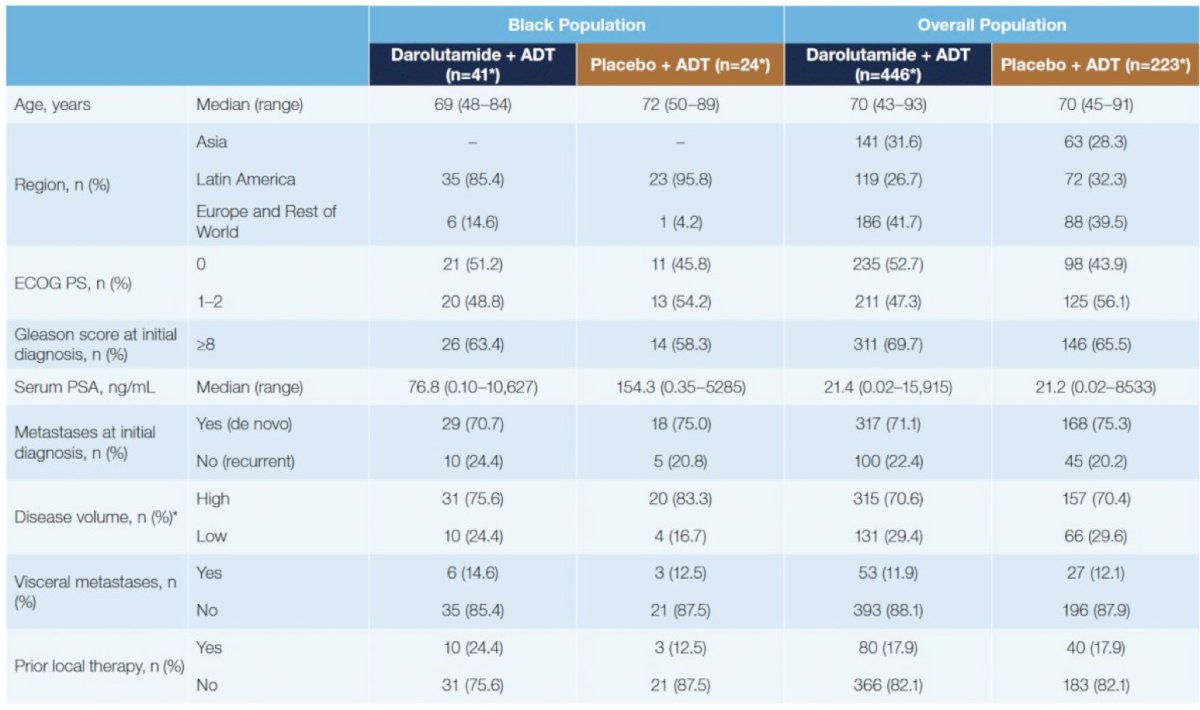
Of 669 patients, 65 (10%; darolutamide, n = 41; placebo, n = 24) were Black. Baseline characteristics were similar between arms, except Black patients had higher median baseline PSA (99.6 versus 21.3 ng/mL), and more patients had high-volume mHSPC (78.5% versus 70.6%):
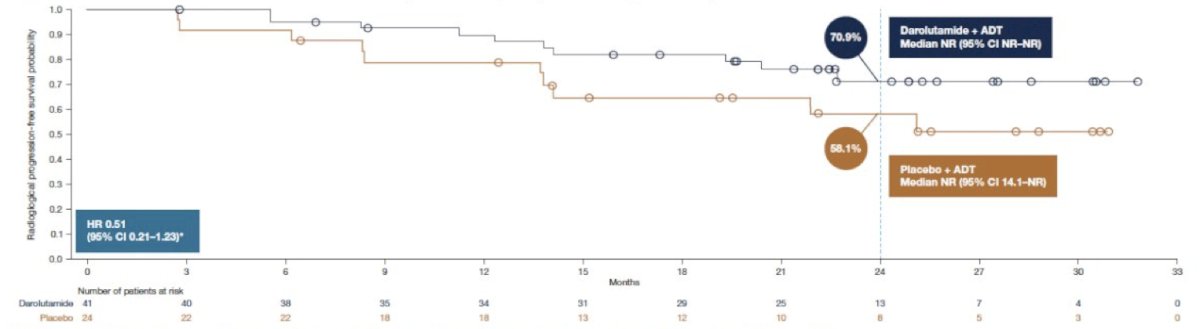
Darolutamide reduced the risk of radiological progression or death by 49% in Black patients (HR 0.51, 95% CI 0.21–1.23) with median radiological progression-free survival not reached in either arm:
The radiological progression-free survival benefit of darolutamide was generally consistent across prespecified subgroups, but the small sample size and limited number of events led to wide confidence intervals. Darolutamide versus placebo delayed time to mCRPC (HR 0.33, 95% CI 0.16–0.67), time to PSA progression (HR 0.33, 95% CI 0.15–0.73), and had a higher rate of PSA <0.2 ng/mL (59.5% versus 18.2%). Incidence of treatment-emergent adverse events was generally similar between the darolutamide and placebo arms (grade 3/4: 19 patients [45%], 9 patients [39%]; serious: 9 patients [21%], 8 patients [35%]):
![The radiological progression-free survival benefit of darolutamide was generally consistent across prespecified subgroups, but the small sample size and limited number of events led to wide confidence intervals. Darolutamide versus placebo delayed time to mCRPC (HR 0.33, 95% CI 0.16–0.67), time to PSA progression (HR 0.33, 95% CI 0.15–0.73), and had a higher rate of PSA <0.2 ng/mL (59.5% versus 18.2%). Incidence of treatment-emergent adverse events was generally similar between dthe arolutamide and placebo arms (grade 3/4: 19 patients [45%], 9 patients [39%]; serious: 9 patients [21%], 8 patients [35%]):](/images/com-doc-importer/236-wsaua-2025/wsaua-2025-efficacy-and-safety-of-darolutamide-adt-in-black-patients-with-metastatic-hormone-sensitive-prostate-cancer-from-the-phase-3-aranote-trial/image-3.jpg)
Treatment emergent adverse events associated with androgen receptor pathway inhibitors were also generally similar in both arms, except for hypertension (9 patients [21%], 7 patients [30%]), vasodilation/flushing (9 patients [21%], 6 patients [26%]), and diabetes/hyperglycemia (9 patients [21%], 4 patients [17%]), which had similar or lower rates with darolutamide versus placebo:
![Treatment emergent adverse events associated with androgen receptor pathway inhibitors were also generally similar in both arms, except for hypertension (9 patients [21%], 7 patients [30%]), vasodilation/flushing (9 patients [21%], 6 patients [26%]), and diabetes/hyperglycemia (9 patients [21%], 4 patients [17%]), which had similar or lower rates with darolutamide versus placebo:](/images/com-doc-importer/236-wsaua-2025/wsaua-2025-efficacy-and-safety-of-darolutamide-adt-in-black-patients-with-metastatic-hormone-sensitive-prostate-cancer-from-the-phase-3-aranote-trial/image-4.jpg)
Dr. Shee concluded his presentation discussing the efficacy and safety of darolutamide + ADT in Black patients with mHSPC from the phase 3 ARANOTE trial with the following take-home points:
- In the subgroup of Black patients from the ARANOTE study, darolutamide was associated with an improvement in radiographic progression-free survival and delayed time to mCRPC, and time to PSA progression, compared with placebo, and similar to what was observed in the overall population
- The radiographic progression-free survival benefit was consistent across all prespecified subgroups of Black patients, although efficacy data were limited by the small sample size and number of events
- PSA response rates and time to PSA progression are notable in the Black population, given the higher PSA levels at baseline, compared with the overall ARANOTE population
- Darolutamide exhibited a favorable safety profile in Black patients compared with placebo, which was generally consistent with the overall ARANOTE population between treatment groups
Presented by: Quoc-Dien Trinh, MD, MBA, Chair, Department of Urology, University of Pittsburgh School of Medicine, University of Pittsburgh Medical Center, Pittsburgh, PA
Written by: Zachary Klaassen, MD, MSc – Urologic Oncologist, Associate Professor of Urology, Georgia Cancer Center, Wellstar MCG Health, @zklaassen_md on Twitter during the 2025 Western Section American Urological Association (AUA) Annual Meeting, Napa Valley, CA, Sun, Nov 2 – Thurs, Nov 6, 2025.
Reference: