

(UroToday.com) The 2025 Western Section AUA annual meeting featured a prostate cancer session and a presentation by Dr. Kevin Shee discussing the integration of genomic prognostic and hallmark signatures from Decipher GRID to predict adverse outcomes in men on active surveillance for prostate cancer. Active surveillance has been accepted as the standard management for lower-risk prostate cancer by major clinical guidelines.
Genomic tools such as the Decipher genomic classifier have improved risk stratification and clinical decision-making in prostate cancer, though their optimal role in active surveillance is still under study. Decipher GRID, a proprietary platform including validated prognostic signatures, hallmark pathway scores, and other expression signatures, represents a potential resource for refining risk assessment in active surveillance.
For this study, the Urologic Outcomes Database at the University of California, San Francisco (UCSF) was queried for men on active surveillance with ≥2 biopsies with Decipher testing performed on biopsy tissue. Outcomes were any upgrade (any increase in Gleason Grade Group), major upgrade (upgrade to ≥ Grade Group 3), and development of unfavorable histology (expansile, or large, cribriform or intraductal carcinoma). An average genomic risk score was subsequently calculated. Multivariable Cox proportional hazards regression using stepwise selection models were performed to determine associations between 18 validated prognostic gene signatures and 37 hallmark cancer pathways with risk of outcomes, adjusting for UCSF Cancer of the Prostate Risk Assessment (CAPRA) score.
Overall, there were 486 men included in this study. The median follow-up for the cohort was 70 (IQR 42-104) months. On diagnostic biopsy, 378 (78%) and 108 (22%) patients had Grade Group 1 and Grade Group 2, respectively. CAPRA risk at diagnosis was low (0-2), intermediate (3-5), and high risk (6-10) in 359 (74%), 126 (26%), and 1 patient, respectively. The median average genomic risk was 0.25 (IQR 0.20-0.31). The heat map of UCSF patients ordered by increasing average genomic risk for normalized scores for 18 prostatic signatures is highlighted as follows:

Additionally, the heat map of UCSF patients ordered by increasing average genomic risk for normalized scores for 37 hallmark gene set scores clustered by unsupervised clustering is noted below:
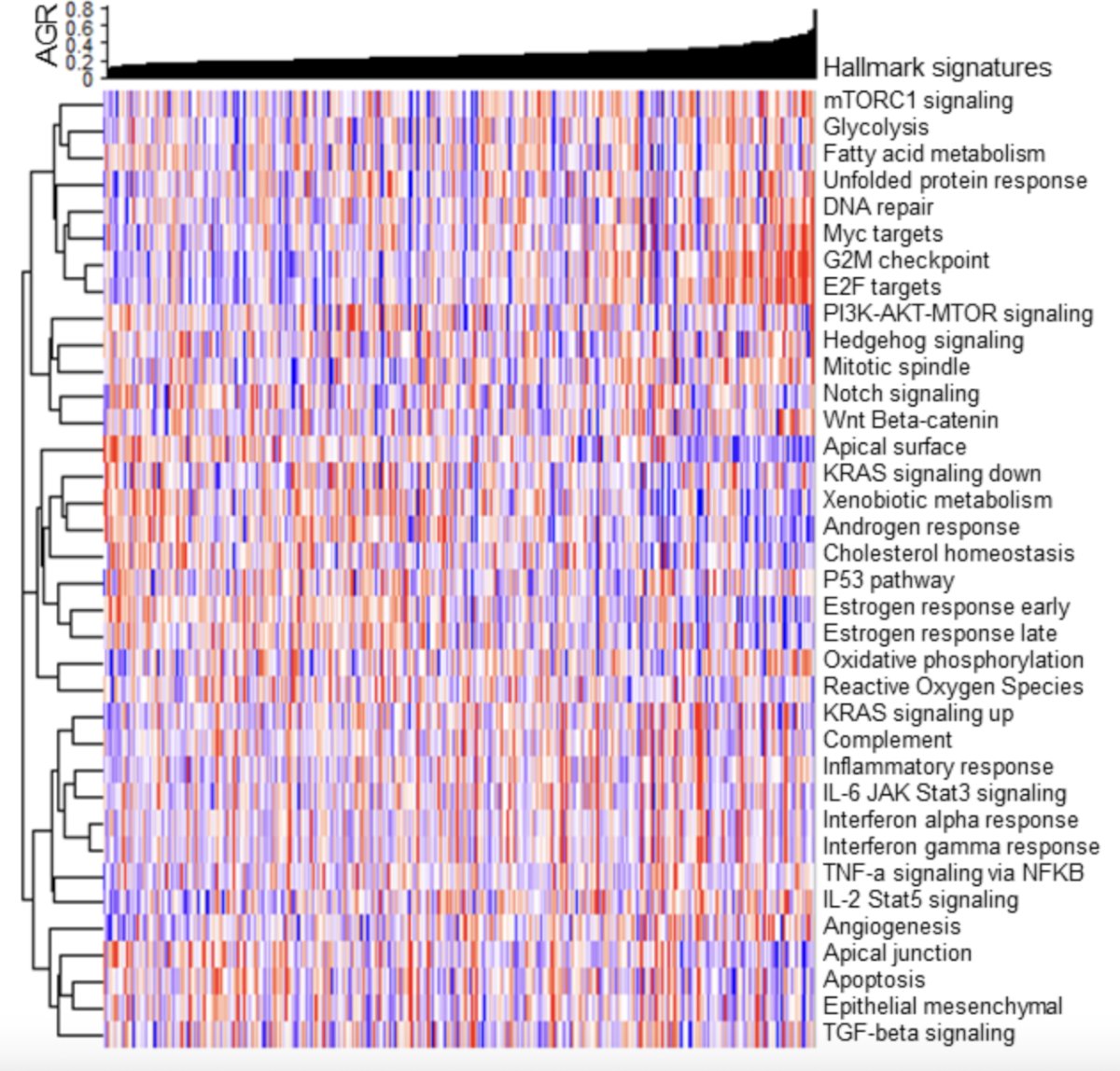
After adjusting for CAPRA, multivariable models demonstrated that genomic signatures Long et al.1 and Yu et al.2 provided independent prognostic value for both upgrade and major upgrade outcomes, and demonstrated that Lapointe et al.3 provided independent prognostic value for unfavorable histology outcomes. After adjusting for CAPRA, hallmark signatures of PI3K/AKT/mTOR signaling and reactive oxygen species pathways also provided independent prognostic value for all outcomes.
Dr. Shee concluded his presentation discussing the integration of genomic prognostic and hallmark signatures from Decipher GRID to predict adverse outcomes in men on active surveillance for prostate cancer with the following take-home points:
- This analysis noted multiple prognostic and hallmark gene expression signatures that prognosticated adverse active surveillance outcomes independent of CAPRA, a well-validated risk stratification tool
- These findings support further validation of these genomic signatures to enhance risk stratification and guide active surveillance management in prostate cancer
Presented by: Kevin Shee, MD, PhD, UCSF, San Francisco, CA
Written by: Zachary Klaassen, MD, MSc – Urologic Oncologist, Associate Professor of Urology, Georgia Cancer Center, Wellstar MCG Health, @zklaassen_md on Twitter during the 2025 Western Section American Urological Association (AUA) Annual Meeting, Napa Valley, CA, Sun, Nov 2 – Thurs, Nov 6, 2025.
References:
- Long Q, Xu J, Osunkoya AO, et al. Global transcriptome analysis of formalin-fixed prostate cancer specimens identifies biomarkers of disease recurrence. Cancer Res. 2014;74(12):3228-3237.
- Yu J, Yu J, Rhodes DR, et al. A polycomb repression signature in metastatic prostate cancer predicts cancer outcome. Cancer Res. 2007;67(22):10657-10663.
- Lapointe J, Li C, Higgins JP, et al. Gene expression profiling identifies clinically relevant subtypes of prostate cancer. Proc Natl Acad Sci USA. 2004;101(3):811-816.