

(Urotoday.com) The 2025 Western Section AUA annual meeting featured a prostate cancer session and a presentation by Amana Liddell, BS, discussing the impact of post-traumatic stress disorder on prostate cancer outcomes following radical prostatectomy in a veteran population. Prostate cancer and post-traumatic stress disorder are both highly prevalent within the veteran population. Given that stress is known to exacerbate numerous diseases, the investigators sought to determine if post-traumatic stress disorder increases the risk of adverse prostate cancer outcomes and all-cause mortality among veterans who have undergone radical prostatectomy.
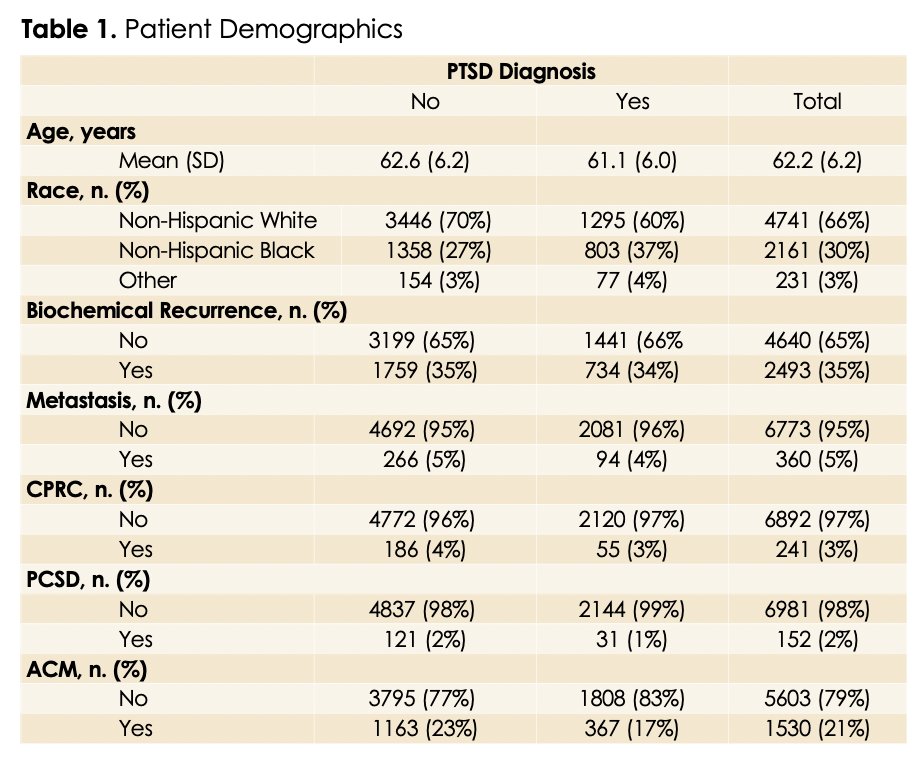
This study utilized the VA SEARCH database to identify 7,133 males who underwent radical prostatectomy within the VA health system after 2000. Overall, 30% (n = 2,175) of this population was diagnosed with post-traumatic stress disorder within 3 years prior to radical prostatectomy based on ICD-9 and 10 codes. Cox proportional hazard models were used to test the association between post-traumatic stress disorder and time to biochemical recurrence, metastatic disease, castration-resistant prostate cancer, prostate cancer-specific death, and all-cause mortality.
The patient demographics of those included in the study are as follows:
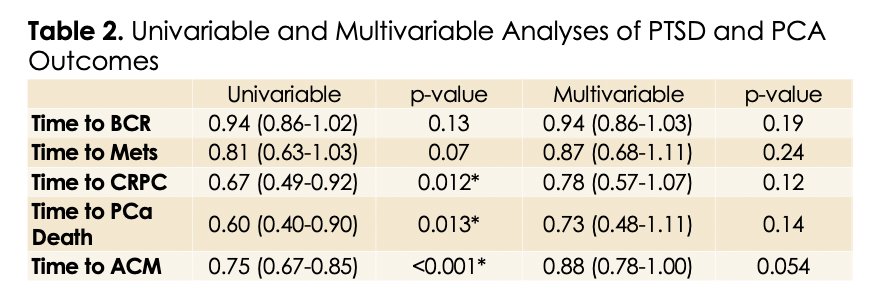
In the univariable analyses, veterans with post-traumatic stress disorder had a 33% reduction in risk of castration-resistant prostate cancer, 40% reduction in risk of prostate cancer-specific death, and 25% reduction in risk of all-cause mortality compared to those without post-traumatic stress disorder. Post-traumatic stress disorder diagnosis did not impact time to biochemical recurrence or time to metastatic disease in the univariable analyses. Multivariable analyses adjusted for demographic and pathological characteristics demonstrated no significant association between post-traumatic stress disorder and prostate cancer-specific progression endpoints. There was, however, a trend for a positive association with post-traumatic stress disorder and improved overall survival (HR 0.88, 95% CI 0.78–1.00, p = 0.054). The following table summarizes the univariable and multivariable analyses of post-traumatic stress disorder and prostate cancer outcomes:
Possible explanations for these findings include differences in healthcare utilization and behavioral factors. More specifically, veterans with post-traumatic stress disorder may engage more frequently with the healthcare system, resulting in earlier detection and treatment of prostate cancer and thus improved outcomes.
Amana Liddell concluded this presentation discussing the impact of post-traumatic stress disorder on prostate cancer outcomes following radical prostatectomy in a Veteran population with the following take-home points:
- Post-traumatic stress disorder did not increase the risk of adverse prostate cancer outcomes such as biochemical recurrence, metastasis, CRPC, and prostate cancer death in veterans who underwent radical prostatectomy
- These findings showed a trend that suggests post-traumatic stress disorder was associated with improved overall survival, which challenges existing literature that links stress with adverse health outcomes
- Future research is needed to further investigate the mechanisms that contribute to improved overall survival in veterans with post-traumatic stress disorder who underwent radical prostatectomy
Presented by: Amana Liddell, BS, Greater Los Angeles Veterans Affairs, Los Angeles, CA
Written by: Zachary Klaassen, MD, MSc – Urologic Oncologist, Associate Professor of Urology, Georgia Cancer Center, Wellstar MCG Health, @zklaassen_md on Twitter during the 2025 Western Section American Urological Association (AUA) Annual Meeting, Napa Valley, CA, Sun, Nov 2 – Thurs, Nov 6, 2025.