

(UroToday.com) The 2025 Western Section AUA annual meeting featured a urothelial carcinoma session and a presentation by Dr. Siamak Daneshmand discussing computational histology artificial intelligence (CHAI) analysis of high-grade (HG) Ta non-muscle invasive bladder cancer risk stratification for progression and recurrence across subgroups.
Current guidelines are conflicted regarding risk stratification of HG Ta non-muscle invasive bladder cancer, and as such, better risk stratification methods are needed to direct clinical management. The CHAI platform has previously been developed to generate predictive and prognostic biomarkers for non-muscle invasive bladder cancer. This platform has been shown to stratify recurrence and muscle-invasive progression risks in an all-comer HG Ta populations better than AUA and EAU groupings, but reclassification rates, as well as performance in papillary-only disease and with a focus on broader stage progression, have yet to be examined.
This study included H&E slides from 269 patients with HG Ta non-muscle invasive bladder cancer that were analyzed with CHAI models, with endpoints of high-grade recurrence-free survival, muscle-invasive progression-free survival, and stage progression-free survival. Cox proportional hazards models were used to assess the degree of association between CHAI biomarker and clinical endpoints, and subgroup analyses were performed for patients with papillary-only disease.
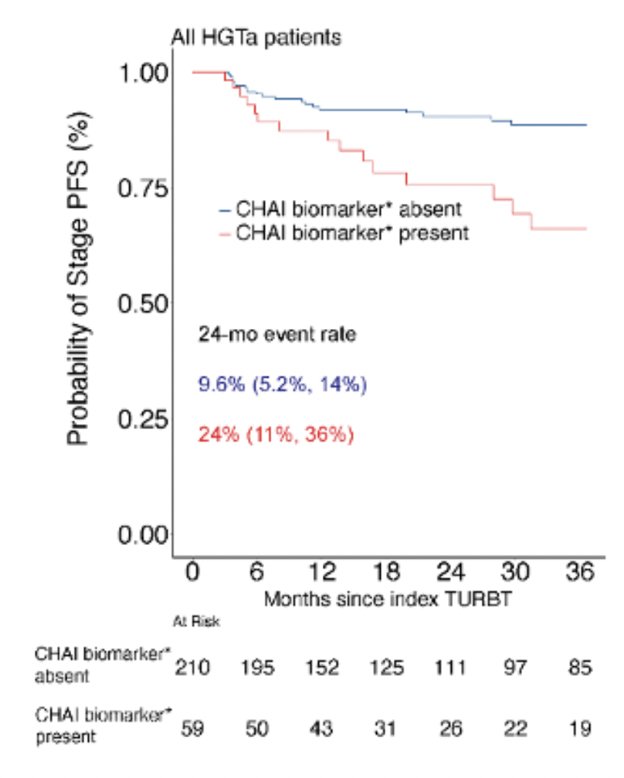
Across the full HG Ta cohort, CHAI high-risk status was significantly correlated with stage progression-free survival (24-month rate: 24% versus 9.6%; HR 2.91, p = 0.0018):
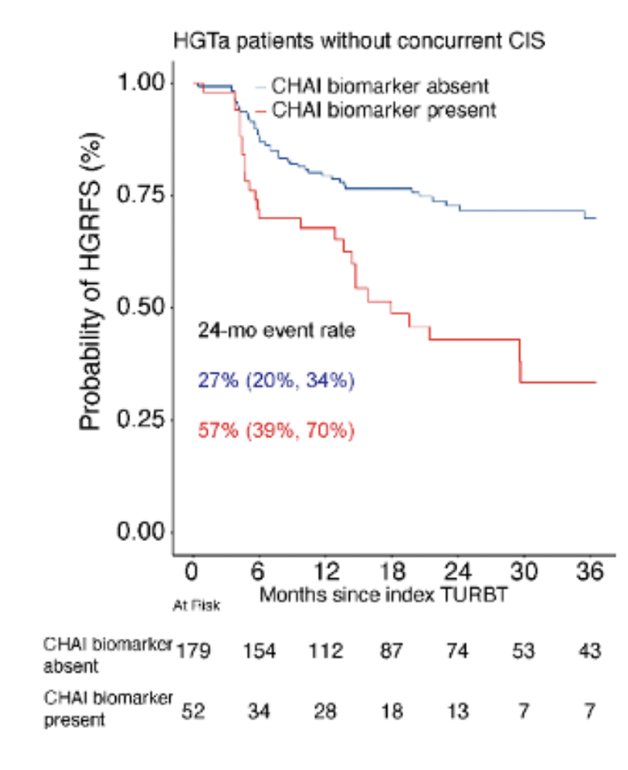
In patients with HG Ta non-muscle invasive bladder cancer without concurrent CIS, CHAI high-risk biomarkers were also significantly associated with high-grade recurrence-free survival (24-month rate: 57% versus 27%; HR 2.55, p < 0.001):
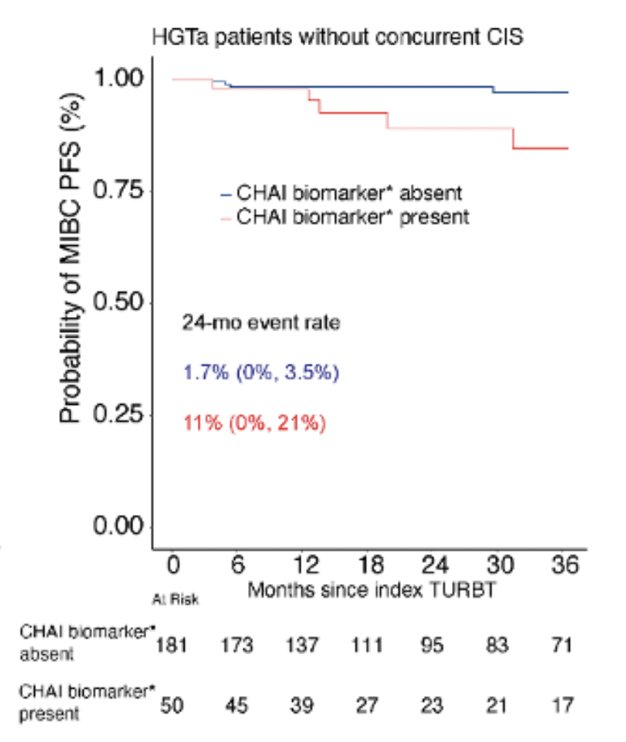
Additionally, in patients with HG Ta non-muscle invasive bladder cancer without concurrent CIS, CHAI high-risk biomarkers were significantly associated with muscle-invasive-progression free survival (24 months rate: 11% versus 1.7%; HR 4.86, p = 0.019):
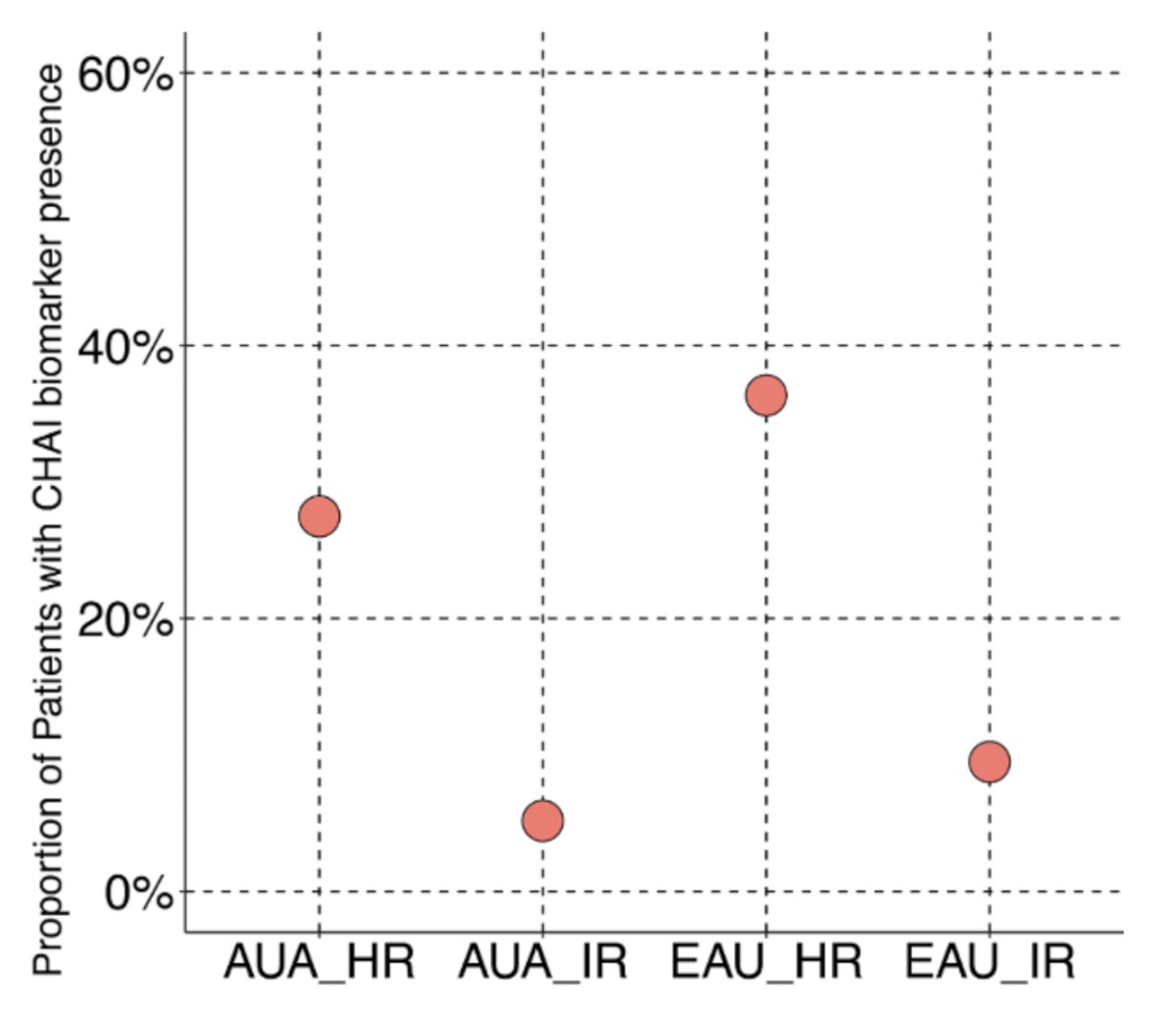
Among patients classified as AUA high risk, AUA intermediate risk, EAU high risk, and EAU intermediate risk, 27%, 5%, 36%, and 9.5%, respectively, were identified as CHAI biomarker present, indicative of increased risk:
Dr. Daneshmand concluded his presentation discussing CHAI analysis of high-grade Ta non-muscle invasive bladder cancer risk stratification for progression and recurrence across subgroups with the following take-home points:
- CHAI biomarker models successfully stratify multiple prognostic risk endpoints in HG Ta non-muscle invasive bladder cancer, both with and without concurrent CIS, and identify the highest risk cases across both high and intermediate risk groups from AUA and EAU guidelines
- Understanding an individual patient’s risks via this clinically available technology may impact clinical management for this traditionally borderline population
Presented by: Siamak Daneshmand, MD, Professor of Urology and Medicine (Clinical Scholar), Director of Urologic Oncology and Clinical Research, Keck School of Medicine, University of Southern California, USC Norris Comprehensive Cancer Center, Los Angeles, CA
Written by: Zachary Klaassen, MD, MSc – Urologic Oncologist, Associate Professor of Urology, Georgia Cancer Center, Wellstar MCG Health, @zklaassen_md on Twitter during the 2025 Western Section American Urological Association (AUA) Annual Meeting, Napa Valley, CA, Sun, Nov 2 – Thurs, Nov 6, 2025.