

(UroToday.com) The 2025 Western Section AUA annual meeting featured a urothelial carcinoma session and a presentation by Dr. Mark Tyson discussing the comparative effectiveness of intravesical gemcitabine versus sequential gemcitabine and docetaxel for high-risk non-muscle invasive bladder cancer.
Gemcitabine and docetaxel are increasingly used for non-muscle invasive bladder cancer, particularly in the setting of BCG shortage and failure. However, the average treatment effect and specific contribution of docetaxel, relative to single-agent gemcitabine, remain undefined. As such, Dr. Tyson and colleagues compared the real-world effectiveness of gemcitabine versus gemcitabine and docetaxel in high-risk non-muscle invasive bladder cancer patients.
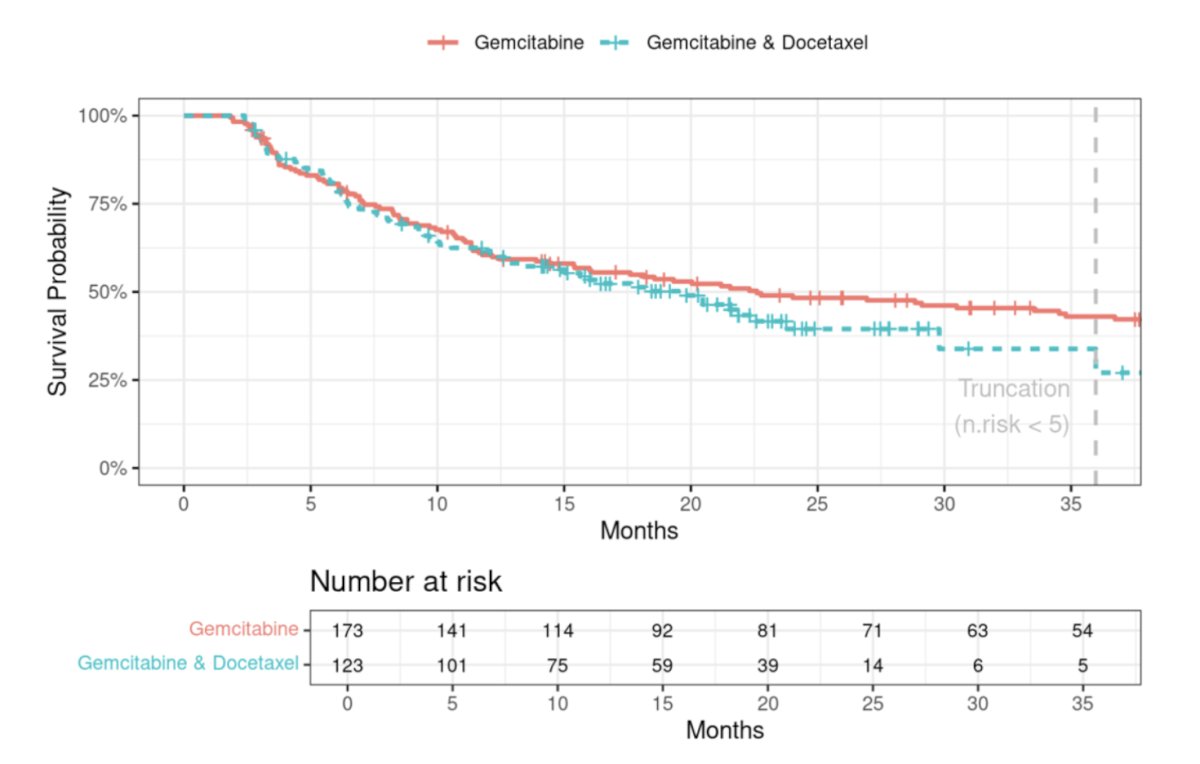
This was a retrospective study of 296 non-muscle invasive bladder cancer patients treated with gemcitabine (n = 173) or gemcitabine and docetaxel (n = 123) across three sites from 2018 to 2023. The primary outcome was high-grade recurrence-free survival, and secondary outcomes included recurrence-free survival, progression-free survival, cystectomy-free survival, cancer-specific survival, overall survival, and adverse events. The investigators performed multivariable Cox regression analyses using a two-stage residual inclusion model to adjust for confounding by indication, and Kaplan-Meier methods were used to estimate survival stratified by BCG cohort and tumor characteristics.
Unadjusted median high-grade recurrence-free survival was comparable between groups: gemcitabine - 22.6 months versus gemcitabine and docetaxel - 19.5 months (p = 0.25):
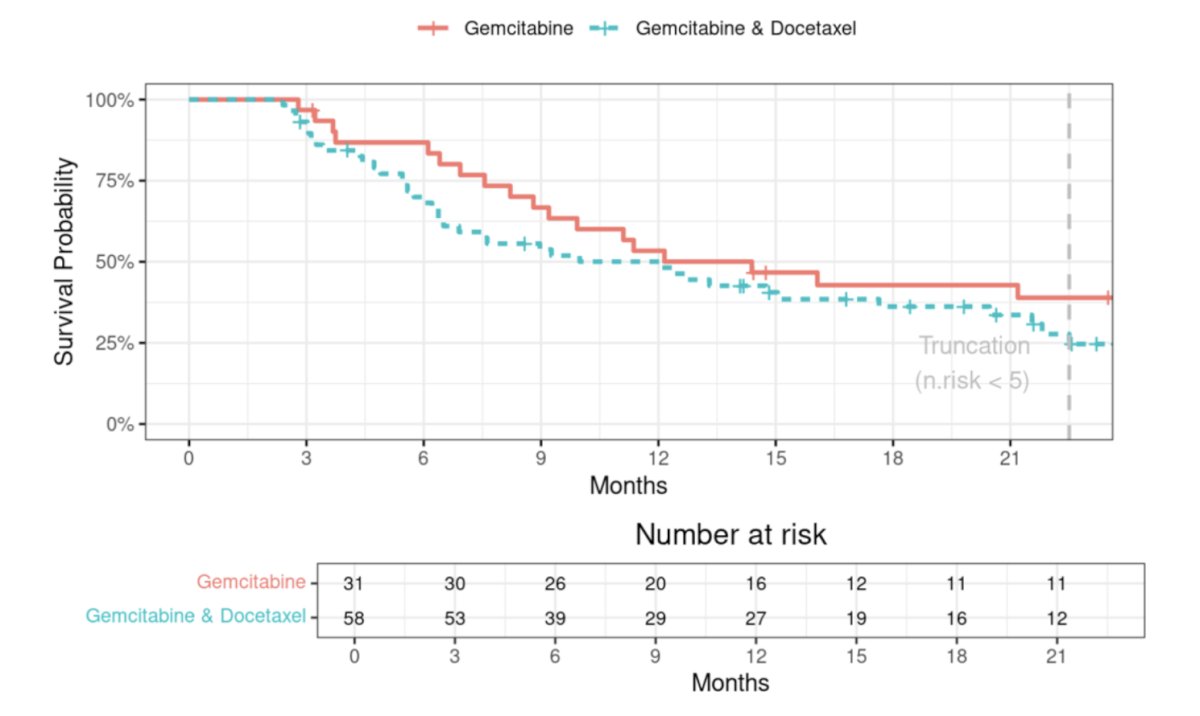
In the subset with BCG-unresponsive CIS (n = 49), the median high-grade recurrence-free survival was similarly comparable: gemcitabine - 12.2 months versus gemcitabine and docetaxel - 7.6 months (p = 0.12). Similar null associations were observed for all secondary outcomes. In a two-stage residual inclusion analysis using year of treatment as the instrumental variable, gemcitabine and docetaxel were not associated with improved high-grade recurrence-free survival (HR 1.09, 95% CI, 0.65-1.82, p = 0.80). Comparable nonsignificant findings were also seen in a sensitivity analysis restricted to patients with BCG-unresponsive disease (n=89; HR 2.24, 95% CI, 0.96-5.24; p = 0.06):
Low-grade adverse events were common: 63% of gemcitabine and 55% of gemcitabine and docetaxel patients reported any adverse event (p = 0.19), while grade ≥3 adverse events were rare (2.3% versus 2.4%, respectively).
Dr. Tyson concluded his presentation discussing comparative effectiveness of intravesical gemcitabine versus sequential gemcitabine and docetaxel for high-risk non-muscle invasive bladder cancer with the following take-home points:
- In this multicenter study, gemcitabine and docetaxel were not associated with improved high-grade recurrence-free survival
- Future prospective trials should clarify the average treatment effect for docetaxel in patients with non-muscle invasive bladder cancer
Presented by: Mark Tyson II, MD, MPH, Urologic Oncologist, Mayo Clinic, Scottsdale, AZ
Written by: Zachary Klaassen, MD, MSc – Urologic Oncologist, Associate Professor of Urology, Georgia Cancer Center, Wellstar MCG Health, @zklaassen_md on Twitter during the 2025 Western Section American Urological Association (AUA) Annual Meeting, Napa Valley, CA, Sun, Nov 2 – Thurs, Nov 6, 2025.