

(UroToday.com) Plenary Session 6 (Stones 2) on the fourth day of WCET 2025 concluded with a panel session moderated by Dr. Marcelo D. Baptistussi (Clinica Plenavita, Brazil). The session, titled “Single Use versus Reusable URS: A Global Perspective,” outlined the current landscape of flexible ureteroscopy (URS).
Dr. Baptistussi highlighted the global expansion of flexible ureteroscope use, which has facilitated minimally invasive urologic procedures worldwide. Single-use models, he noted, reduce the risk of cross-infection and eliminate the need for post-procedure sterilization, thereby enhancing safety. Reusable ureteroscopes, by contrast, remain attractive for their lower per-case cost but require rigorous maintenance and strict quality control. Finally, Dr. Baptistussi cautioned that the increasing reliance on single-use devices raises important environmental concerns, as their disposal may present significant challenges in the future. With that groundwork laid, he introduced three key speakers who delivered comprehensive lectures on the subject.
The Role of Reusable Ureteroscopes in Retrograde Intrarenal Surgery (RIRS)
The first speaker, Dr. Bogdan Geavlete (Saint John Emergency Clinical Hospital, Bucharest), drew on more than 30 years of experience and over 1,500 ureteroscopies annually at his high-volume academic center. His department has used both reusable and single-use flexible ureteroscopes extensively, with more than 2,000 single-use procedures to date.
He underscored the importance of directly comparing reusable and single-use instruments, citing a 2023 study that positioned digital reusables as reliable tools for routine diagnosis and treatment of upper urinary tract pathology. Yet sterility remains a critical challenge. Even with meticulous manual cleaning and hydrogen peroxide sterilization, contamination from bacteria, proteins, hemoglobin, or adenosine triphosphate has been documented in reusable scopes. Durability was another focal point: earlier generations often failed after just 10–20 procedures, but his team reported improved longevity with newer models such as the Flex XC Storz, which endured up to 160 procedures, and in one case exceeded 500 without repair. Despite these advances, many scopes in his center ultimately sustained significant damage, including perforation of the working channel, sheath wear, optical fiber breakage, and deformation after repeated sterilization.
Dr. Geavlete highlighted the remarkable expansion of disposable devices, from 25 models in 2023 to more than 60 in 2025 (Figure 1). Yet the central question persists: should single-use replace reusables? Published studies consistently show that stone-free rates, operative times, and complication rates are broadly equivalent between the two categories. Economic analyses have reached similar conclusions: in high-volume centers, the per-case costs of reusables and disposables largely overlap, while in lower-volume settings, the balance may shift. A recent study likewise reported no statistically significant differences in clinical outcomes, including stone-free rate, median operative time, and Clavien-Dindo ≥2 complications, between single-use and reusable devices. Another review emphasized that cost patterns vary across countries, reinforcing the importance of local context. Together, these findings support a hybrid strategy: reserving single-use scopes for complex or high-risk cases where scope damage is more likely, while relying on reusables for routine practice. Single-use instruments may provide superior deflection, particularly for accessing the lower pole, and some data suggest lower postoperative infection rates, whereas reusables offer increasing durability, with some scopes now lasting hundreds of procedures without repair.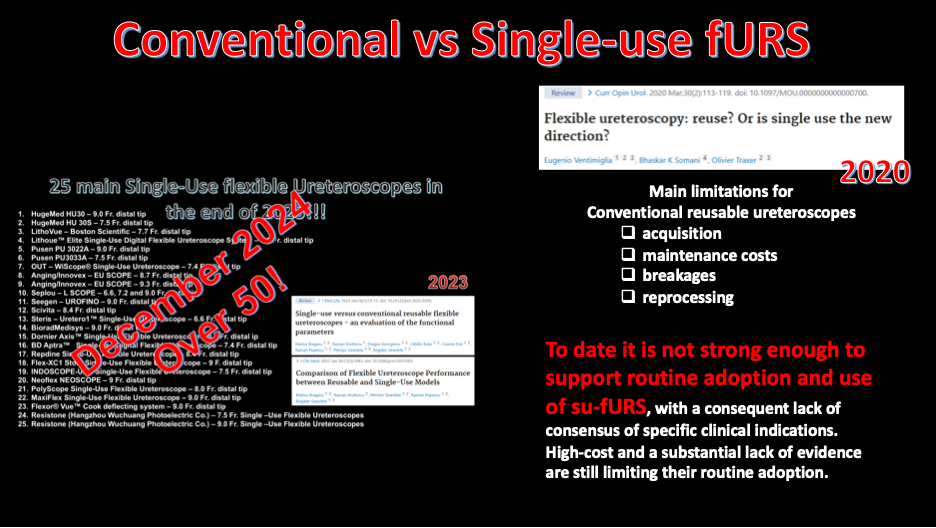
Figure 1.
Dr. Geavlete also emphasized the unique role of advanced imaging technologies such as Narrow Band Imaging (NBI) and SPIES (Storz Professional Image Enhancement System), which his team has used for over a decade to improve the diagnosis and treatment of upper urinary tract tumors. He argued that these imaging capabilities, available in very few single-use models, remain a decisive advantage for reusables.
To conclude, Dr. Geavlete compared the two scopes head-to-head (Figure 2). Ultimately, he reaffirmed that in high-volume centers, the most practical solution is a hybrid strategy, with reusable ureteroscopes forming the backbone of daily practice and single-use instruments reserved for particularly challenging or high-risk cases. He stressed the need for specialized training, especially for nursing staff, to maintain reusable devices and reduce costly damage, and noted that in routine practice at least four ureteroscopes (two reusable and two disposable) should be available to ensure procedural continuity. For upper tract tumors, advanced imaging modalities such as NBI and SPIES are indispensable, providing diagnostic accuracy that remains limited in most single-use models.

Figure 2.
He closed with a cautionary note: although disposable devices offer cleaner workflows, they are not yet recyclable, raising long-term environmental concerns. His final slides emphasized this duality: the efficiency and safety benefits of single-use scopes contrasted with the mounting waste they generate. Ultimately, he argued, the challenge for the field will be to balance innovation and safety with sustainability, ensuring that advances in flexible ureteroscopy do not come at the cost of future environmental burden.
Disposable Flexible Ureteroscope: Is It the Gold Standard?
Dr. Steffi Yuen (Chinese University of Hong Kong) was the second speaker of the panel, posing the provocative question of whether disposable flexible ureteroscopes should now be considered the gold standard. She reviewed the rapid technological improvements in scope design, including ergonomic handpieces, transparent distal tips, improved torque mechanisms, and integrated intrarenal pressure sensors.
Scope selection, she emphasized, must balance numerous factors: device size and durability, vision quality, maneuverability, sheath use, intrarenal pressure and temperature, as well as stone characteristics such as load, volume, location, and hardness. In practice, surgeons must also weigh sterilization demands, manpower, repair costs, and environmental considerations (Figure 3).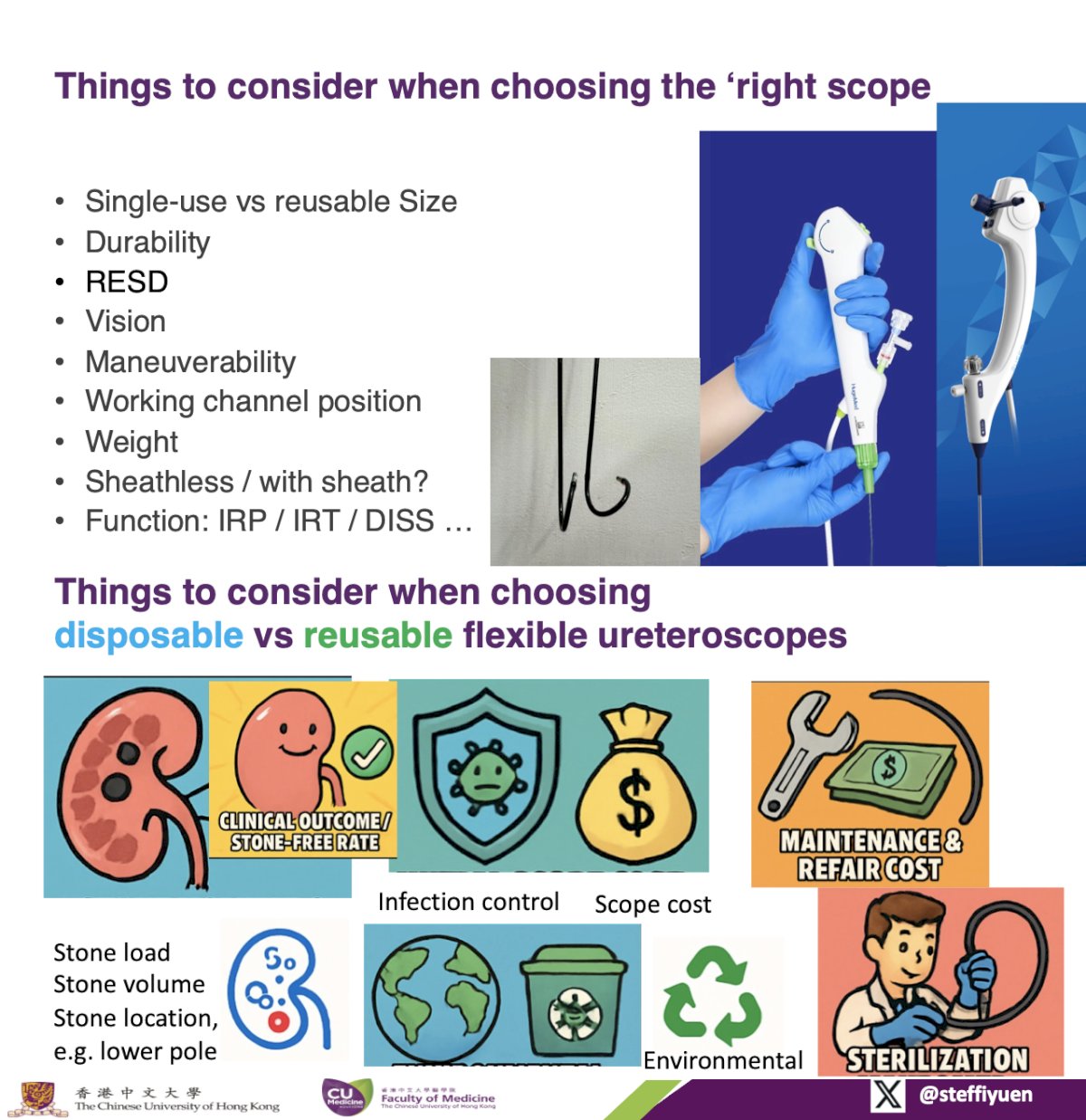
Figure 3.
Data from the pre-Flexible and Navigable Suction sheaths (pre-FANS) era showed that disposable scopes were often reserved for more complex cases, such as stones larger than 2 cm or those located in the lower pole. With the advent of suction ureteral access sheaths (FANS) in 2022, outcomes shifted markedly. Global collaborative studies and multicenter randomized controlled trials demonstrated higher single-stage stone-free rates, fewer reinterventions, and minimal postoperative fever or sepsis. One multicenter RCT showed not only superior stone-free rates but also better quality-of-life scores and reduced use of stone baskets with suction-enabled sheaths (Figure 4).

Figure 4.
A large propensity-matched analysis further underscored that FANS is a safe and effective technique irrespective of scope type, with disposable scopes paired with 10/12Fr sheaths achieving the highest likelihood of complete clearance, in some series approaching 100% (Figure 5).
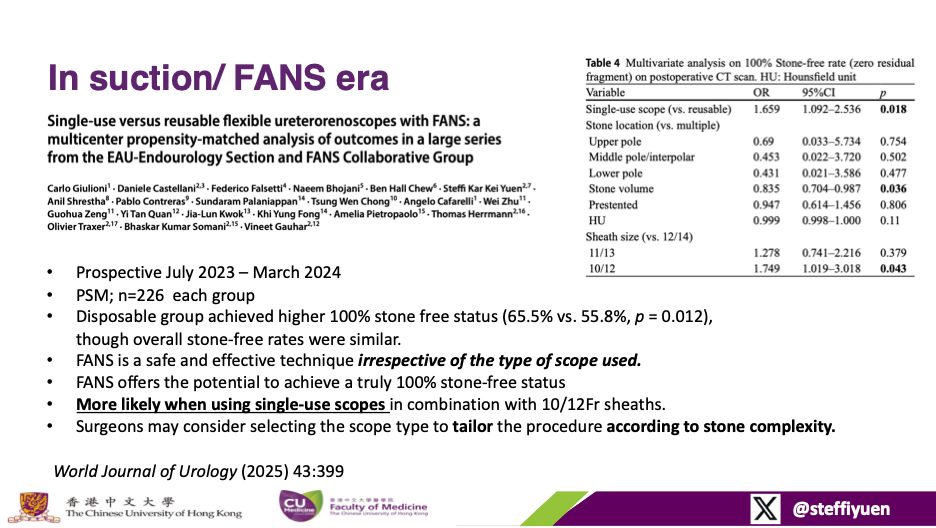
Figure 5.
Dr. Yuen also cautioned that scope performance within FANS systems is not uniform but varies with sheath size and brand. Deflection strength can be significantly reduced once the scope is inserted, with notable differences across 10, 11, and 12 Fr sheaths (Figure 6). Smaller-caliber disposable scopes tend to preserve maneuverability, whereas larger or mismatched pairings risk compromised access, particularly problematic for lower-pole stones, where maximal deflection is required.

Figure 6.
She then turned to real-world data, highlighting that while FANS delivers reliable outcomes regardless of scope type, clinical practice often involves reusing disposables. In a multicenter series of more than 2,000 patients, 88% of reused disposable scopes were limited to two uses or fewer, while 12% were used three to five times. Scope malfunction prompted intraoperative exchange in 3.9% of cases, most often due to impaired deflection or image quality. Importantly, while stone-free rates remained good overall, residual fragments were more frequent with reused devices, particularly in cases involving lower-pole stones, positive urine cultures, or prolonged operative times (Figure 7).
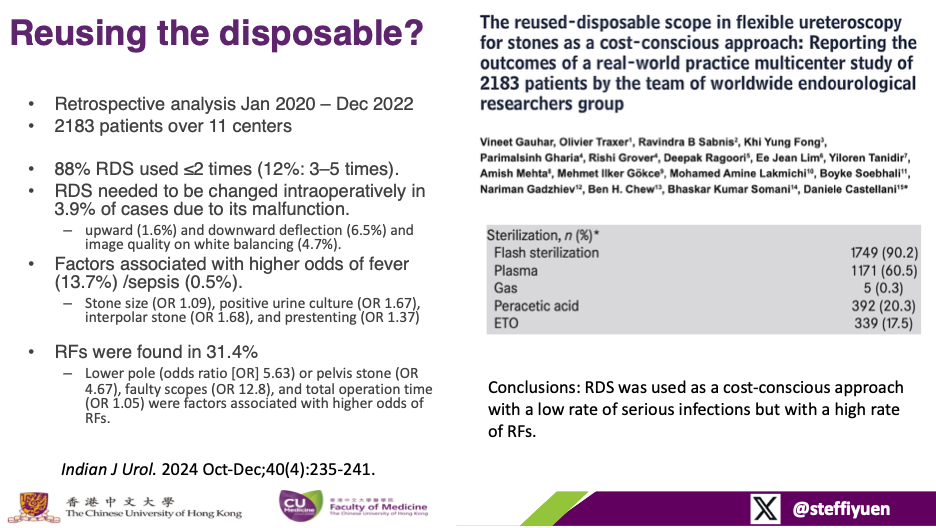
Figure 7.
Dr. Yuen concluded with results from an international survey of nearly 700 endourologists: more than half now use disposable scopes exclusively, 20% rely solely on reusables, and the remainder employ a hybrid strategy (Figure 8).
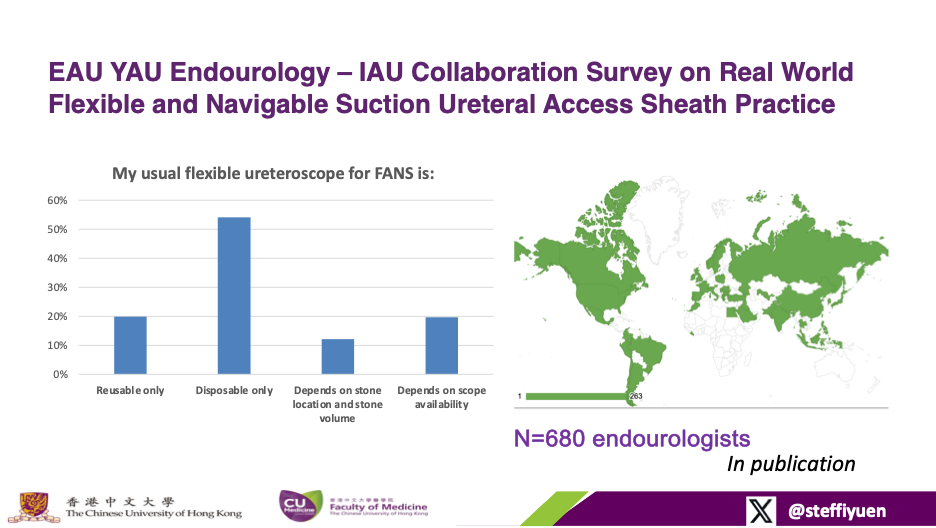
Figure 8.
Dr. Yuen’s take-home message was that disposable flexible ureteroscopes are rapidly gaining global popularity, but the true “gold standard” remains context-dependent. The choice between disposable and reusable scopes should be tailored to each case, taking into account patient and stone characteristics, local availability and cost structures, and the evolving role of adjunct technologies such as suction-enabled access sheaths, pressure monitoring, and advanced lasers. In this framework, disposables may be particularly advantageous in complex or infection-prone cases, while reusables retain value in routine practice, especially within high-volume centers.
Environmental Impact of Single-Use and Reusable Endoscopes
The final presenter, Dr. Kevin Koo (Mayo Clinic), shifted the discussion to a broader lens: environmental sustainability. While clinical performance and cost remain essential considerations, he argued that in 2025 environmental impact must also weigh into scope selection. Emissions from raw material extraction and global supply chains, the growing challenge of electronic waste, occupational exposure of staff to chemicals used in reprocessing, and regulatory pressures for greener healthcare all contribute to the overall picture. Healthcare as a whole accounts for an estimated 5–10% of global carbon emissions, with operating rooms among the largest generators of waste and energy consumption. Endoscopy, he emphasized, substantially adds to this footprint across each of these domains.
Single-use devices, composed of plastics, electronics, and metals, carry a fixed and relatively high carbon cost per procedure due to manufacturing, transport, packaging, and disposal, typically through incineration or landfill. Reusable scopes distribute their initial manufacturing footprint across many cases, but require resource-intensive reprocessing, including large volumes of water, detergents, sterilizing agents, electricity, and staff time (Figure 9). They also necessitate frequent repairs, each with financial and environmental costs.

Figure 9.
Dr. Koo noted findings showing an average repair rate of one per 15 ureteroscopies (6.5%). Across a lifespan spanning hundreds or even thousands of procedures, a flexible ureteroscope may undergo numerous repair cycles, each compounding both financial and environmental costs (Figure 10).
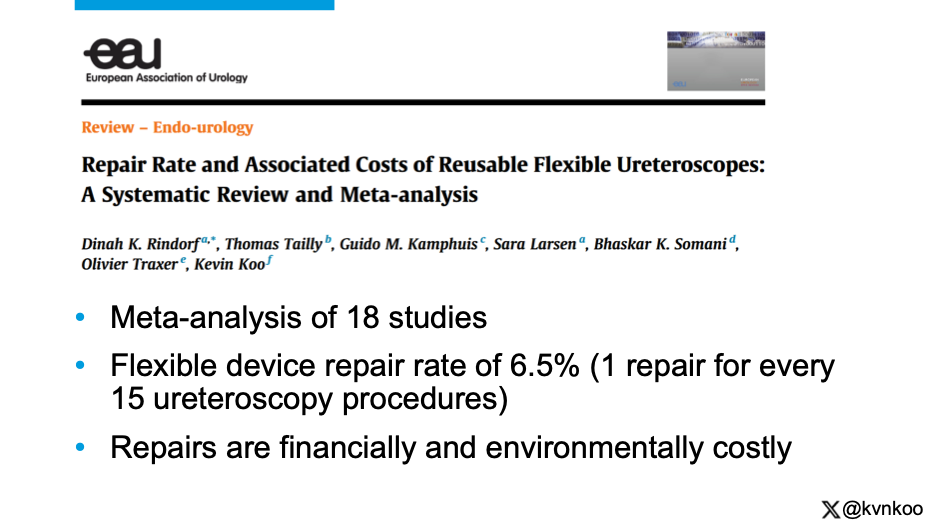
Figure 10.
Life cycle assessment (LCA) is the gold standard for quantifying environmental impact, measuring carbon emissions, water and energy use, and solid waste across a device’s lifespan. Results in urology are mixed: some analyses show marginal overall differences between single-use and reusable scopes, while others highlight trade-offs such as greater solid waste for disposables and higher water and energy consumption for reusables (Figure 11). The balance is strongly shaped by case volume and reprocessing efficiency. High-volume centers can spread the footprint of reusables across many procedures, while lower-volume centers may face higher per-case burdens. In general, disposables tend to generate less carbon but more solid waste, whereas reusables conserve materials yet consume more water and energy with repeated sterilization. Thus, the environmental and financial implications of scope selection are inherently context-dependent, varying by institution, resources, and clinical priorities.
 Figure 11.
Dr. Koo outlined practical models: high-volume centers with robust reprocessing may favor reusables for routine use; lower-volume or resource-limited settings may lean toward disposables; and hybrid strategies can balance the two (Figure 12).
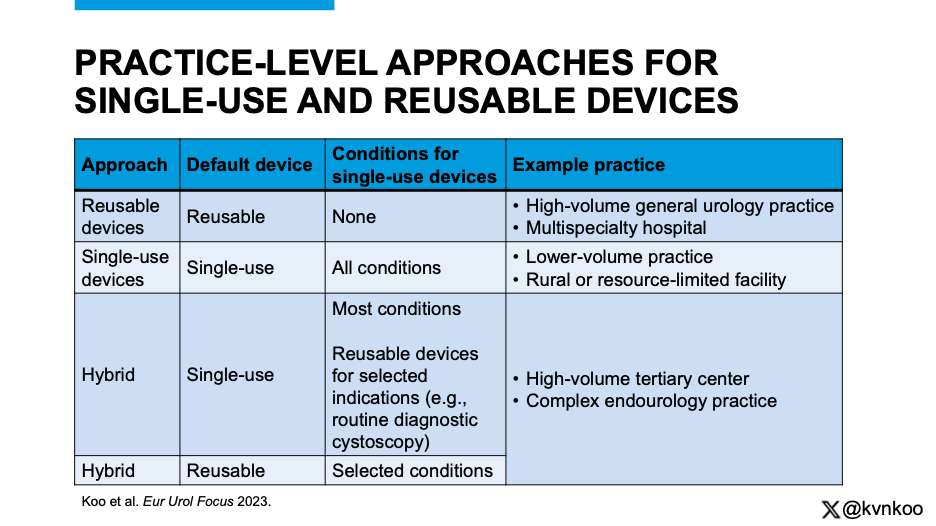
Figure 12.
In his own practice (Figure 13), reusables remain the default, but a hybrid approach is employed in situations where conditions are likely to accelerate scope damage and shorten device lifespan. For ureteroscopy, single-use scopes are favored in cases involving large stone burdens greater than 15 mm, lower-pole stones requiring extreme deflection, multifocal upper tract tumors, prolonged or bilateral procedures, and anatomically complex kidneys where torque and strain place added stress on the instrument. For cystoscopy, disposables may be selected in patients with challenging anatomy, in immunocompromised individuals at elevated infection risk, or in emergency and bedside settings where rapid availability and guaranteed sterility are critical.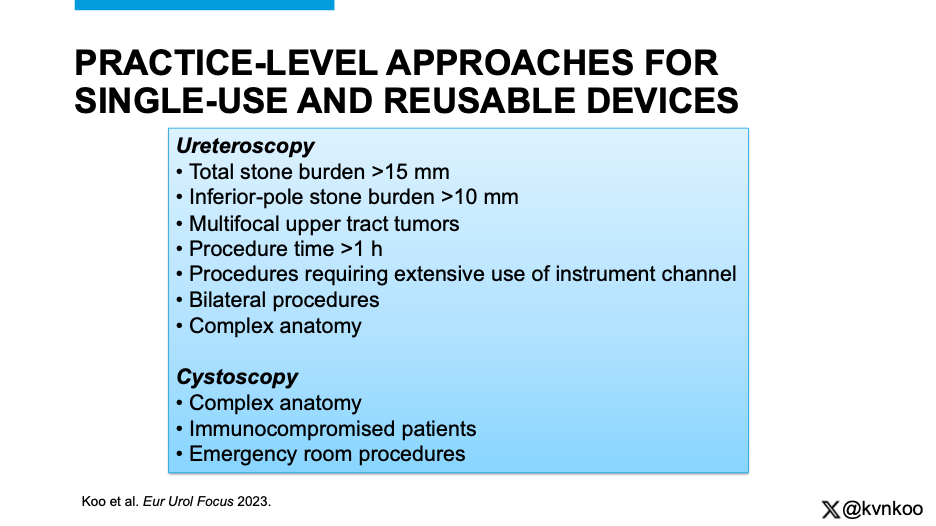
Figure 13.
Dr. Koo concluded by reminding the audience that both single-use and reusable endoscopes carry environmental costs, albeit at different points in their life cycles. True sustainability, he argued, depends on three integrated factors: device longevity, efficient and less resource-intensive reprocessing infrastructure, and waste systems capable of handling medical equipment responsibly (Figure 14). Moving forward, innovation must focus not only on clinical performance but also on eco-design and circular economy principles. That includes extending the lifespan of devices through repair and refurbishment, lowering water and energy demands in reprocessing, adopting greener materials and packaging, and building industry–hospital partnerships for recycling. Ultimately, sustainability will only be achieved when environmental considerations are weighed alongside cost and clinical effectiveness in device selection.

Figure 14.
Plenary Session 6 closed on a comprehensive global perspective on the debate between single-use and reusable ureteroscopes. Dr. Geavlete underscored the durability and advanced imaging capabilities of reusables, advocating a hybrid approach. Dr. Yuen highlighted the rapid rise of disposables and the transformative impact of suction technology, noting that the “gold standard” depends on context. Dr. Koo broadened the conversation to include environmental sustainability, demonstrating that hybrid models may also be the most responsible ecological path forward.
Together, their perspectives reflected the complexity of modern device selection: balancing clinical performance, cost, infection control, and environmental responsibility. As Dr. Baptistussi summarized in moderating the session, the global endourology community must continue to innovate and to adapt, as technology, economics, and sustainability intersect in the operating room. The future of ureteroscopy and urology as a whole will depend not on choosing sides, but on striking the right balance between innovation and practicality, efficiency and safety, and above all, progress and responsibility.
Presented by:
- Prof. Bogdan Geavlete, MD, PhD; Saint John Emergency Clinical Hospital, Bucharest
- Steffie Yuen MD; Department of Surgery, The Chinese University of Hong Kong; @steffiyuen
- Kevin Koo MD, MPH, MPhil; Department of Urology, Mayo Clinic; @kvnkoo
Moderated by: Marcelo Baptistussi, MD; Clinica Plenavita, Brazil; @MBaptistussi
Plenary Chair: Dr. Madhu Agrawal, Dr. Brian Matlaga, Dr. Hassan Razvi
Written by: Seyed Amiryaghoub M. Lavasani, BA, University of California, Irvine, @amirlavasani_ on Twitter during the 2025 World Congress of Endourology and Uro-Technology (WCET) Annual Meeting, September 08-12, 2025, Phoenix, Arizona USA