

(UroToday.com) On the third day of the World Congress of Endourology and Uro-Technology, Dr. Heiko Yang (University of Colorado) delivered an inspiring presentation during the State-of-the-Art plenary session titled “Kidney in a Bag: The Next Frontier for Urologic Innovation and Discovery.” He opened with a video of a pig urinating, his “favorite video of 2025,” which he explained was living proof of the concept at the heart of his talk: a kidney that had been excised, perfused ex vivo, transplanted back, and restored to function.
Dr. Yang continued by defining the foundation of his work: normothermic ex vivo kidney perfusion (NEVKP). NEVKP is a technology designed to keep kidneys alive outside the body by supplying oxygen and nutrients while removing waste. By sustaining kidney function outside the body, NEVKP offers a versatile experimental platform that not only enables prolonged preservation for transplantation but also provides a living system in which novel therapies, disease mechanisms, and physiologic processes can be rigorously studied. Though long applied in transplantation for other organs, current commercial perfusion devices are expensive, difficult to access for research, and not optimized for kidneys (Figure 1). Yang and colleagues recognized that to push the boundaries of kidney research and therapy, they needed to design their own system.

Figure 1.
The origins of “Kidney in a Bag” began as a lighthearted conversation with Dr. Marshall Stoller: “Wouldn’t it be cool if we could keep a kidney from a stone former alive long enough to watch a kidney stone form?” That thought experiment quickly evolved into a concrete project. The first designs were rudimentary, “barely better than a drawing on a napkin”, but they laid the groundwork for what followed (Figure 2).

Figure 2.
The schematics were brought to Dr. Alan Flake, a titan in pediatric surgery credited with the creation of the artificial womb. With Dr. Flakes guidance, the team’s designs became tangible, leading to their first experiment. Using a sheep kidney, they achieved four hours of ex vivo perfusion with production of half a liter of urine, an encouraging starting point (Figure 3)!
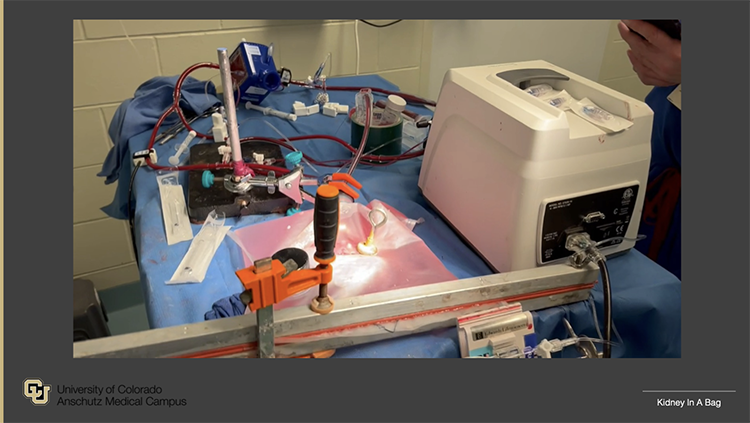
Figure 3.
After several iterations, Dr. Yang’s team settled on an optimized prototype that they now use regularly Figure 4). The key innovations of this design include a circuit that stabilized kidneys in a containment bag, recycled perfusate, and incorporated a pinch-valve bypass loop to regulate flow between the kidney and oxygenator

Figure 4.
Dr. Yang emphasized the significant learning curve and experience working on this model. Early perfusions lasted only a few hours, but with experience the team extended viability to 24 hours and beyond (Figure 5).

Figure 5.
Functional assessments during perfusion included urine production, diuretic responsiveness to furosemide (Lasix), and maintenance of potassium homeostasis, all benchmarks of renal physiology (Figure 6). The presentation featured another “favorite video”: the subtle peristalsis of a ureter six hours into perfusion, a visual sign that the system was sustaining kidney function.

Figure 6.
To further this endeavor, the group developed an in vivo validation model. Porcine kidneys were perfused ex vivo for 24 hours and then auto-transplanted back into the animals. The results were striking: the kidneys produced urine, maintained perfusion with favorable Doppler resistive indices, and preserved histologic integrity (Figure 7). To date, the team has performed approximately 70 perfusions, including 19 successful porcine auto-transplantations.
Figure 7.
A central strength of the “Kidney in a Bag” program is its accessibility. The circuit can be built for approximately $1,500, with reagent costs of $200–500 per run. This is significantly cheaper than commercial platforms and allows for scalability. Dr. Yang demonstrated this with a setup capable of running multiple kidneys simultaneously, enabling paired experiments for rigorous comparison of conditions and therapies (Figure 8). The platform has been applied not only in porcine models but also in human kidneys, including polycystic and pediatric specimens, and even in multi-organ configurations such as simultaneous kidney-spleen perfusion.

Figure 8.
Beyond this, Dr. Yang envisions NEVKP as a bridge between discovery and patient care. He referenced a polycystic kidney disease (PKD) patient advocate’s lament that “if I were a mouse, I’d be cured of my PKD by now,” underscoring the translational bottleneck. Many therapies succeed in vitro or in animal models but never advance because there is no human tissue testing platform. NEVKP provides that opportunity. The team has shown that candidate therapeutics can be delivered to human kidneys on the circuit. Furthermore, Dr. Yang suggested that methods traditionally avoided in surgery, such as intrarenal pressure and pyelotubular backflow, may be repurposed as effective delivery routes for gene therapy.
In closing, Dr. Yang highlighted one of the program’s newest directions: replacing red blood cells with an alternative oxygen carrier derived from earthworms. In a recent experiment, a pig kidney perfused for 12 hours with this solution was auto-transplanted, and the animal survived with solitary kidney function seven days later. He noted that normothermic ex vivo kidney perfusion is, at its core, an enabling platform with therapeutic and investigative importance across transplantation, genetic kidney disease, and the basic and translational science of nephrology and urology. Yet the deeper lesson is that true innovation can emerge from unexpected places, even from what began as a joke. With creativity, persistence, and a kind of MacGyver-like ingenuity, transformative innovations in medicine become possible.
Presented by: Heiko Yang, MD, PhD; University of Colorado, @HeikoYangMDPhD on Twitter during the 2025 World Congress of Endourology and Uro-Technology (WCET) Annual Meeting, September 08-12, 2025, Pheonix, Arizona USA
Moderated by: Duane Baldwin, MD; Mantu Gupta, MD
Plenary Chair: Monica Farcas, MD; Kenneth Pace, MD; Bradley Schwartz, DO
Written by: Seyed Amiryaghoub M. Lavasani, B.A., University of California, Irvine, @amirlavasani_ on Twitter during the 2025 South Central American Urological Association (AUA) Annual Meeting, Orlando, FL, Wed, Sept 10 – Sat, Sept 13, 2025.