

(UroToday.com)The 2025 World Congress of Endourology and Uro-Technology opened the doors with an exceptional Basic Science Poster session on stone disease moderated by Drs. Pablo Contreras and Brett Johnson. In the session, there was a compelling poster on the role of genetic testing in stone disease titled "Genetic Testing in Kidney Stone Disease: A Single-Institutional Analysis", presented by Anne C. Roberts, BS, a student from the University of Alabama at Birmingham, part of the research team led by Dr. Kyle Wood.
In this study, the investigators conducted a retrospective review of patients with nephrolithiasis who underwent genetic testing (PreventionGenetics® or Invitae®) via buccal swab between 2019 and 2024. Eligible patients for genetic testing were those with high-risk stone disease characteristics such as early onset stone formers (< 18 years old), chronic kidney disease (CKD), high stone burden or nephrocalcinosis on imaging, and a history of recurrent disease (≥3 episodes). The primary aim of their study was to determine the diagnostic yield of monogenic mutations and their correlation with clinical findings consistent with kidney stone disease.
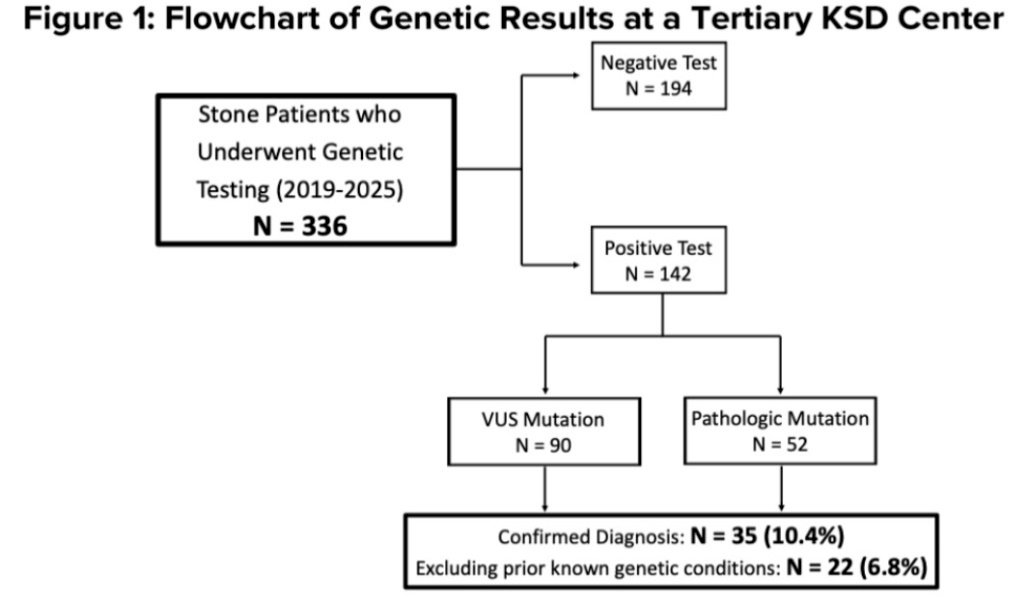
A total of 336 patients were included and grouped by genetic results (142 with mutations vs. 194 with no mutations). Of the 142 patients with positive genetic tests, 90 had variants of unknown significance (VUS), and 52 had at least one pathogenic mutation. A monogenic cause for stone disease was identified in 35 patients, 22 of whom (6.8%) represented new diagnoses, while the remainder had known cystinuria (which was excluded).
Additionally, they conducted a multivariable logistic regression for the adjusted analysis were they identified multiple predictive factors for a positive genetic test, including: Diabetes mellitus (OR 2.72, 95% CI: 1.08-6.82, p=0.03), CKD (OR 2.16, 95% CI: 1.06-4.42, p=0.03), early onset disease (OR 2.22, 95% CI: 1.21-4.06, p=0.01), bilateral stone disease (OR 3.02, 95% CI: 1.36-6.68, p=0.01) and nephrocalcinosis (OR 2.75, 95% CI: 1.28-5.9, p=0.01).
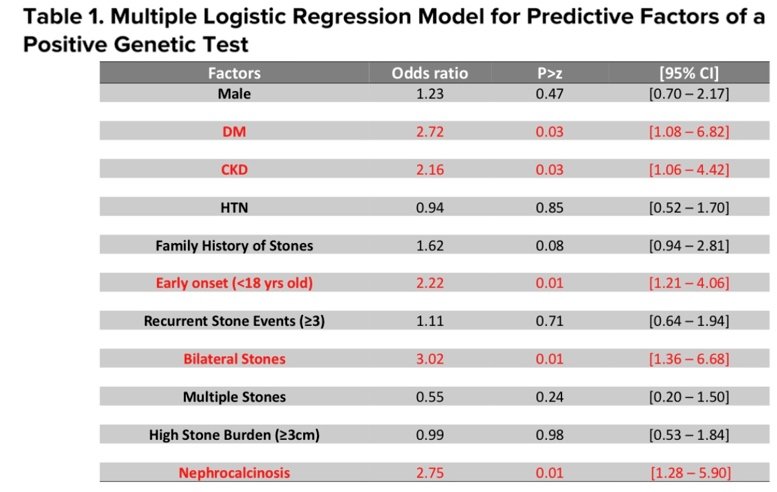
With these results, they concluded that genetic testing in high-risk stone formers offers a meaningful diagnostic yield, particularly for rare genetic conditions. Patients with diabetes mellitus, CKD, early-onset, or bilateral stone disease may be strong candidates for testing. The authors emphasized the value of incorporating genetic counseling and multidisciplinary care in these cases.
The presentation generated thoughtful discussion. Dr. James Lingerman, from Indiana University, raised two important questions:
- Why might diabetes be associated with positive genetic findings?
Ms. Roberts and Dr. Kyle Wood acknowledged the established link between diabetes and stone formation but highlighted that whether underlying genetic abnormalities contribute requires further study.
- Which genetic abnormalities were identified?
The most common were mutations in SLC3A1 and SLC7A9 (cystinuria-related), AGXT, and UTP70, among others.
Dr. Brett Johnson, from the University of Texas Southwestern, then asked whether genetic testing should be offered to all high-risk patients, considering potential cost-benefit limitations. The authors responded that while not universally necessary, testing could meaningfully impact management by guiding genetic counseling and multidisciplinary interventions that might otherwise be overlooked.
This poster raises an interest in the role of genetic testing in the realm of stone disease, offering a new perspective on diagnosis, prevention, and treatment of patients with nephrolithiasis. While promising, these findings stem from a single-institution analysis. Nevertheless, I believe that attention should be paid to this.
Presented by: Anne C. Roberts, BS, University of Alabama at Birmingham. Co-Authors: John Norton, MD, MPH; Feres Camargo Maluf, MD; Hannah Jarvis, MD; Joseph Crivelli, MD; Sonia Fargue, MD; Dean Assimos, MD; Kyle Wood, MD.
Written by: Jonathan Badin-Castro, MD. Endourology and Minimally Invasive Surgery Fellow, University of California, Irvine. @JonBadin on Twitter during the 2025 World Congress of Endourology and Uro-Technology: September 8 – 12, 2025. Phoenix, Arizona.
References:- Roberts CA, Norton J, et al. Analysis of Genetic Testing in Kidney Stone Disease: A Single-Institutional Analysis. University of Alabama at Birmingham. Presented at WCET2025.