

(UroToday.com) The 2022 WCET annual meeting included a kidney imaging and thermal ablation session featuring work from Allen Rojhani and colleagues presenting results of a study assessing newer ways to calculate kidney stone volumes. Obtaining reliable and accurate measurements of kidney stone volumes is important for urologists to develop an effective treatment plan for treating nephrolithiasis. Larger sized stones are often managed in a more invasive way, including lithotripsy or PCNL procedures, rather than smaller stones which are often passed spontaneously. Currently, the stone volume determination method of choice is using the European Association of Urology (EAU) ellipsoid formula. With this formula, the volume of a stone is calculated by obtaining the length, depth, and width of a stone using CT imaging. This study aimed to test the validity of the EAU formula and to investigate whether a newer method for calculating stone volumes via a novel 3-D rendering software would be more reliable.
This experiment utilized declassified human kidney stones to compare the accuracy of ellipsoid formula volumes versus CT-based 3D volumes using gas pycnometry as a ground truth stone volume determination reference. Gas pycnometry is a well-documented scientific method that can precisely calculate the volume and density of solids in the laboratory. After air-drying and weighing 25 calcium-oxalate kidney stones, the researchers used a gas pycnometer to obtain the true stone volume of each stone. Next, imaging of the stones was obtained using a CT machine and their volume was calculated using the longest depth, width, and length which was inputted into the EAU ellipsoid formula. The CT images were then used to obtain a 3-dimensional rendition of the stones using a novel software, 3D SlicerTM, and volumes were rendered from the 3D images. In order to understand the agreeance of stone volume measurements among the three methods, scatter plots and coefficients of determination were obtained.
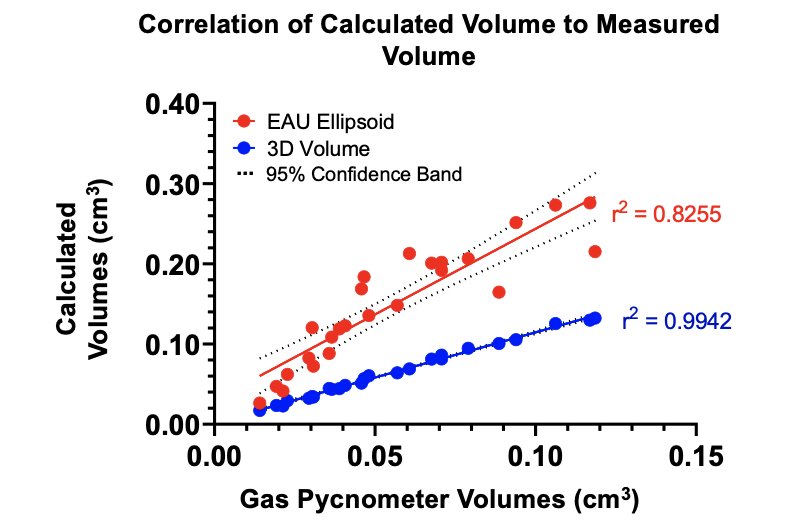
When comparing independent stone volume measurement of the 25 stones, the 3D volume method overestimated true stone volume (i.e., volume obtained via gas pycnometry) by 17%, while the EAU ellipsoid formula method overestimated the true stone volume by 175%:

Scatter plots were created to illustrate the correlation between gas pycnometry and 3D volumes versus gas pycnometry and EAU ellipsoid volumes. The coefficient of determination for gas pycnometry vs 3D volumes was 0.9943, indicating a strong correlation. On the other hand, the coefficient of determination for gas pycnometry vs ellipsoid formula volumes were 0.8255, indicating a poor correlation:
Allen Rojhani concluded his presentation with the following statements:
- CT-based 3D volumes more accurately represent the stone volume compared to the EAU ellipsoid formula.
- Both methods overestimate stone volume. The EAU ellipsoid formula overestimates stone volume by 175% compared to 17% for the CT-based 3D volume.
Presented by: Allen Rojhani, BS - MD, Department of Urology – University of California, Irvine
Written by: Allen Rojhani, BS - MD Candidate at the Drexel University College of Medicine and 2022-2023 LIFT Research Fellow at the University of California, Irvine Department of Urology during the 39th World Congress of Endo urology and Uro-Technology (WCET), Oct 1 - 4, 2022, San Diego, California.