

(UroToday.com) The 2025 Society of Urologic Oncology (SUO) annual meeting, held in Phoenix between December 2 and December 5, 2025, was host to the Poster Session. Dr. Vitaly Margulis presented poster #166: ENLIGHTED Phase 3 study: Efficacy and Safety of Padeliporfin Vascular Targeted Photodynamic Therapy (VTP) for Treatment of Low-grade Upper Tract Urothelial Cancer (LG UTUC).
Upper tract urothelial carcinoma represents 5–10% of all urothelial cancers, with an annual incidence in the USA of ~2 cases per 100,000 people. Up to 60% of patients present with pyelocaliceal tumors and ~40% with ureteral tumors. Key risk factors include smoking, aristolochic acid exposure, and Lynch/Lynch-like syndromes. (1) Management is further challenged by the high prevalence of chronic kidney disease in this population. Tumor ablation is the preferred first-line approach for low-risk favorable disease but may also be considered in low-risk unfavorable or select high-risk favorable cases with low-volume tumors, or in patients who are not candidates for radical nephroureterectomy. Close endoscopic surveillance remains essential, and the need for effective organ-sparing strategies continues to be unmet. (2)
The ENLIGHTED global pivotal phase III trial is a single-arm, open-label study conducted at 22 sites across the USA, France, Spain, Germany, Austria, and Israel. The planned enrollment is 100 patients, with the current analysis including 79 evaluable participants. Padeliporfin VTP is an IV-administered, photosensitizer-based combination therapy paired with a laser light delivery system that emits near-infrared light at 753 nm through an optic fiber to precisely target lesions in the upper tract urothelium.

Dr. Margulis highlighted that upon light activation, padeliporfin triggers a cascade of pathophysiological events that have a strong impact on tumor vasculature, and consists of the following consecutive steps:

The primary efficacy endpoint of ENLIGHTED is the absence of upper tract urothelial tumors in the ipsilateral kidney and ureter during the primary response evaluation (28 ± 3 days after up to three treatments in the padeliporfin VTP induction phase). A complete response is defined by all of the following:
- Absence of a visual tumor on endoscopy
- No evidence of tumor on biopsy, when feasible
- Negative urinary cytology obtained via instrumental collection
Key inclusion criteria:
- New or recurrent low-grade, non-invasive upper tract urothelial carcinoma
- Up to two biopsy-confirmed low-grade tumor lesions
- Lesion size 5–15 mm in the kidney or 5–20 mm in the ureter (endoscopically measured) on the ipsilateral side
- No high-grade cells detected on instrumental cytology
Key exclusion criteria:
- Current high-grade or muscle-invasive (>pT1) urothelial carcinoma of the bladder
- Current or prior CIS in the upper urinary tract
- History of invasive T2 or higher urothelial cancer within the past 2 years
- Photosensitive skin disorders or porphyria
The ENLIGHTED induction and maintenance treatment schema is shown in the figures below.
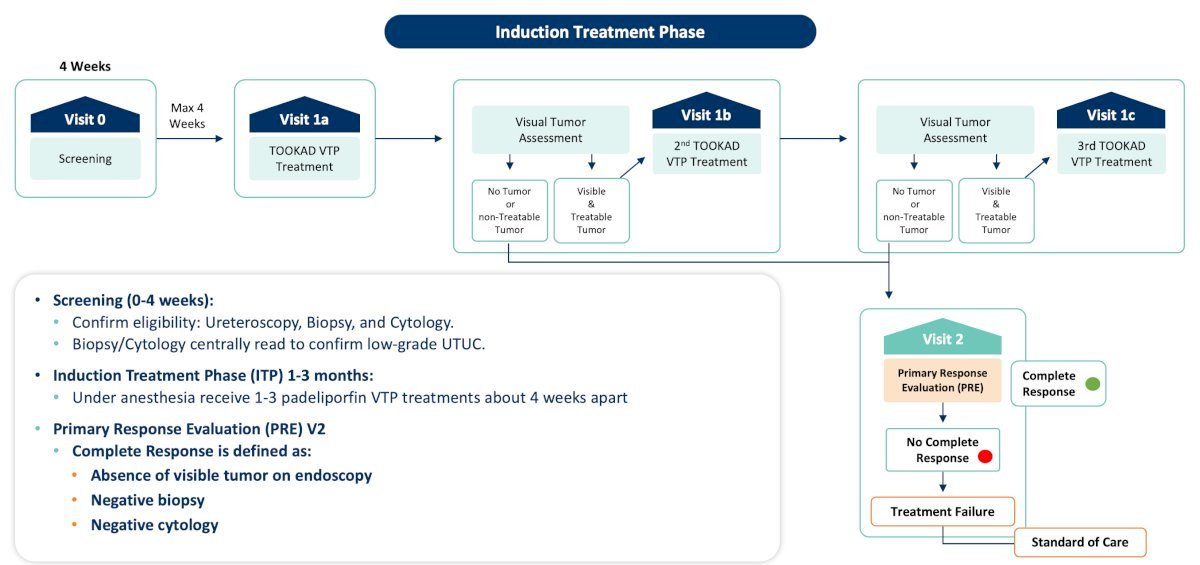
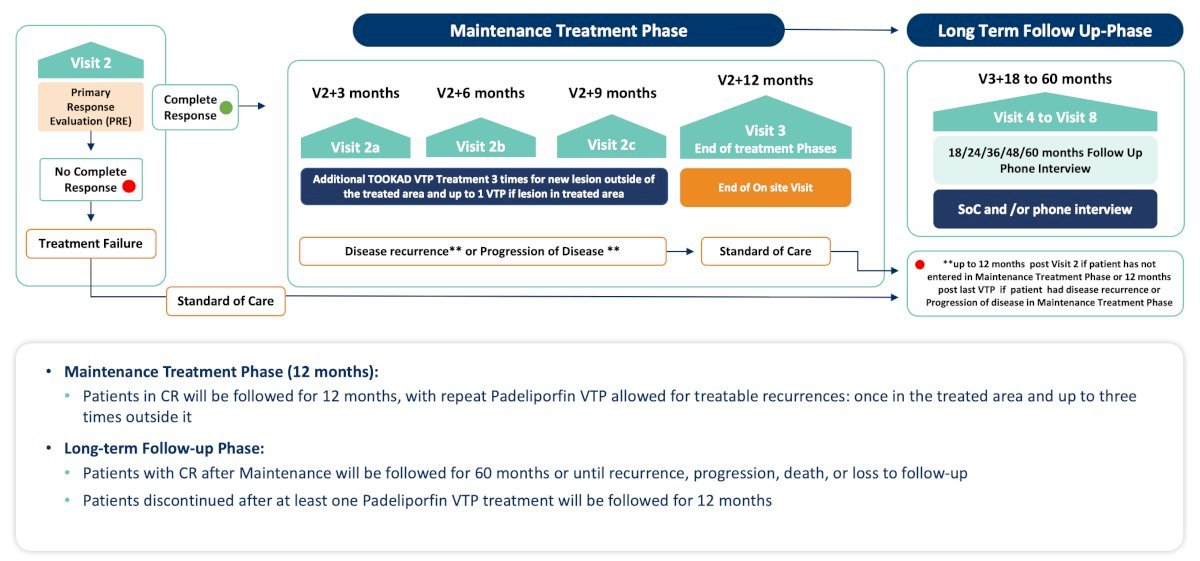
The interim analysis, predefined in the protocol, was performed once 50 patients had completed the induction treatment phase (ITP). As of July 28, 2025, cutoff, the key findings were:
- Complete response: 70%
- Partial response: 18%
- Disease recurrence: 10%
- Disease progression: 2%
Notably, 18% of patients have completed the maintenance treatment phase (MTP), and all maintained a complete response in the treated area for ≥12 months.
From a safety perspective, the most common adverse events were hematuria (11.6%), flank pain (9.7%), nausea (5.8%), procedural pain (4.6%), abdominal pain (4.3%), vomiting (3.9%), dysuria (3.5%), fatigue (3.5%), and UTI (2.3%). All were Grade 1–2 and resolved within a few days. A total of 19 serious adverse events (7.3%) were reported. One patient experienced a Grade 3 SAE (renal colic attributed to VTP), which resolved within 2 days.
Dr. Margulis concluded his presentation discussing interim results of efficacy and safety from the ENLIGHTED phase 3 study with the following take-home points:
- Padeliporfin VTP treatment has demonstrated evidence of efficacy:
- Complete response: 70%
- Partial response: 18%
- Disease recurrence: 10%
- Disease progression: 2%
- Padeliporfin VTP treatment has demonstrated an acceptable safety profile
Presented by: Vitaly Margulis, MD, Urologic Oncologist at UT Southwestern Medical Center, Dallas, TX
Written by: Julian Chavarriaga, MD, Urologic Oncologist at Penn State Health, @chavarriagaj on Twitter during the 2025 Society of Urologic Oncology (SUO) annual meeting held in Phoenix, AZ, between the 2nd and 5th of December 2025.
Reference:
- Nally E, Young M, Chauhan V, Wells C, Szabados B, Powles T, Jackson-Spence F. Upper Tract Urothelial Carcinoma (UTUC): Prevalence, Impact and Management Challenge. Cancer Manag Res. 2024 May 17;16:467-475. doi: 10.2147/CMAR.S445529. PMID: 38774494; PMCID: PMC11107909.
- Rouprêt M, Babjuk M, Burger M, Capoun O, Cohen D, Compérat EM, Cowan NC, Dominguez-Escrig JL, Gontero P, Hugh Mostafid A, Palou J, Peyronnet B, Seisen T, Soukup V, Sylvester RJ, Rhijn BWGV, Zigeuner R, Shariat SF. European Association of Urology Guidelines on Upper Urinary Tract Urothelial Carcinoma: 2020 Update. Eur Urol. 2021 Jan;79(1):62-79. doi: 10.1016/j.eururo.2020.05.042. Epub 2020 Jun 24. PMID: 32593530.