

(UroToday.com) The 2025 SUO annual meeting featured the Joseph A. Smith Mentorship Award Lecture, presented by Dr. Cheryl Lee, who discussed level 5 mentorship and moving from transaction to transformation. Dr. Lee started her presentation by highlighting that the pillars of academia are akin to a stool in that mentorship strengthens with each leg (clinical service, research, education, and administration). However, we rarely think about ways to enhance mentoring nor do we strive for transformation. As part of her presentation, Dr. Lee inserted anecdotes from colleagues she sees as level 5 mentors. The first is Dr. Jay Smith, asking him how he became one of the most important mentors to so many leaders. Dr. Smith’s responses were humble and as follows:
- I never read a book on it
- I never met with a faculty member in 10 years
- At times, I used nonverbal cues
- “I’m not a mentor”
- But most importantly, he pushed people along to realize their potential
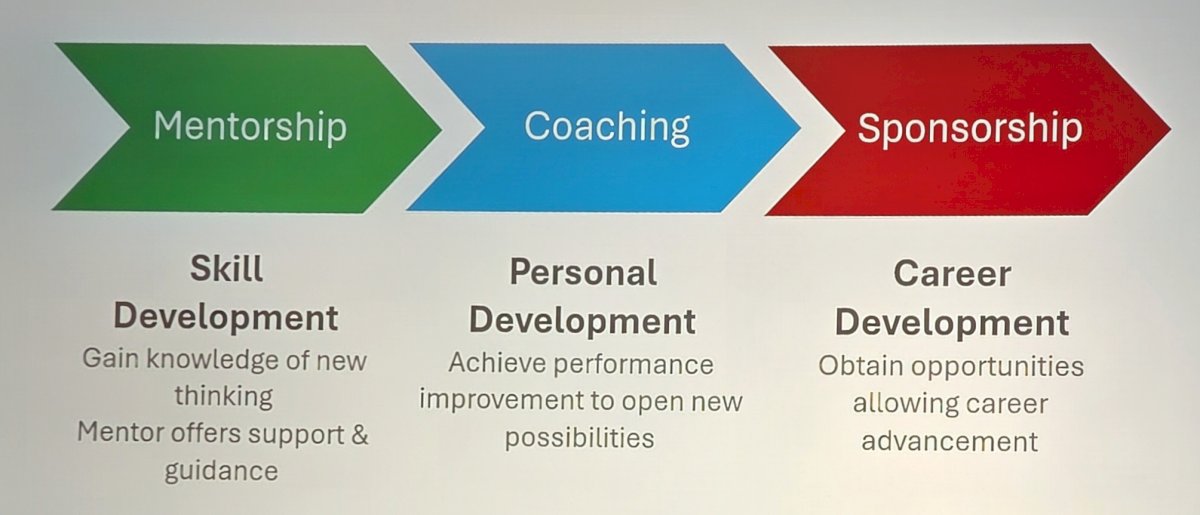
Types of Relationships are important, and include:
- Mentorship: Skill Development – gain knowledge of new thinking, mentor offers support and guidance
- Coaching: Personal Development - achieve performance improvement to open new possibilities
- Sponsorship: Career Development - obtain opportunities allowing career advancement
According to the second level 5 mentor, Dr. Lee spoke with, Dr. Paul Lange, he had no formula for mentorship other than that he cared. He also sought to be moral, seek excellence, lead by example, and be tough on residents so they could reach their full potential. According to a comprehensive review of 19 eligible articles of US and Canada survey data assessing the effects of mentorship on surgery residents' burnout and well-being,1 high quality mentorship was associated with decreased burnout and increased well-being in most studies. However, mentorship may not help with burnout and well-being if residents do not believe mentorship is beneficial. Dr. Lee notes that mentorship should be one intervention in a multipronged approach to wellness.
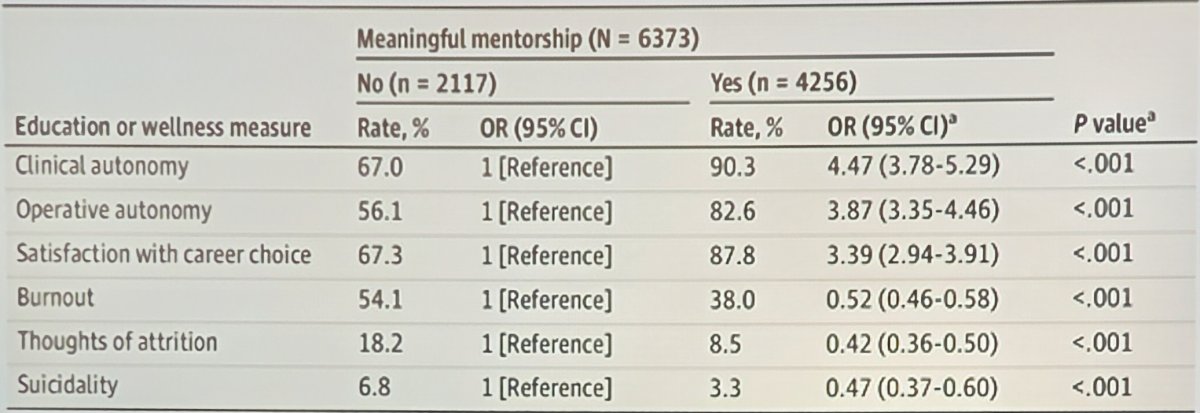
Silver et al.2 performed a survey study of surgery residents after the ABS in-service exam, including 6,956 residents (301 programs), with an 85.6% survey response.2 They found that meaningful mentorship was positively associated with clinical autonomy, operative autonomy, and satisfaction with their career choice. Lack of meaningful mentorship was associated with burnout, thoughts of attrition, and suicidality:
A third survey assessed NIH K Awardees from 2006–2009 (n=1227),3 with a 75% survey response rate. Career satisfaction was correlated with:
- Time spent with mentor
- Mentor’s behavior
- Mentor prestige
- Extent of mentoring in various roles
- Collegiality of the mentoring relationship
Overall, 90% of subjects were satisfied with their research mentorship.
How are we doing in Urology? Dr. Lee noted a 2022 survey of 64 urology residency program directors (response rate 54%).4 Among these programs, 75% approved formal mentorship programs, and 58% had an established program (others largely felt informal programs were sufficient). However, only 5% of programs had official training for faculty, 20% had career development courses for trainees, and 38% did not have specified meeting expectations for mentor-mentees.
According to the third level 5 mentor, Dr. Lee spoke with, Jack McAninch, modeling is critical, and building trust is essential. Mentorship requires a personal component; we must lead by example, and we must work hard to transcend expectations.
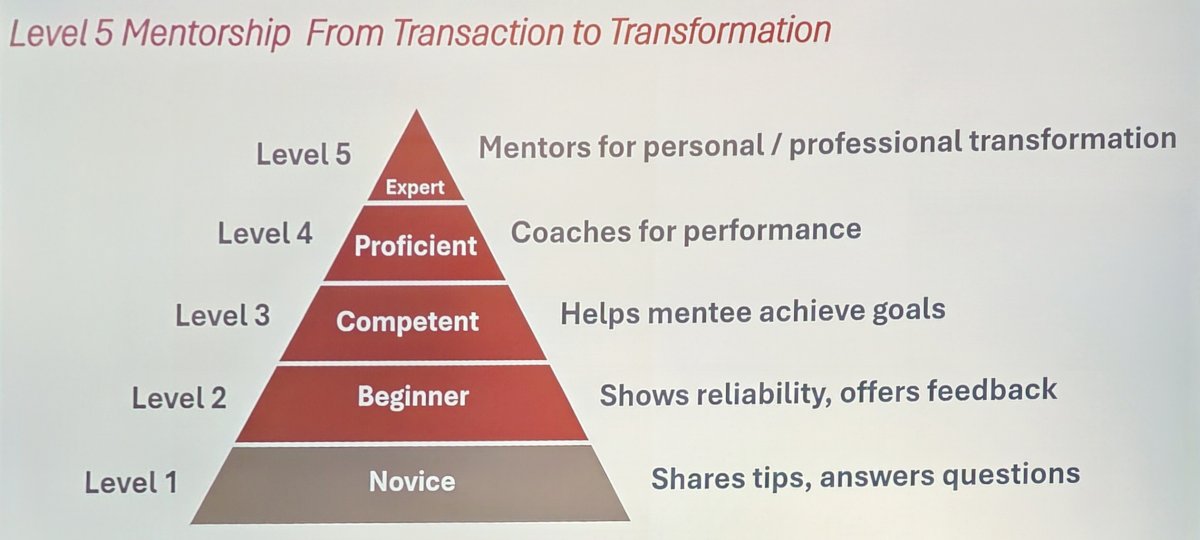
Dr. Lee notes that Level 5 Leadership is a concept introduced in 2001 by Jim Collins in Good to Great. This book notes that leaders who combine extreme personal humility with intense professional will drive their organizations to sustained greatness. The Dreyfus Model is a model of the stages of skills acquisition from novice to expert: Novice → Advanced Beginner → Competent → Proficient → Expert. This is widely applied in: medical education, surgical training, leadership development, and competency-based assessment. The Dreyfus Model provides a framework for mentorship:
Dr. Jim Montie, Dr. Lee’s fourth level 5 mentor, states that we must find the right niche, develop talents, maintain a work-life balance, and help others advance their career, not your own.
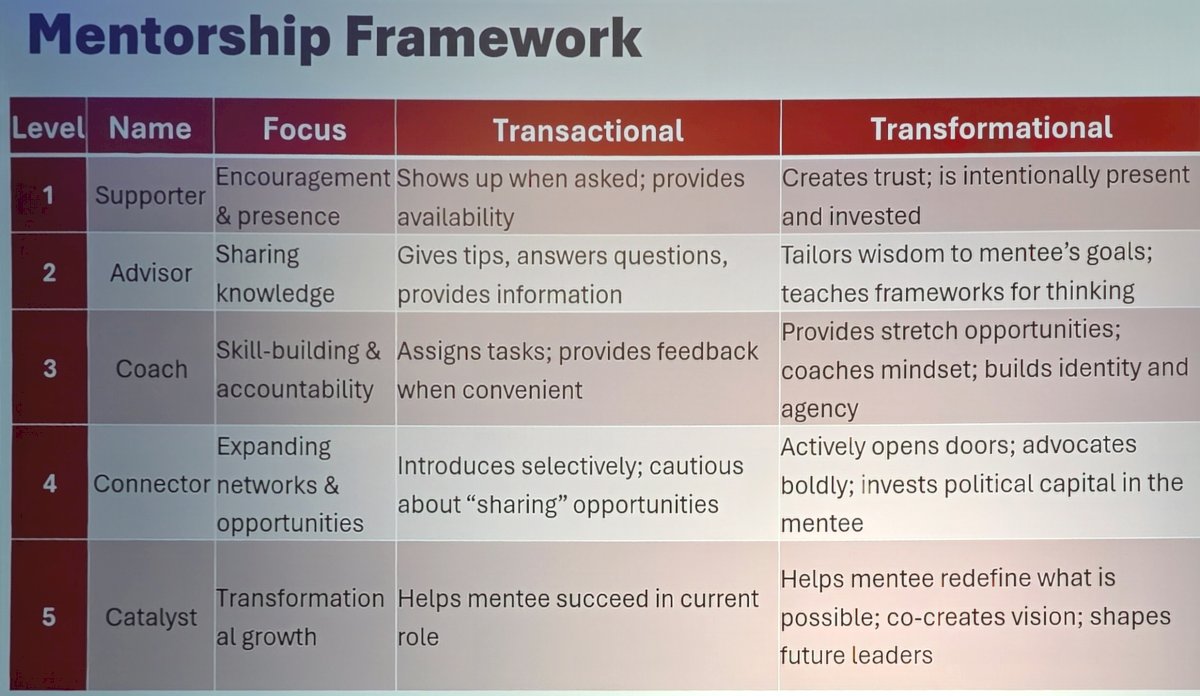
For the remainder of her presentation, Dr. Lee provided both transactional and translational examples of each level of mentorship:
- Level 1: Supporter (Encouragement and Presence) - A Framework for expanding mentorship impact
- Transactional: the mentor shows up when asked and provides availability
- Transformational: the mentor creates trust, is intentionally present, and invested
- Impact: the mentee feels seen and valued
- Level 2: Advisor (Share Knowledge) - A Framework for expanding mentorship impact
- Transactional: the mentor gives tips, answers questions, provides information
- Transformational: the mentor tailors wisdom to mentee’s goals and teaches frameworks for thinking
- Impact: the mentee gains clarity and direction
- Level 3: Coach (Build Skill and Confidence) - A Framework for expanding mentorship impact
- Transactional: the mentor assigns tasks and provides feedback when convenient
- Transformational: the mentor provides stretch opportunities, coaches mindset, and builds identity and agency
- Impact: the mentee develops confidence and competence
- Level 4: Connector (Expand Networks and Opportunities) - A Framework for growing mentorship impact
- Transactional: the mentor introduces mentee selectively, but may be cautious about “sharing” opportunities
- Transformational: the mentor actively opens doors, advocates boldly, and invests political capital in the mentee
- Impact: the mentee accesses new circles and resources
- Level 5: Catalyst (Transformational Growth) - A Framework for expanding mentorship impact
- Transactional: the mentor helps mentee succeed in current role
- Transformational: the mentor helps mentee redefine what is possible, co-creates vision, and shapes future leaders
- Impact: the mentee becomes empowered, self-directed, and inspired to mentor others
The final level 5 mentor Dr. Lee talked to was Dr. Paul Schellhammer, who advocates for the power of suggestion. He also did not see himself as a mentor. He notes that we should be molding someone into the best they can be at every level, and we should recognize talent.
Dr. Lee concluded her presentation discussing level 5 mentorship with the following key take-away points:
-
Effective mentorship drives career satisfaction and success
-
We should all strive to be a level 5 mentor
-
Level 5 leaders/mentors will drive the future of the SUO
Presented by: Cheryl T. Lee, The Ohio State University, Columbus, OH
Written by: Zachary Klaassen, MD, MSc – Urologic Oncologist, Associate Professor of Urology, Georgia Cancer Center, Wellstar MCG Health, @zklaassen_md on Twitter during the 2025 Society of Urologic Oncology (SUO) annual meeting held in Phoenix, AZ, between the 2nd and 5th of December 2025.
References:
- Gaeta ED, Gilbert M, Johns A, et al. Effects of Mentorship on Surgery Residents’ Burnout and Well-Being: A Scoping Review. J Surg Educ. 2024 Nov;81(11):1592-1601.
- Silver CM, Yuce TK, Clarke CN, et al. Disparities in Mentorship and Implications for US Surgical Resident Education and Wellness. JAMA Surg. 2024 Jun 1;159(6):687-695.
- DeCastro R, Griffith KA, Ubel PA, et al. Mentoring and the career satisfaction of male and female academic medical faculty. Acad Med. 2014 Feb;89(2):301-311.
- Chen A, Harnett J, Kothari P, et al. A review of mentorship in Urology: Are we satisfied? Curr Urol Rep. 2022 Dec;23(12):383-392.