

(UroToday.com) The 2025 SUO Annual Meeting featured a prostate cancer poster session where Anthony Zhang and colleagues presented a retrospective analysis evaluating whether the Decipher genomic classifier may improve risk stratification for men on active surveillance (AS) when combined with Gleason Grade Group (GG). The authors hypothesized that genomic risk could further differentiate progression patterns within the same GG and help personalize AS intensity.
The investigators performed a retrospective review of 224 men with GG1–2 prostate cancer enrolled in AS who underwent Decipher genomic testing. Risk groups were classified into four combinations integrating GG and Decipher category:
- GG1 low GC
- GG1 intermediate GC
- GG1 high GC
- GG2 low GC
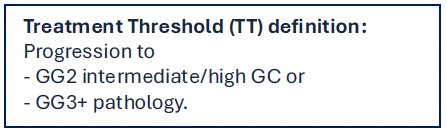
The primary outcome was progression to a treatment threshold, defined as development of GG2 intermediate/high GC or GG3+ pathology. The study also evaluated predictors of progression, including PSA density.

A total of 224 men were included, distributed as follows:
- GG1 low GC: 8.5%
- GG1 intermediate GC: 24.1%
- GG1 high GC: 22.8%
- GG2 low GC: 44.6%
Progression to the treatment threshold by 60 months occurred in 10.5% of GG1 low GC, 13% of GG1 intermediate GC (p=0.83 vs low GC), 29.4% of GG1 high GC (p=0.036), and 90% of GG2 low GC (p=0.001).

Higher PSA density was independently associated with progression (p=0.009). Illustrated below is a Fine & Gray competing risks regression model with cumulative incidence curves stratified by the combined GG–GC groups, visually demonstrating the divergence in progression risk across the four strata.
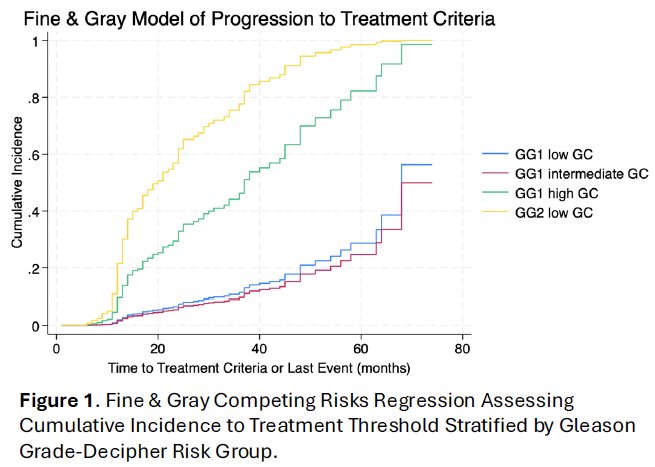
The authors concluded that GG1 low and intermediate GC showed similarly favorable AS outcomes, while GG1 high GC and GG2 low GC represent higher-risk subgroups. Integration of Decipher with Grade Group may refine biopsy intervals, support continued AS in patients with favorable genomics, and identify those who may require earlier definitive treatment.
Presented by: Anthony Zhang, MD, Clinical Research Fellow, Yale School of Medicine, New Haven, CT
Written by: Rashid K. Sayyid, MD, MSc, Assistant Professor, Urologic Oncologist, Department of Urology at The University of Arizona and Banner University Medical Center – Tucson, AZ, @rksayyid on X during the 2025 Society of Urologic Oncology (SUO) Annual Meeting, Phoenix, AZ, December 2nd–5th, 2025