

(UroToday.com) The 2025 SUO annual meeting featured a prostate cancer session and a presentation by Dr. Nicholas Pickersgill discussing genetic ancestry and stage-specific differences in prostate cancer genomic alterations. Men of African ancestry have higher prostate cancer-specific mortality than men of European ancestry.
Socioeconomic and access to care factors contribute, but mounting evidence suggests differences in tumor genomics may also play a role. Most prior studies have relied on self-reported race and have evaluated localized and metastatic tumors either in aggregate or in isolation. Whether ancestry-associated genomic differences vary disease stage remains unknown.
Dr. Pickersgill and colleagues analyzed 3,574 prostate cancer patients with genetically inferred ancestry who underwent matched tumor-normal targeted sequencing via MSK-IMPACT (468 genes). Genetic ancestry was estimated using ADMIXTURE with the 1000 Genomes reference panel. Patients were classified as predominantly African (≥80% African ancestry; n = 291) or European (≥80% European ancestry; n = 3,283). Somatic mutations, copy-number alterations, gene fusions, and pathogenic germline variants were assessed. Multivariable logistic regression, adjusted for age, Gleason score, and sequencing year, tested for differences by ancestry, stage (localized [stage 1-3] versus metastatic [stage 4]), and ancestry-stage interaction.
SPOP mutations demonstrated a significant ancestry-stage interaction (p < 0.05), being enriched in African metastatic tumors (OR 1.9, 95% CI 1.1–3.1) and depleted in European metastatic tumors (OR 0.7, 95% CI 0.5–0.9) despite similar prevalence in localized disease (African 11%, European 10%):
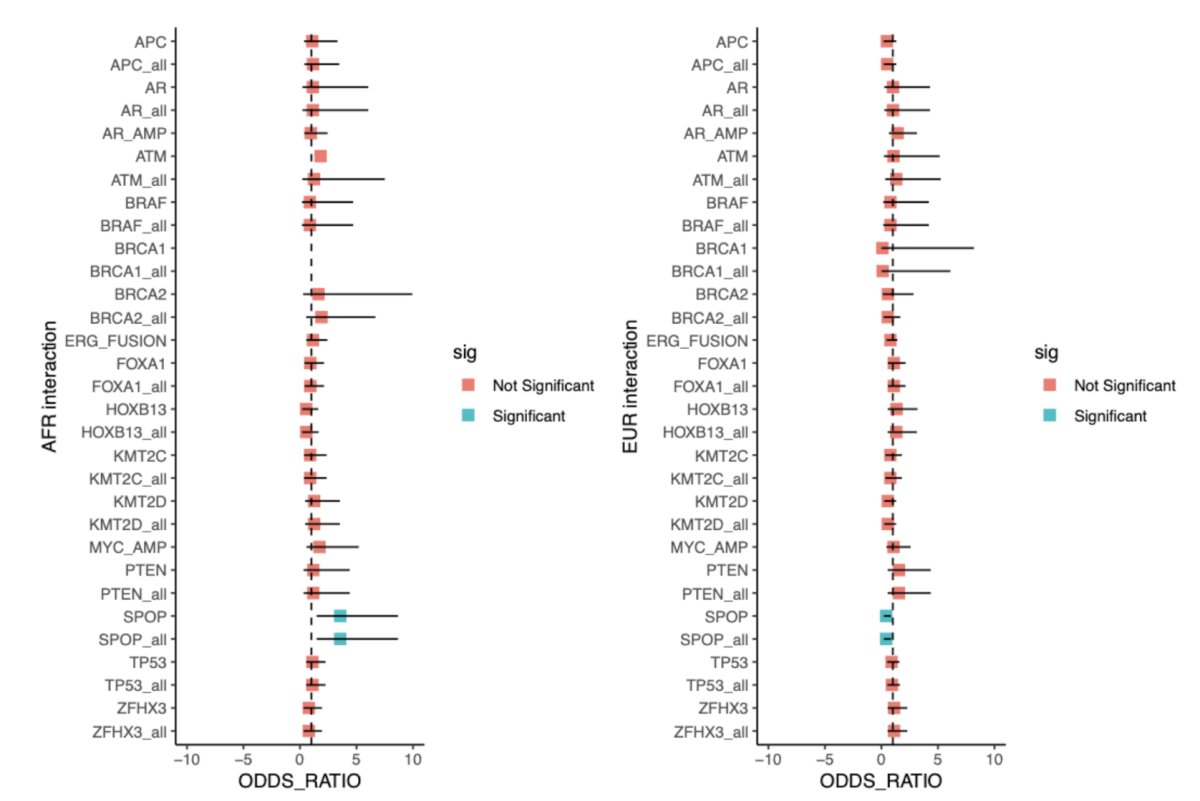
ERG fusions were substantially less common in African tumors overall (localized: 14% versus European 50%; metastatic: 24% versus European 41%, both p < 0.001). MYC amplification was more frequent in African metastatic disease (23% versus 15% in European, p = 0.01), with no significant difference in localized tumors (13% versus 11%). BRAF mutations were enriched in localized African tumors (4% versus 1% in European, p = 0.03) but not metastatic cases. BRCA2 and other DNA repair gene alterations showed no significant differences by ancestry in either stage category.
Dr. Pickersgill concluded his presentation discussing genetic ancestry and stage-specific differences in prostate cancer genomic alterations with the following take-home points:
- Prostate cancer genomic profiles differ by genetic ancestry, with some differences modulated by disease stage
- The novel SPOP ancestry–stage interaction suggests distinct molecular progression pathways in African versus European men
- Many actionable alterations occur at similar rates across ancestries, supporting equitable genomic testing and precision therapy access
Presented by: Nicholas Pickersgill, MD, Memorial Sloan Kettering Cancer Center, New York, NY
Written by: Zachary Klaassen, MD, MSc – Urologic Oncologist, Associate Professor of Urology, Georgia Cancer Center, Wellstar MCG Health, @zklaassen_md on Twitter during the 2025 Society of Urologic Oncology (SUO) Annual Meeting, Phoenix, AZ, Wed, Dec 3 – Fri, Dec 5, 2025.