

(UroToday.com) The 2025 Society of Urologic Oncology (SUO) Annual Meeting was host to a prostate cancer poster session. Dr. Diego Ospina Gonzalez presented PSMAndARPI, a phase II study of 177Lu-PSMA-617 plus androgen receptor pathway inhibitor (ARPI) versus 177Lu-PSMA-617 as first-line treatment of prostate-specific membrane antigen (PSMA)-positive progressive metastatic castration-resistant prostate cancer (mCRPC).
¹⁷⁷Lu-PSMA-617 selectively targets PSMA-expressing cells and delivers β-emitting radiation that induces DNA damage and tumor cell death. In VISION, ¹⁷⁷Lu-PSMA-617 improved overall survival and radiographic progression-free survival in heavily pretreated mCRPC.1
Emerging data also suggest that DNA-damage responses from radioligand therapy may enhance susceptibility to androgen receptor (AR) blockade, supporting the clinical evaluation of combined ¹⁷⁷Lu-PSMA-617 + ARPI strategies in earlier-line mCRPC.
PSMAndARPI is a randomized, open-label, phase II trial comparing:
- ¹⁷⁷Lu-PSMA-617 7.4 GBq IV every 6 weeks x 6 cycles + ARPI
- Choice of abiraterone acetate/prednisone or enzalutamide, per investigator
- ¹⁷⁷Lu-PSMA-617 monotherapy

Eligible participants are adults with PSMA-positive progressive mCRPC who have not received prior systemic therapy in the mCRPC setting.
Randomization is stratified according to the chosen ARPI, the presence or absence of visceral metastases, and duration of prior androgen deprivation therapy. This stratification helps balance disease burden, biology, and treatment history between arms — key considerations in the first-line mCRPC setting. A centralized PSMA PET is required for eligibility and response assessment.
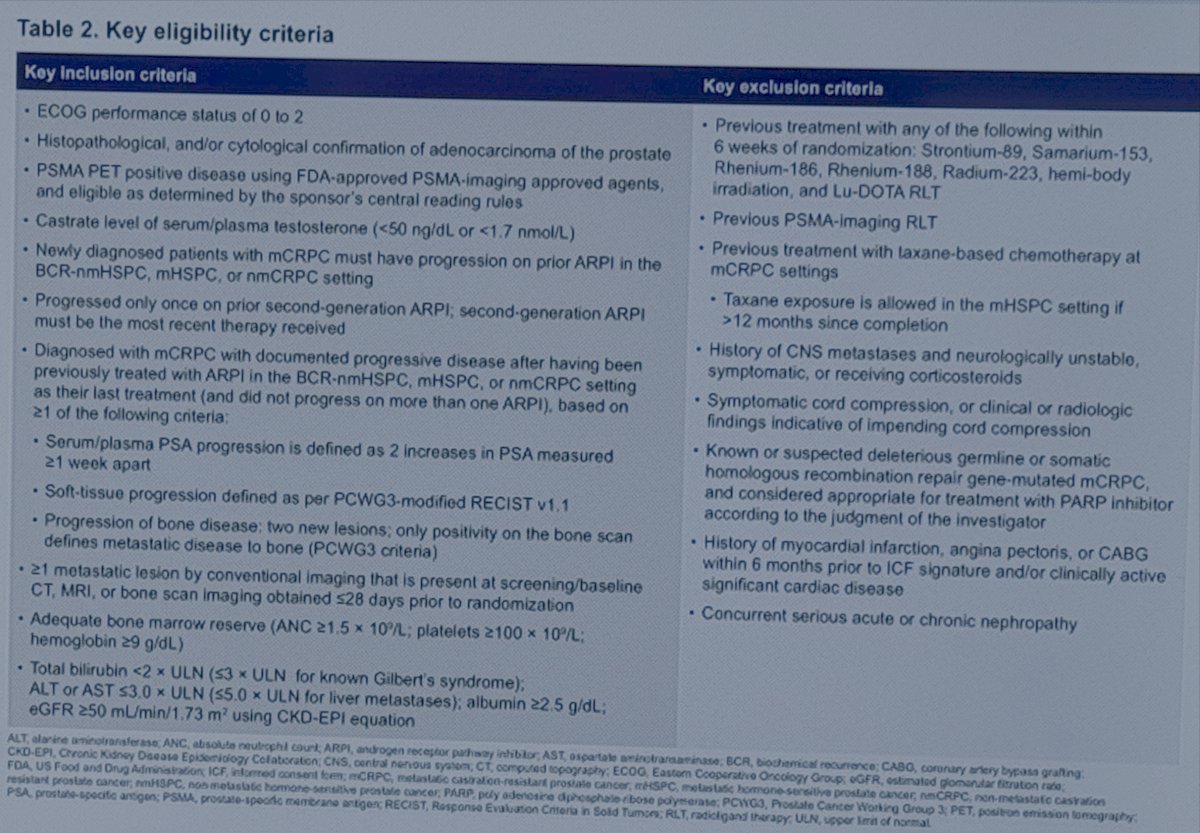
The key eligibility criteria are as follows:
- Inclusion
- Histologically confirmed prostate adenocarcinoma
- Progressive mCRPC
- PSMA-positive disease on PET per specified criteria
- ECOG 0–2
- Castrate testosterone level (<50 ng/dL)
- Up to one prior ARPI in the hormone-sensitive setting permitted
- Documented progression by PSA, radiographic, or clinical criteria
- Exclusion
- Prior systemic therapy for mCRPC
- Prior PSMA-targeted radioligand therapy
- Prior chemotherapy for mCRPC (taxanes in mHSPC permitted unless progression within 12 months)
- Significant renal impairment
- Symptomatic brain metastases or cord compression
- Other malignancy requiring active therapy
The primary endpoint is radiographic progression-free survival (rPFS) by blinded independent central review (BICR), using PCWG3-modified RECIST v1.1. The key secondary endpoints are:
- PSA50 response rate
- Objective response rate (ORR) in measurable disease
- Overall survival
- Time to symptomatic skeletal events
- Safety and tolerability
- Time to PSA progression
- Time to first subsequent therapy
- Quality-of-life measures
Exploratory endpoints include genomic and biomarker correlates and treatment exposure.
The study assessments are as follows:
- Efficacy
- rPFS assessed via CT/MRI and bone scan, plus PSMA PET
- Imaging intervals per PCWG3 and study protocol
- Safety
- Adverse events (AEs) graded by CTCAE v5.0
- Laboratory monitoring, hematology, renal function, and treatment-emergent toxicities
- Safety follow-up for ≥30 days after the last treatment dose
The study is actively enrolling men with PSMA-positive progressive mCRPC. The first patient was enrolled in September 2023. The study is planned for completion in 2025.
Dr. Ospina-Gonzalez concluded as follows:
- PSMAndARPI evaluates whether adding an ARPI to ¹⁷⁷Lu-PSMA-617 in the first-line mCRPC setting can improve radiographic and PSA outcomes compared to radioligand therapy alone.
- The study is grounded in strong biologic rationale for synergy between PSMA-targeted radiation and AR blockade.
- With rPFS as the primary endpoint and robust secondary endpoints—including PSA50, ORR, OS, and QoL—the trial is designed to provide a comprehensive understanding of combined radioligand + ARPI therapy.
- Enrollment is ongoing, and results are anticipated to inform future treatment paradigms for PSMA-positive mCRPC.
Presented by: Diego Ospina Gonzalez, Medical Director, Rlt, Prostate Cancer, Medical Affairs, US Oncology at Novartis
Written by: Rashid K. Sayyid, MD, MSc, Assistant Professor, Urologic Oncologist, Department of Urology at The University of Arizona and Banner University Medical Center – Tucson, AZ, @rksayyid on X during the 2025 Society of Urologic Oncology (SUO) annual meeting held in Phoenix, AZ, between the 2nd and 5th of December 2025.
References
- Sartor O, de Bono J, Chi KN et al. Lutetium-177-PSMA-617 for Metastatic Castration-Resistant Prostate Cancer. N Engl J Med. 2021; 385(12):1091-1103.