

(UroToday.com) The 2025 SUO annual meeting featured a kidney session and a presentation by Dr. Brian Shuch discussing ZIRCON-X and the impact of 89Zr-girentuximab PET/CT versus conventional imaging on clinical decision-making in patients with indeterminate renal masses. Current standard of care for the detection of clear cell renal cell carcinoma (ccRCC) in patients with indeterminate renal masses is based on conventional imaging with contrast-enhanced CT/MRI and renal mass biopsy.
However, CT/MRI is limited by challenges in accurately distinguishing benign from malignant lesions, and biopsy is invasive and often non-diagnostic. There remains an unmet need for a non-invasive diagnostic technique for clear cell RCC that can improve risk stratification, guide clinical decision-making, and minimize overtreatment and undertreatment. The phase 3 ZIRCON study demonstrated high accuracy for the detection, localization, and characterization of clear cell RCC with 89Zr-girentuximab PET/CT.1 At SUO 2025, Dr. Shuch and colleagues presented results from ZIRCON-X, a post-hoc analysis using data collected from ZIRCON, to evaluate the impact of 89Zr-girentuximab PET/CT on clinical management of patients presenting with indeterminate renal masses.
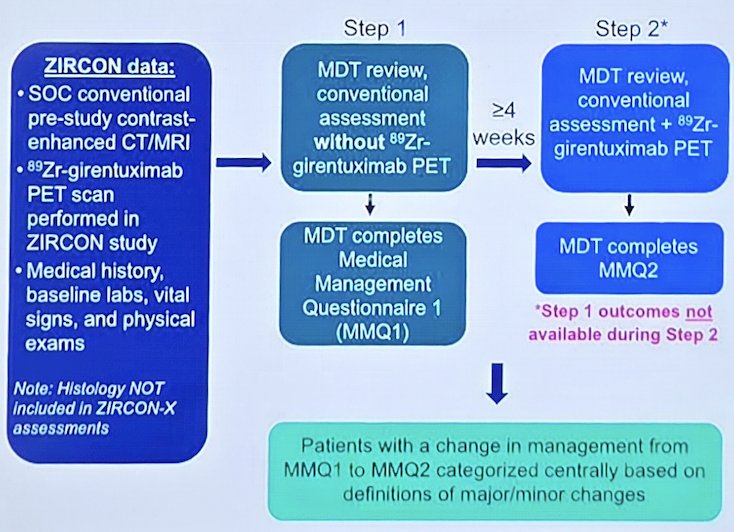
ZIRCON-X was a non-interventional, post-hoc study assessing imaging data collected during ZIRCON. Eligibility criteria of ZIRCON were previously published.1 Four multidisciplinary teams at independent institutions reviewed cases and made clinical management decisions using clinical/laboratory data in 2 steps:
- Step 1: First with conventional imaging (CT/MRI) images
- Step 2: After ≥4 weeks (to minimize bias and ensure comparison integrity), with 89Zr-girentuximab PET/CT images
Step-1 outcomes were not available during Step-2, but teams were able to review CT/MRI during Step-2. Each patient case was reviewed once by a single multidisciplinary team. Each multidisciplinary team included ≥1 nuclear medicine physician and ≥2 urologists with >5 years of experience in RCC and genitourinary PET/CT interpretation. Clinical and laboratory data were available during case reviews, but multidisciplinary teams were blinded to patient histology and management decisions from ZIRCON:
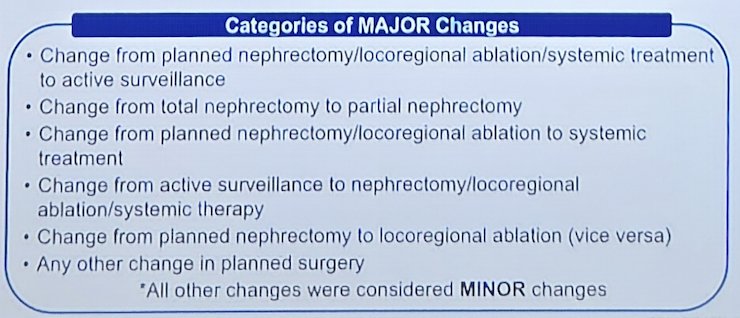
Primary endpoints were the proportion of patients with a change in clinical management driven by 89Zr-girentuximab PET/CT versus conventional imaging and hypothetical changes (major/minor) in clinical management based on 89Zr-girentuximab PET/CT versus conventional imaging:
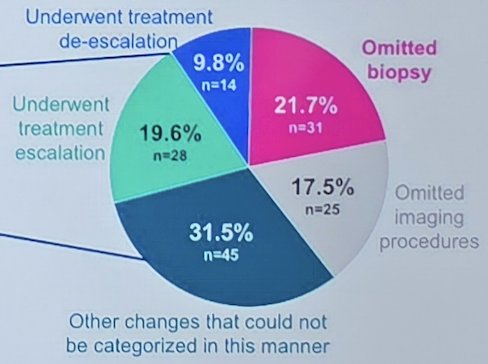
Of 294 patients included in the analysis, 143 (48.6%) would have undergone change in clinical management due to 89Zr-girentuximab PET/CT imaging versus conventional imaging:
- 28/143 (19.6%) escalated treatment
- 14/143 (9.8%) de-escalated treatment
- 31/143 (21.7%) avoided biopsy
- 25/143 (17.5%) avoided additional imaging
- 45/143 (31.5%) had other changes
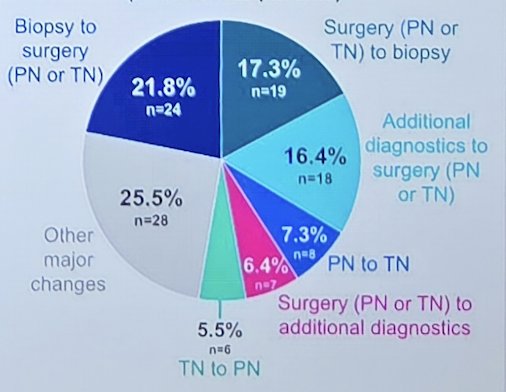
Major changes in clinical management would have occurred in 110/294 (37.4%) patients due to 89Zr-girentuximab PET/CT imaging versus conventional imaging:
- 24/110 (21.8%) switched from biopsy to surgery
- 19/110 (17.3%) from surgery to biopsy
- 18/110 (16.4%) from additional diagnostic testing to surgery
- 8/110 (7.3%) from partial to total nephrectomy
- 7/110 (6.4%) from surgery to additional diagnostic testing
- 6/110 (5.5%) from total to partial nephrectomy
Minor changes in clinical management would have occurred in 33/294 (11.2%) patients. 89Zr-girentuximab PET/CT imaging increased multidisciplinary team confidence in clinical management plans versus conventional imaging for 93/294 (31.6%) patients.
Dr. Shuch concluded his presentation discussing ZIRCON-X and the impact of 89Zr-Girentuximab PET/CT versus conventional imaging on clinical decision-making in patients with indeterminate renal masses with the following take-home points:
- Nearly half of patients would have had a change in their clinical management plan based on 89Zr-girentuximab PET/CT imaging results
- Over 1/3 of all patients (3/4 of patients with any change) would have had a major change in management, based on defined categories
- Approximately 30% of patients had a treatment escalation or de-escalation
- Over 20% of patients could have potentially avoided a biopsy
- 89Zr-girentuximab PET may provide clarity on the spatial localization of clear cell RCC within the kidney
Presented by: Brian Shuch, MD, Professor of Urology, Director of the Kidney Cancer Program, Alvin & Carrie Meinhardt Endowed Chair in RCC Cancer Research, University of California Los Angeles (UCLA), UCLA Urology, Los Angeles, CA
Written by: Zachary Klaassen, MD, MSc – Urologic Oncologist, Associate Professor of Urology, Georgia Cancer Center, Wellstar MCG Health, @zklaassen_md on Twitter during the 2025 Society of Urologic Oncology (SUO) Annual Meeting, Phoenix, AZ, Wed, Dec 3 – Fri, Dec 5, 2025.
Related content: Phase II Trial Compares PET Imaging to Conventional Scans Post-Nephrectomy - Brian Shuch
ZIRCON-X: How CAIX PET Imaging Influences Surgery, Biopsy, and Treatment Strategy in Indeterminate Renal Masses - Brian Shuch
Reference: