

(UroToday.com) The 2025 Society of Urologic Oncology (SUO) Annual Meeting was host to a bladder cancer poster session. Dr. Sarah Psutka presented the design and implementation of a patient-centric expanded access program with Cretostimogene Grenadenorepvec (CG) in BCG-unresponsive non-muscle invasive bladder cancer (NMIBC).
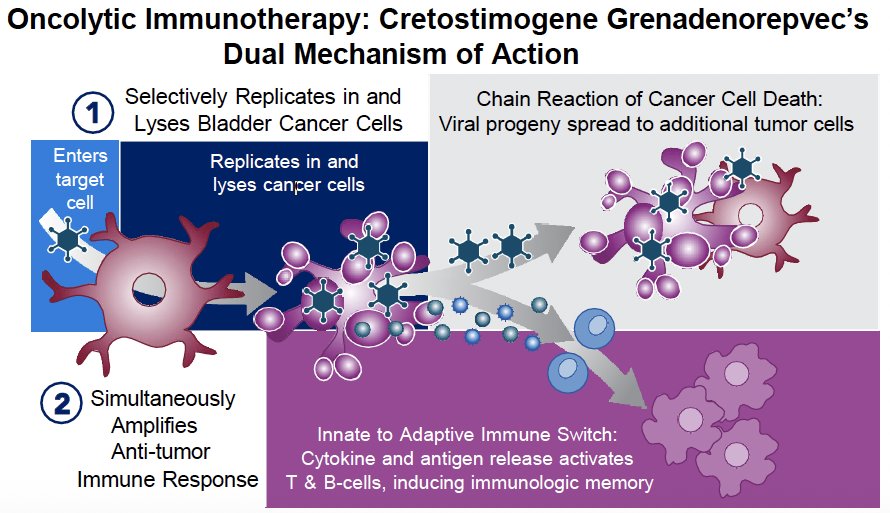
CG is an oncolytic immunotherapy with a dual mechanism of action – it selectively replicates in and lyses cancer cells, while amplifying the immune response against bladder tumors. BOND-003 is evaluating CG in high-risk, BCG-unresponsive NMIBC, with the CIS population demonstrating a 75.5% any-time complete response rate and a median duration of response (DoR) of 27.9 months. No Grade ≥3 treatment-related adverse events have been observed, consistent with previous findings.1-4
CG was accordingly granted US FDA Fast Track and Breakthrough Therapy Designations in high-risk, BCG-unresponsive NMIBC CIS +/-Ta/T1. An Expanded Access Program (EAP) is a pathway designed to give patients access to potentially beneficial investigational treatments before they are approved.5
CRETO-EAP offers CG for patients with CIS-containing, BCG-unresponsive NMIBC meeting the following eligibility criteria:
- Ineligible for, or have limited access to, other BCG-unresponsive CIS clinical trials
- Are unable to tolerate available treatment options
- Have limited or restricted access to alternative therapies
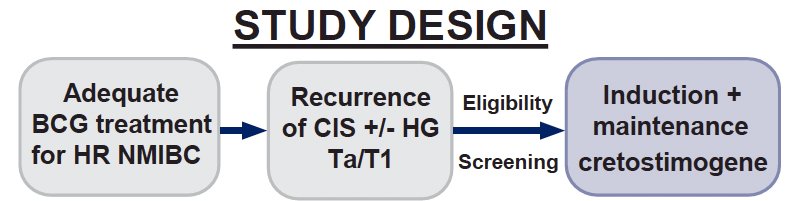
The study design is illustrated below:
This study employs ‘flexible’ entry criteria:
- ECOG 0–3
- Expanded window for prior intravesical BCG
- Previous investigational therapy permitted
- Adaptable screening process
The eligibility and efficacy are based on local assessments. The co-primary endpoints are safety and complete response at any time. The secondary endpoints are:
- Duration of response
- Progression-free survival
- Patient-reported outcomes
- Health-related quality of life
The study administration schedule is as follows:
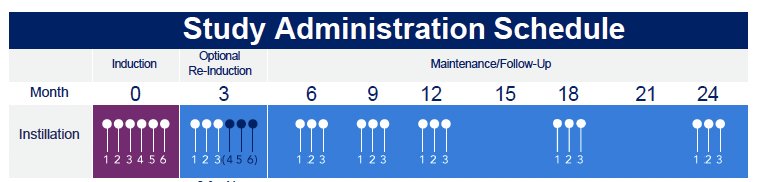
Partial responders (6 months and beyond) may receive continued treatment at the discretion of the investigator. Direct, streamlined post-instillation close contact instructions will be provided to all participating centers. Patients will be assessed for response during routine NMIBC surveillance, according to AUA/SUO guidelines.
For additional information on how to participate, interested parties may contact CG Oncology Inc. at: .
Presented by: Sarah Psutka, MD, MS, FACS, Urologic Oncologist, Associate Professor of Urology, Department of Urology, Fred Hutchinson Cancer Research Center, University of Washington, Seattle, WA
Written by: Rashid K. Sayyid, MD, MSc, Assistant Professor, Urologic Oncologist, Department of Urology at The University of Arizona and Banner University Medical Center – Tucson, AZ, @rksayyid on X during the 2025 Society of Urologic Oncology (SUO) Annual Meeting, Phoenix, AZ, December 2nd–5th, 2025
Related content: Design and Safety of a Patient-Centric Expanded Access Program with Cretostimogene Grenadenorepvec - Sarah Psutka
- Burke JM, Lamm DL, Meng MV, et al. A first-in-human phase 1 study of CG0070, a GM-CSF expressing oncolytic adenovirus, for the treatment of nonmuscle invasive bladder cancer. J Urol. 2012; 188(6):2391-2397.
- Packiam VT, Lamm DL, Barocas DA, et al. An open-label, single-arm, phase II multicenter study of the safety and efficacy of CG0070 oncolytic vector regimen in patients with BCG-unresponsive non-muscle-invasive bladder cancer: Interim results. Urol Oncol. 2018; 36(9):440-447.
- Li R, Checkori A, Patel SG, et al. Oncolytic adenoviral therapy plus pembrolizumab in BCG-unresponsive non-muscle-invasive bladder cancer: the phase 2 CORE-001 trial. Nat Med. 2024; 30(2):484-492.
- Tyson MD, Bivalacqua TJ, Flaig TW, et al. AUA 2025: BOND-003 Cohort P – A Multinational, Single-arm Study of Intravesical Cretostimogene Grenadenorepvec for the Treatment of High-Risk, Papillary Only, BCG-Unresponsive Non-Muscle Invasive Bladder Cancer. AUA Annual Meeting Abstract. 2025.
- U.S. Food and Drug Administration. Expanded Access. Available at: https://www.fda.gov/news-events/public-health-focus/expanded-access. Accessed 2025.