

(UroToday.com) The 2025 SUO annual meeting featured a urothelial carcinoma session and a presentation by Dr. Yair Lotan discussing the prognostic performance of a computational histology artificial intelligence (CHAI) biomarker in muscle-invasive bladder cancer.
The standard definitive treatment for muscle-invasive bladder cancer is radical cystectomy, which traditionally includes neoadjuvant chemotherapy, which confers an additional survival benefit. However, the survival benefit of neoadjuvant chemotherapy is only 5-10%, and only 30-40% of muscle-invasive bladder cancer cases receive neoadjuvant chemotherapy in the United States. The limited benefit and adoption underscore the need for a more personalized, risk-adapted approach to identify patients most likely to benefit from neoadjuvant chemotherapy (high risk) or avoid overtreatment in those cured with surgery alone (low risk). In this study, Dr. Lotan and colleagues applied the CHAI biomarker platform, previously used to develop a now commercially available prognostic tool in non-muscle invasive bladder cancer, to develop a prognostic biomarker in muscle invasive bladder cancer.
The CHAI platform applies deep learning to extract quantitative histologic features from H&E-stained whole-slide images, to analyze muscle-invasive bladder cancer cases from The Cancer Genome Atlas (TCGA; the development cohort). A continuous histologic risk signature for overall survival was derived and dichotomized into high- and low-risk groups using a 50-50 cutoff. The investigators validated the locked biomarker in an independent retrospective cohort of clinical T2 muscle-invasive bladder cancer patients who underwent radical cystectomy without neoadjuvant chemotherapy. Multivariate Cox proportional hazards models assessed associations with recurrence-free survival, cause-specific survival, and overall survival. Kaplan-Meier methods and log-rank tests were used for survival analysis.
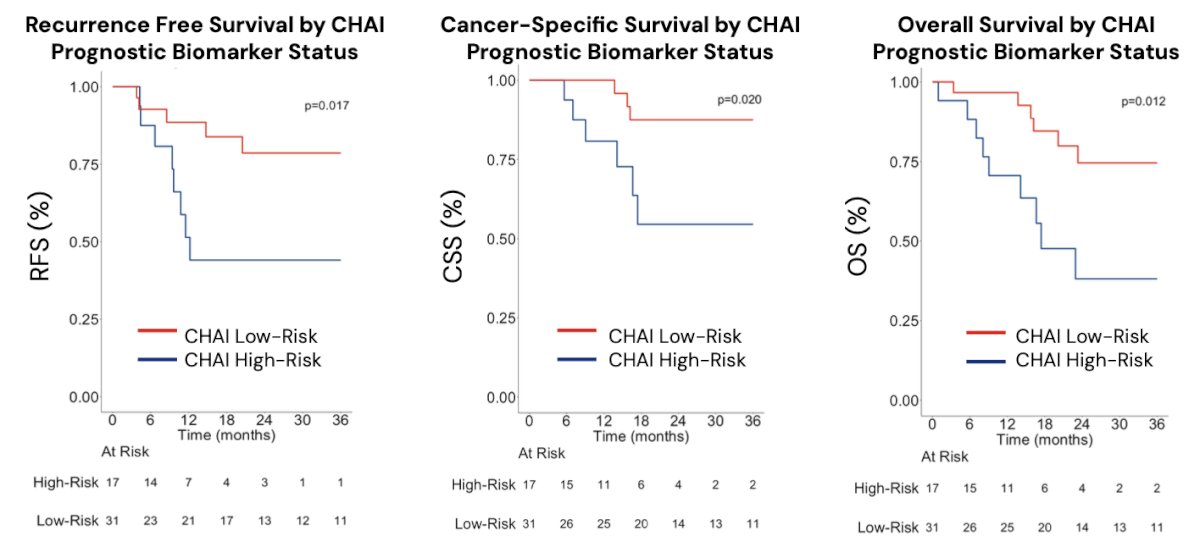
Among 89 muscle-invasive bladder cancer patients (41 in development, 48 in validation), the biomarker stratified validation patients into 17 (35%) high-risk and 31 (65%) low-risk:

High-risk was significantly associated with inferior recurrence-free survival (HR 3.64, 95% CI 1.17, 11.3), cause-specific survival (HR 4.51, 95% CI 1.12, 18.1), and overall survival (HR 3.51, 95% CI 1.24, 9.95), all p < 0.05. Associations remained significant after controlling for age and presence of CIS (p < 0.05).
At 1 year, high-risk patients had worse outcomes:
- Recurrence risk 49% versus 11%
- Cause-specific mortality 19% versus 0%
- Overall mortality 29% versus 3.3%
These differences persisted at 3 years:
- Recurrence risk 56% versus 21%
- Cause-specific mortality 45% versus 13%
- Overall mortality 62% versus 25%
Dr. Lotan concluded his presentation discussing the prognostic performance of a CHAI biomarker in muscle-invasive bladder cancer with the following take-home points:
- A deep learning-based histologic biomarker derived from pre-treatment H&E TURBT slides effectively stratifies clinical T2 muscle invasive bladder cancer patients by risk of recurrence, cancer-specific mortality, and overall mortality
- Future efforts will evaluate the biomarker’s predictive ability in neoadjuvant chemotherapy-treated cohorts
- Such a tool could be used to optimize muscle invasive bladder cancer patient selection for neoadjuvant chemotherapy by identifying those most likely to benefit, and sparing those who may be cured with surgery alone
Presented by: Yair Lotan, MD, Urologic Oncologist, UT Southwestern Medical Center, Dallas, TX
Written by: Zachary Klaassen, MD, MSc – Urologic Oncologist, Associate Professor of Urology, Georgia Cancer Center, Wellstar MCG Health, @zklaassen_md on Twitter during the 2025 Society of Urologic Oncology (SUO) Annual Meeting, Phoenix, AZ, Wed, Dec 3 – Fri, Dec 5, 2025.