

(UroToday.com) The 2025 SUO annual meeting featured a urothelial carcinoma session and a presentation by Dr. Reuben Ben-David discussing preoperative ctDNA predicting upstaging and recurrence in high-risk non-muscle invasive bladder cancer undergoing radical cystectomy.
Most bladder tumors are diagnosed at an early stage and are classified as non-muscle invasive bladder cancer. Despite recent intravesical treatment breakthroughs in non-muscle invasive bladder cancer, recurrence rates and risk of progression to muscle invasive bladder cancer remain significant. Over the past decade, ctDNA has emerged as a promising biomarker for treatment response and disease progression. The objective of this study was to assess if pre-cystectomy ctDNA status predicts recurrence-free survival and correlates with disease upstaging in high-risk non-muscle invasive bladder cancer patients undergoing radical cystectomy.
This was a bi-center analysis of patients with non-muscle invasive bladder cancer (N0M0) who underwent radical cystectomy between 2021-2023 and had prospective serial tumor-informed ctDNA analyses performed before and after radical cystectomy. The molecular residual disease window was defined as the initial 90 days after radical cystectomy. The primary endpoint was recurrence-free survival, analyzed with the Kaplan-Meier method for patients with a minimum follow-up of 3 months.
There were 56 non-muscle invasive bladder cancer patients with a median follow-up time of 13 months (IQR 6-18) and a median age of 67 years (IQR 62-72) included in this analysis: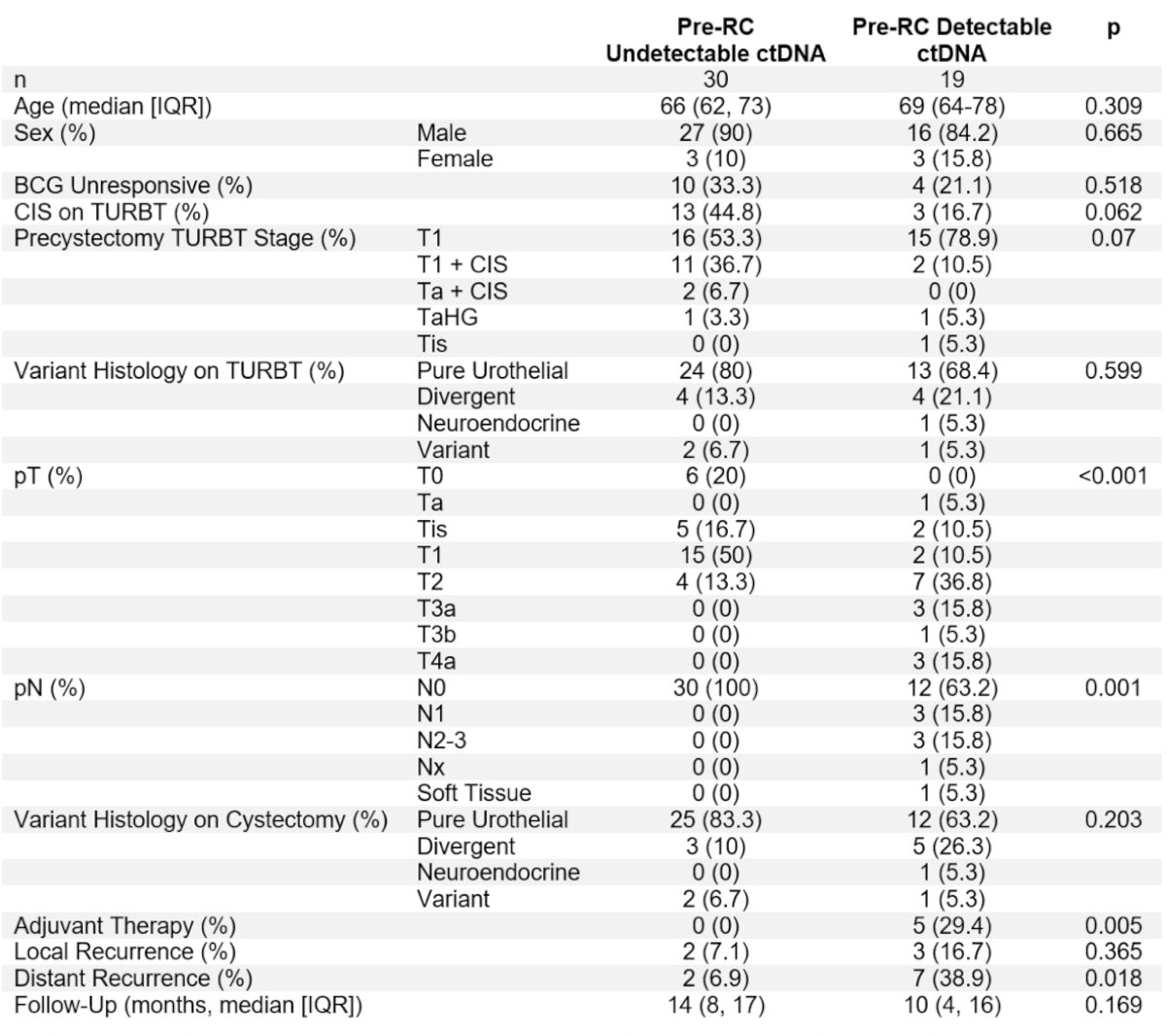
Among these patients, 45 had pre-radical cystectomy ctDNA status available, 15 (33.3%) had detectable, and 30 (66.7%) had undetectable ctDNA. Additionally, 13 had BCG-unresponsive disease (28.9%).
The most common pre-radical cystectomy pathology was T1 HG (60%) and T1 HG + CIS (28.9%). Detectable pre-radical cystectomy ctDNA (versus undetectable ctDNA) were more commonly upstaged (≥pT2), 66.7% versus 13.3% and 33.3% versus 0% had pN+. Among patients with undetectable ctDNA, 20% had pT0, and none had ≥pT3 or pN+ disease. On survival analysis, detectable pre-radical cystectomy ctDNA had worse recurrence free survival than undetectable ctDNA (log-rank, p < 0.0001, HR 11, 95% CI 2.27-53.8), with worse 6-month recurrence free survival of 64.3% (95% CI 43.5-95) versus 100% and 12-month recurrence free survival of 38.6% (95% CI 17.1-87.2) versus 95.7% (95% CI 87.7-100), respectively:
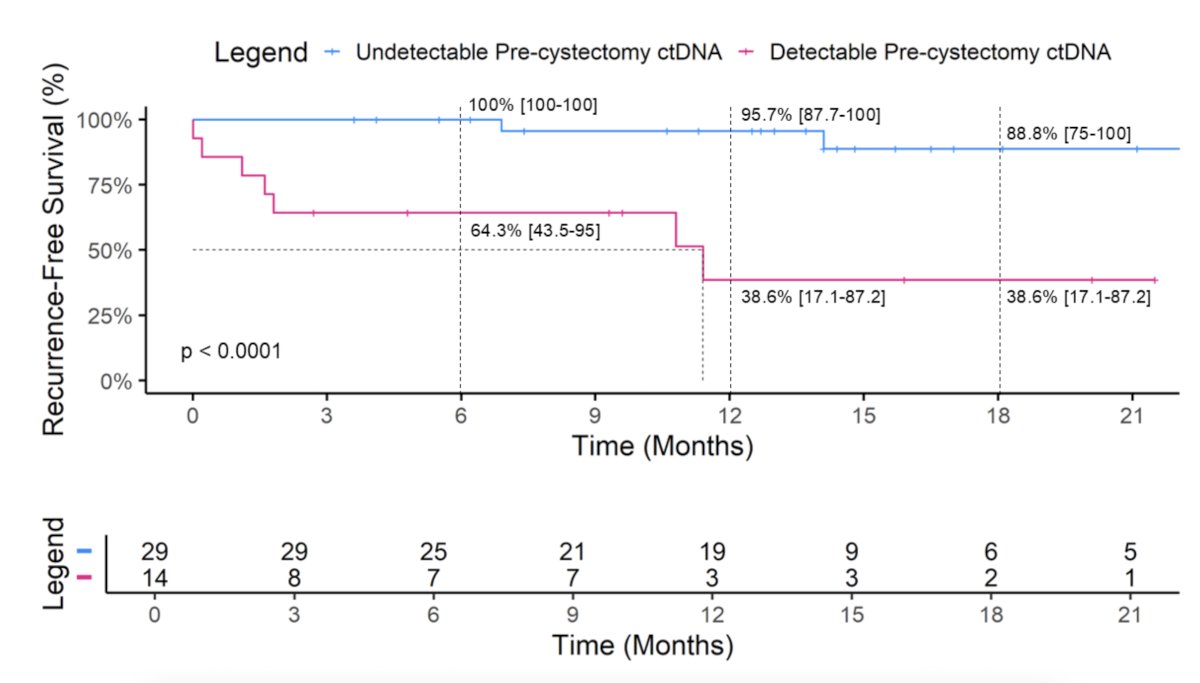
Detectable molecular residual disease ctDNA has worse recurrence-free survival than undetectable ctDNA (log-rank, p < 0.0001).
Dr. Ben-David concluded his presentation discussing preoperative ctDNA predicting upstaging and recurrence in high-risk non-muscle invasive bladder cancer undergoing radical cystectomy with the following take-home points:
- Detectable ctDNA status for high-risk non-muscle invasive bladder cancer pre-radical cystectomy was associated with worse recurrence-free survival, increased risk of pathological upstaging, and locally advanced disease with lymph node metastasis
- Clinicians should consider the use of ctDNA monitoring as a prognostic biomarker in the management and risk stratification of high risk non muscle invasive bladder cancer
Presented by: Reuben Ben-David, Icahn School of Medicine, Mount Sinai Hospital, New York, NY
Written by: Zachary Klaassen, MD, MSc – Urologic Oncologist, Associate Professor of Urology, Georgia Cancer Center, Wellstar MCG Health, @zklaassen_md on Twitter during the 2025 Society of Urologic Oncology (SUO) Annual Meeting, Phoenix, AZ, Wed, Dec 3 – Fri, Dec 5, 2025.