

(UroToday.com) The 2024 Society of Urologic Oncology (SUO) annual meeting held in Dallas, between December 3 and December 6, 2024, was host to the Abstract/Posters Session. Dr. Alexander Zhu discussed the role of voided urine cell-free DNA as a biomarker for upper tract urothelial carcinoma (UTUC).
Cell-free DNA (cfDNA) is a promising liquid biopsy biomarker for various malignancies, including urothelial bladder cancer. However, the use of cfDNA in upper tract urothelial carcinoma (UTUC) has not been extensively studied, with prior research primarily focusing on plasma cfDNA. Voided urine cfDNA remains relatively unexplored. This study aimed to assess the reliability of urine or plasma cfDNA as a biomarker for UTUC using low-pass whole genome sequencing (LP-WGS
The investigators prospectively enrolled four patients with known or suspected UTUC undergoing radical nephroureterectomy. Peripheral blood and voided urine samples were collected from all patients prior to surgery.
cfDNA was isolated from urine and plasma using standard protocols. Genomic DNA was extracted from radical nephroureterectomy specimens and established as tissue DNA. Next-generation sequencing using LP-WGS was performed on all samples (urine, plasma, tissue) to a minimum depth of 0.1x. Sequenced reads were matched against the human reference genome (hg19).
Using a custom-developed, clinically validated bioinformatics pipeline, copy number alterations (CNAs)—genomic regions of the samples that deviated from the reference genome—were identified. CNAs of urine and plasma were matched against tissue samples, and differences in CNAs at the chromosomal and sub-chromosomal levels were identified among all three sample types.
A total of four patients underwent radical nephroureterectomy; the final pathology was pT1N0 (n=2) and pT2Nx (n=2). All patients had preoperative voided urine cfDNA, preoperative plasma cfDNA and tumor tissue DNA available for analysis.
The extent of genomic alterations including the percent of abnormal 1Mb regions by chromosome of plasma cfDNA, urine cfDNA and radical Nephroureterectomy are outlined in the figure below: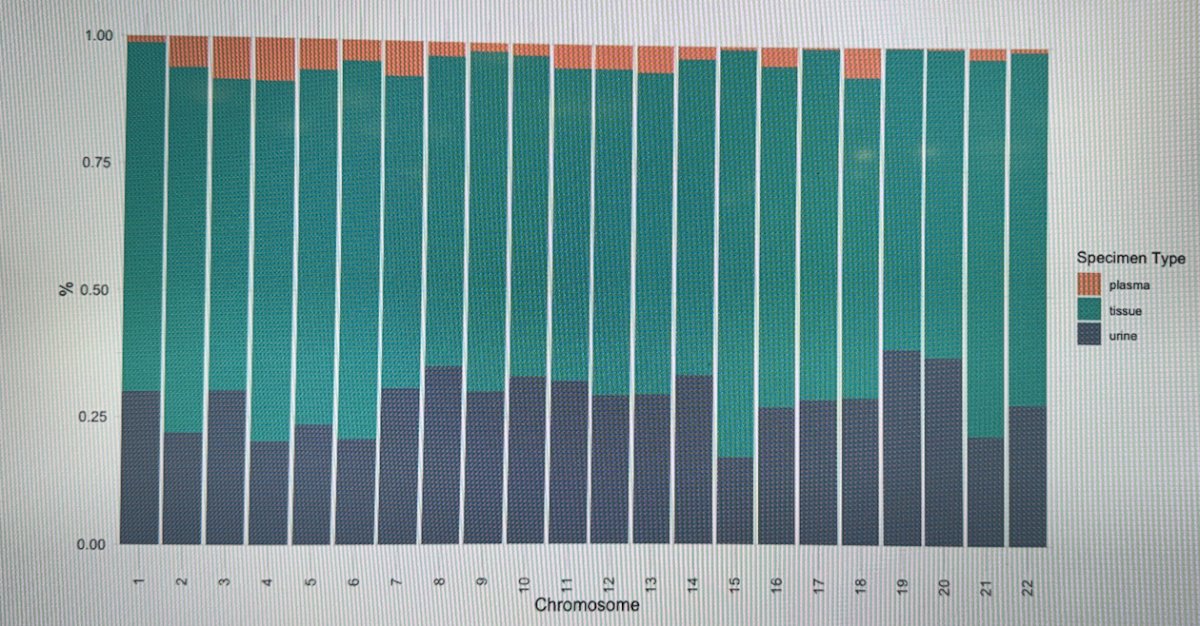
At the chromosomal level, we observed that CNAs in urine cfDNA closely mirrored that of tissue as illustrated in the figure below: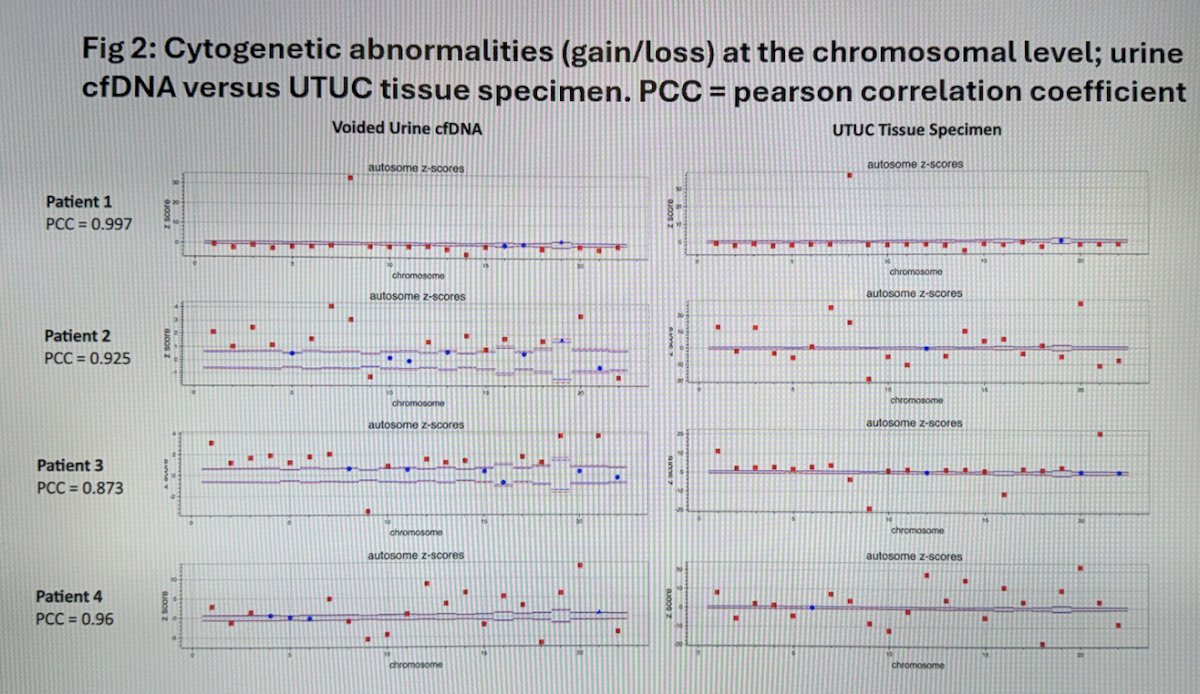
The correlation coefficients for chromosomal abnormalities between urine vs. tissue were impressive ranging from 0.873 to 0.997. However, this correlation was not observed in Plasma cfDNA and tissue samples.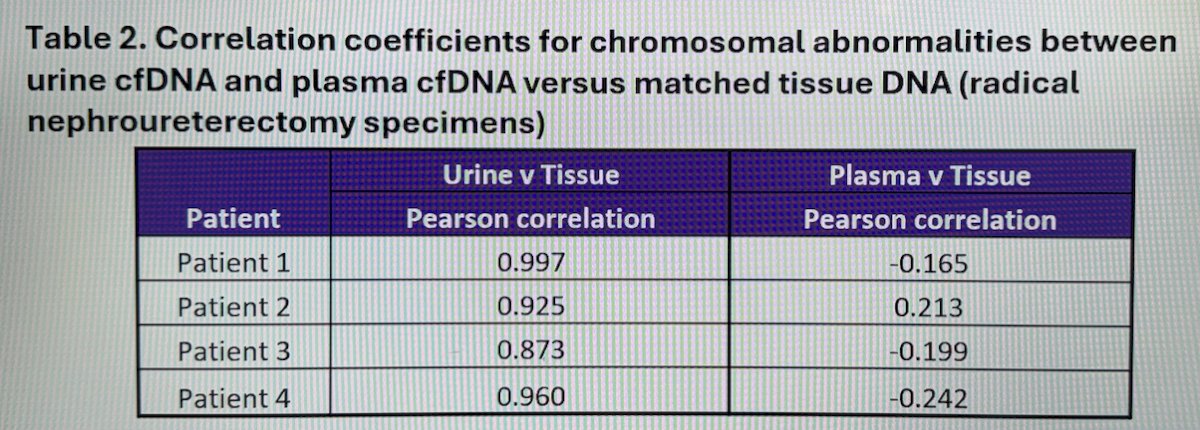
Dr. Alex Zhu concluded their poster by noting several key findings:
- In this pilot study of cfDNA for UTUC, CNAs of urine cfDNA closely mirrored those of tissue samples.
- However, the same relationship was not observed between plasma cfDNA and tissue samples.
- These findings serve as proof of concept that UTUC can be detected in urine supernatant using LP-WGS.
- Despite the small sample size, the data suggest that urine cfDNA has the potential to serve as an accurate biomarker for UTUC, offering a less invasive yet equally informative approach to UTUC diagnosis and surveillance.
Presented by: Alexander Zhu, MD, Society of Urologic Oncology fellow at the University of Washington School of Medicine, Seattle, USA.
Written by: Julian Chavarriaga, MD – Urologic Oncologist at Cancer Treatment and Research Center (CTIC) Luis Carlos Sarmiento Angulo Foundation via Society of Urologic Oncology (SUO) Fellow at The University of Toronto. @chavarriagaj on Twitter during the 2024 Society of Urologic Oncology (SUO) annual meeting held in Dallas, between the 3rd and 6th of December, 2024.