

(UroToday.com) The 2024 SUO annual meeting included a prostate cancer session, featuring a debate regarding the management of localized radiorecurrent prostate cancer, and a presentation by Dr. Kara Watts discussing the role of salvage focal ablation. Currently, ~90-95% of men with biochemical recurrence after radiotherapy are managed with ADT alone.
There are several reasons for this approach, including higher comorbidity, suboptimal functional outcomes, higher risk older patients, and few centers/surgeons that are willing to perform a salvage radical prostatectomy.
Why should we treat local recurrences? A systematic review from Kishnan et al.1 of 992 patients for patients undergoing primary radiotherapy for high grade prostate cancer (Gleason Grade 4-5) showed that over a median follow-up of 6.4 years, there was a 24% local failure rate, 37% distant metastasis rate, and 30% prostate cancer specific mortality rate. This study found that the development of local failure was significantly associated with overall survival (HR 1.70), prostate cancer specific survival (HR 3.10), and distant metastasis free survival (HR 1.92).
Dr. Watts notes that focal therapy is supported by the guidelines and that there has been a shift towards treatment in the primary setting based on number of publications over the years:
- Up to 2013: 30 studies, 7 energies, 2,350 patients
- Up to 2015: 37 studies, 7 energies, 3,230 patients
- 2015 – 2021: 72 studies, 8 energies, 5,827 patients
Improvements in imaging have certainly helped utilization of focal therapy. The proPSMA trial from 20202 randomized 302 men for staging studies to either PSMA PET/CT versus CT/bone scan with subsequent crossover. PSMA PET/CT detection of nodal metastases had a sensitivity of 74% and a specificity of 98%. Overall, PSMA PET/CT had a 27% greater accuracy than conventional imaging: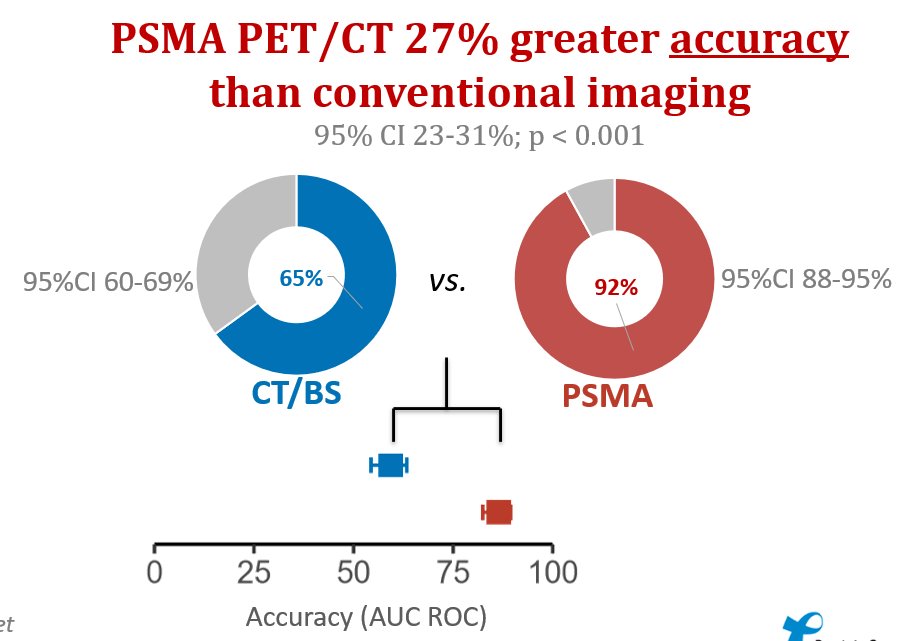
Several studies have looked at post-salvage radical prostatectomy specimens to see if patients would have been candidates for focal therapy. Marra and colleagues3 assessed 41 men that underwent salvage radical prostatectomy via whole mount review, looking at tumor location, volume, and grade: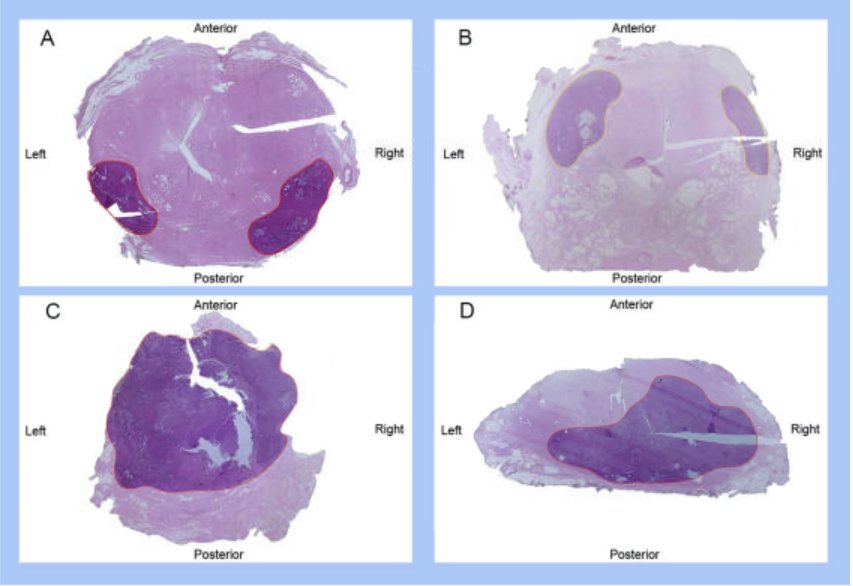
Candidates for focal therapy were those that had: a unifocal lesion, unilateral lesion with <50% on the contralateral side (hockey stick), 2 foci on the ipsilateral side, or 2 foci, one that is clinically relevant. Overall, 56% of men were deemed eligible for salvage focal therapy: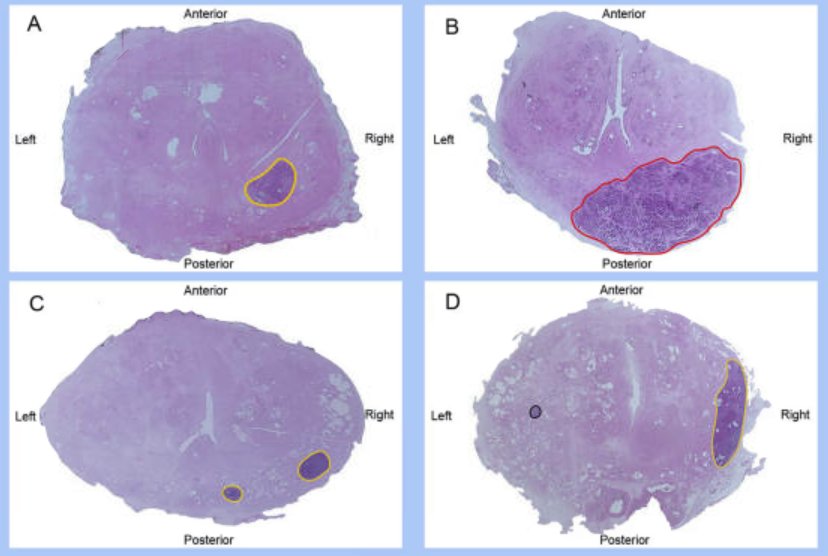
In 2021, Chesnut et al.4 assessed 77 patients that underwent salvage radical prostatectomy with preoperative MRI, systematic/targeted biopsy, and post surgery tumor maps.4 The primary outcome was the ability of clinicopathologic and imaging criteria to identify patients who may be eligible for salvage partial gland ablation based on detailed tumor map from whole-mount salvage radical prostatectomy slides. Of these 77 patients, 15 patients (19%) were determined to be eligible for salvage partial gland ablation based on biopsy-proven unilateral disease in contiguous sextant segments, a dominant lesion on MRI concordant with biopsy location or no focal region of interest, and no imaging evidence of extraprostatic disease.
The MASTER study was a 2021 systematic review of outcomes for local salvage therapy after primary radiotherapy.5 There were 150 studies assessing 11,322 patients, the vast majority of which were salvage whole gland ablation and salvage radiotherapy studies:
Adjusted 5 year recurrence free survival ranged from 50% after cryotherapy to 60% after HDR brachytherapy and SBRT, with no significant differences between any modality and radical prostatectomy: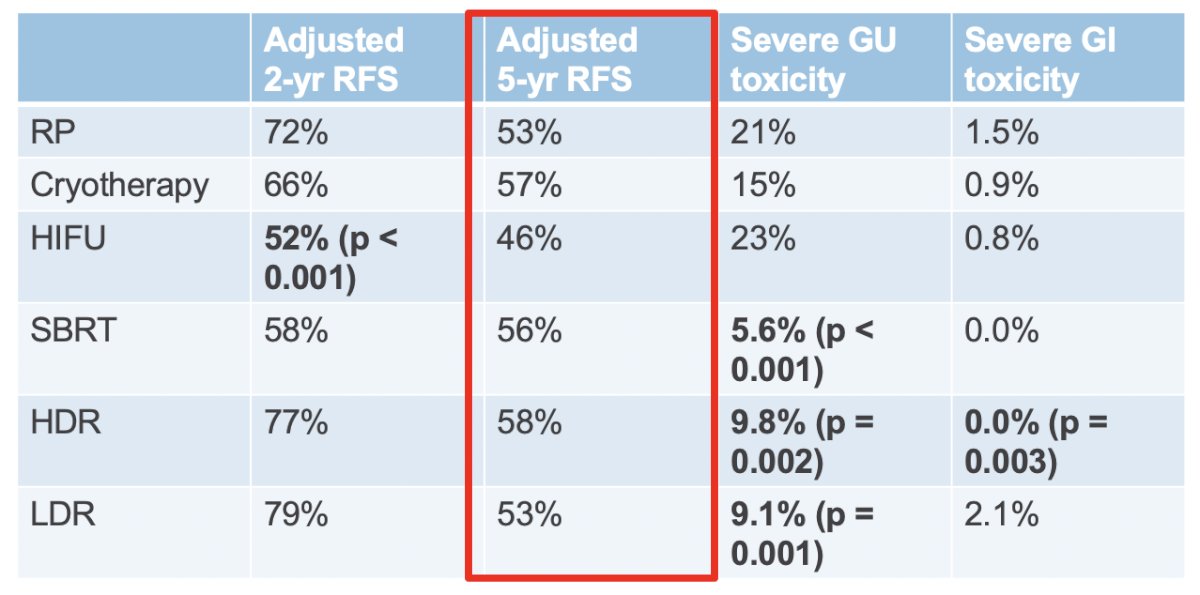
Functionally, favorable incontinence rates are seen after brachytherapy and salvage focal cryotherapy. Erectile dysfunction was high after all treatment modalities, and difficult to assess the impact from treatment due to high rates of erectile dysfunction prior to salvage treatment: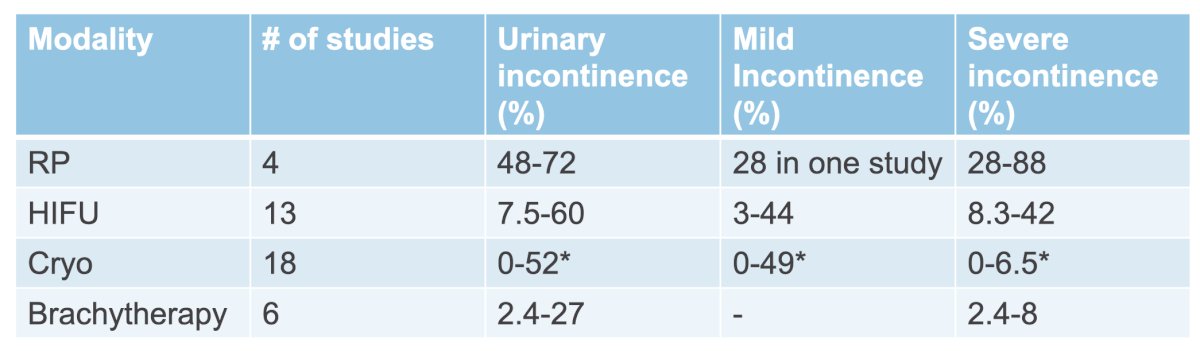
McPherson and colleagues6 recently assessed outcomes of salvage radical prostatectomy versus salvage ablation therapy among 444 patients treated at Memorial Sloan Kettering Cancer Center and the University of Western Ontario. Propensity score methodology was used and identified 378 patients with more comparable pre-salvage PSA, Gleason score, and primary radiation treatment. Over a median follow-up of 6.0 years (IQR: 3.0 – 9.7) for survivors, 48 patients died of disease and 88 developed metastases. There was a non-significantly higher rate of cancer-specific (HR 1.02, 95% CI 0.51, 2.06, p = 0.9) and improved metastasis-free survival (HR 0.71, 95% CI 0.44, 1.13, p = 0.15) among patients undergoing salvage ablation compared to patients undergoing salvage radical prostatectomy: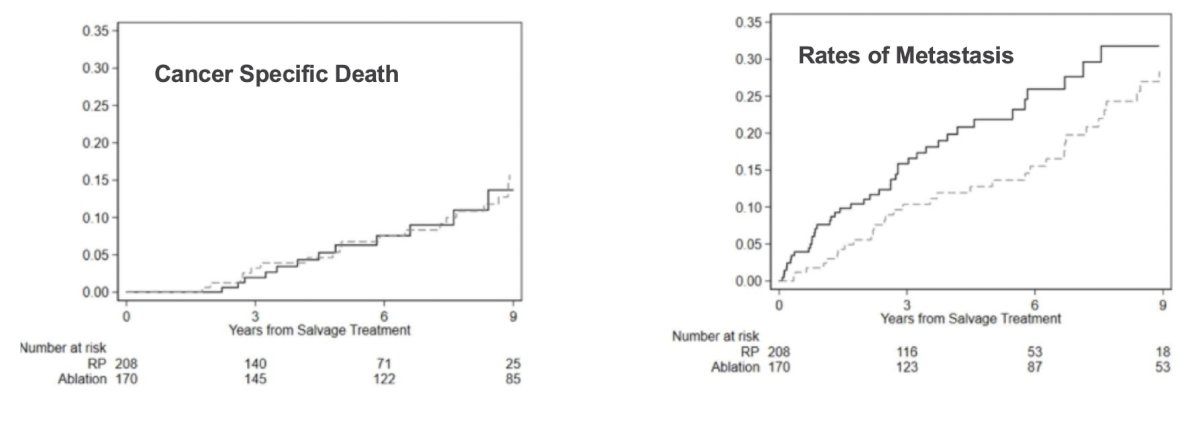
There were 143 patients who received hormonal therapy, with higher rates of ADT in salvage ablation (HR 1.42, 95% CI 0.97, 2.08, p = 0.068):
Ongoing trials include the SAFE Pilot Trial of salvage focal IRE for radio-recurrent prostate cancer.
Dr. Watts concluded her presentation discussing the role of salvage focal ablation with the following take home messages:
- Some patients will benefit from salvage treatment
- There are very few head to head comparison studies between salvage modalities, particularly salvage focal
- Limited studies suggest oncologic outcomes superior for focal salvage cryotherapy amongst ablative technologies
- Salvage focal ablation offers superior functional outcomes compared to salvage prostatectomy, in some studies, inferior to salvage radiotherapy, but longer term data after salvage radiotherapy is lacking
- The burden is on proper patient selection (imaging and biopsy technique) and counseling patients at the outset
Presented by: Kara Watts, MD, Montefiore Einstein, Bronx, NY
Written by: Zachary Klaassen, MD, MSc – Urologic Oncologist, Associate Professor of Urology, Georgia Cancer Center, Wellstar MCG Health, @zklaassen_md on Twitter during the 2024 Society of Urologic Oncology (SUO) Annual Meeting, Dallas, TX, Tues, Dec 3 – Fri, Dec 6, 2024.
References:
- Kishan AU, Chu FI, King CR, et al Local failure and survival after definitive radiotherapy for aggressive prostate cancer: An individual patient-level meta-analysis of six randomized trials. Eur Urol. 2020 Feb;77(2):201-208.
- Hofman MS, Lawrentschuk N, Francis, RJ, et al. Prostate-specific membrane antigen PET-CT in patients with high-risk prostate cancer before curative-intent surgery or radiotherapy (proPSMA): A prospective, randomized, multicentre study. Lancet 2020 Apr 11;395(10231):1208-1216.
- Marra G, Calleris G, Massari E, et al. Topography of prostate cancer recurrence: A single-centre analysis of salvage radical prostatectomy specimens and implications for focal salvage treatments. Eur Urol Open Sci. 2022 Dec 15:47:110-118.
- Chesnut GT, Tin AL, Sivaraman A, et al. Defining the index lesion for potential salvage partial or hemi-gland ablation after radiation therapy for localized prostate cancer. Urol Oncol. 2021 Aug;39(8):495.e17-495.e24.
- Valle LF, Lehrer EJ, Markovic D, et al. A systematic review and meta-analysis of local salvage therapies after radiotherapy for prostate cancer (MASTER). Eur Urol. 2021 Sep;80(3):280-292.
- McPherson V, Nair SM, Tin AL, et al. Comparison of salvage radical prostatectomy vs. salvage ablation therapy for biopsy-proven radio-recurrent localized prostate cancer. Can Urol Assoc J. 2024 Feb;18(2):41-46.