

(UroToday.com) The 2024 Society of Urologic Oncology (SUO) annual meeting held in Dallas, between December 3 and December 6, 2024, was host to the Abstract/Posters Session. Dr Madison Wahlen discussed the impact of BCG shortage on disease recurrence for patients with non-muscle invasive bladder cancer: a SEER patterns of care analysis.
Dr. Wahlen began her poster presentation by sharing that the current gold standard treatment for high-risk non-muscle invasive bladder cancer (NMIBC) is transurethral resection of bladder tumor (TURBT) followed by adjuvant intravesical Bacillus Calmette-Guérin (BCG). Since 2012, the world has been dealing with BCG shortages, affecting and limiting its use in many urologic practices. Studies from Europe and Asia have observed an increased risk of recurrence among patients impacted by BCG shortages.1 However, the generalizability of these findings to the United States (US) remains limited. The aim of this study was to investigate the impact of BCG shortages on disease recurrence among patients with NMIBC in the US.
Using the Surveillance, Epidemiology, and End Results (SEER) database, the investigators conducted a patterns of care study on bladder cancer, specifically querying patients diagnosed with NMIBC in 2019 who underwent TURBT and had known information about BCG shortages.
The primary endpoint was recurrence-free survival. The investigators used Kaplan-Meier estimates for analysis and extended Cox proportional hazards regression to model recurrence, adjusting for demographic, clinical, and hospital characteristics.
A total of 581 patients were included in the analysis, with 21% impacted by BCG shortages. The study utilized two models: Model 1 included patients affected by BCG shortages who did not receive BCG, and Model 2 included patients affected by BCG shortages who still received intravesical BCG. A total of 194 patients experienced a recurrence event.
The investigators reported that patients impacted by BCG shortages did not have an increased hazard of recurrence compared to those not impacted. This was consistent in both Model 1 (HR 1.04, 95% CI 0.71-1.52, p=0.88) and Model 2 (HR 0.86, 95% CI 0.58-1.28, p=0.78). Even when comparing patients impacted by BCG shortages who received BCG versus those who did not, there was no significant difference in recurrence events (p=0.08).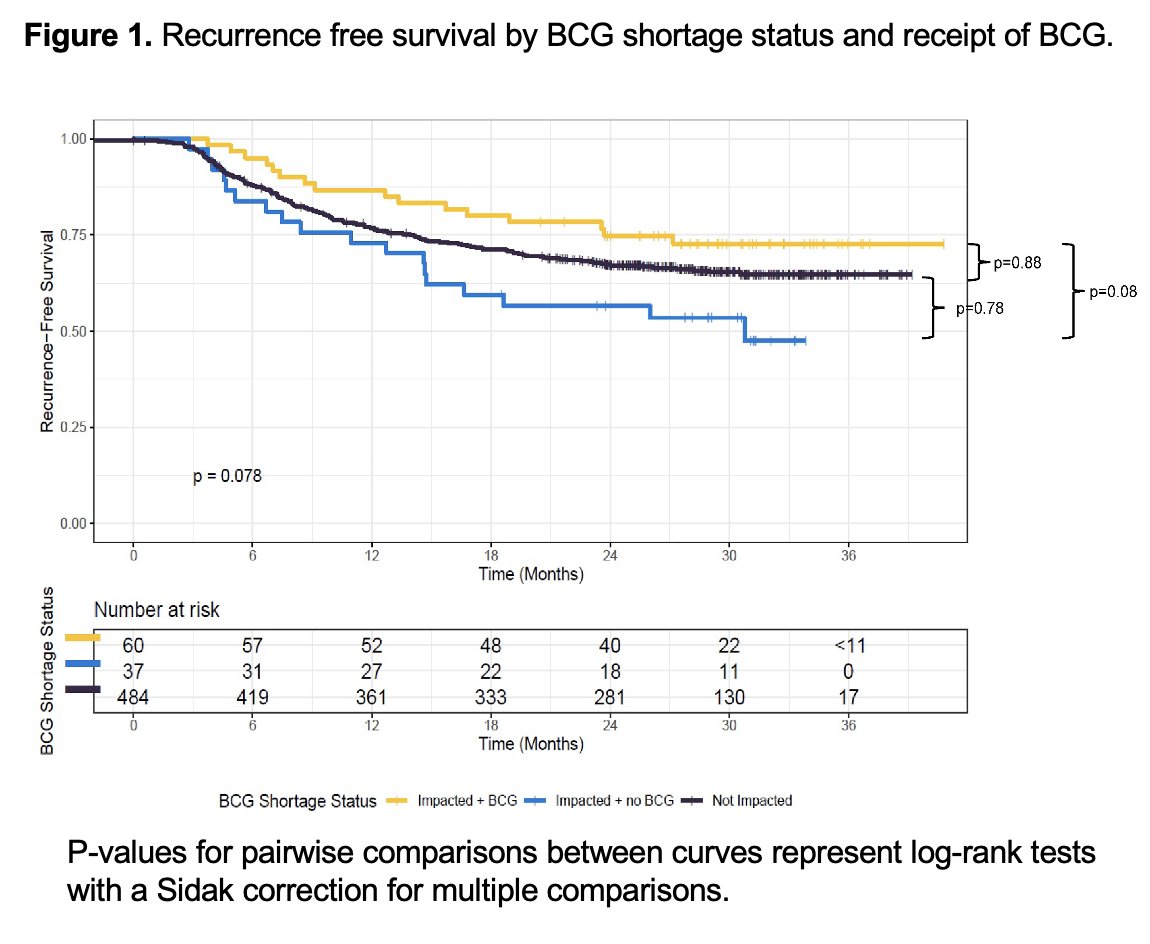
Notably, patients who received BCG had a 54% reduced risk of recurrence compared to those who did not receive BCG (HR 0.46, 95% CI 0.33-0.65).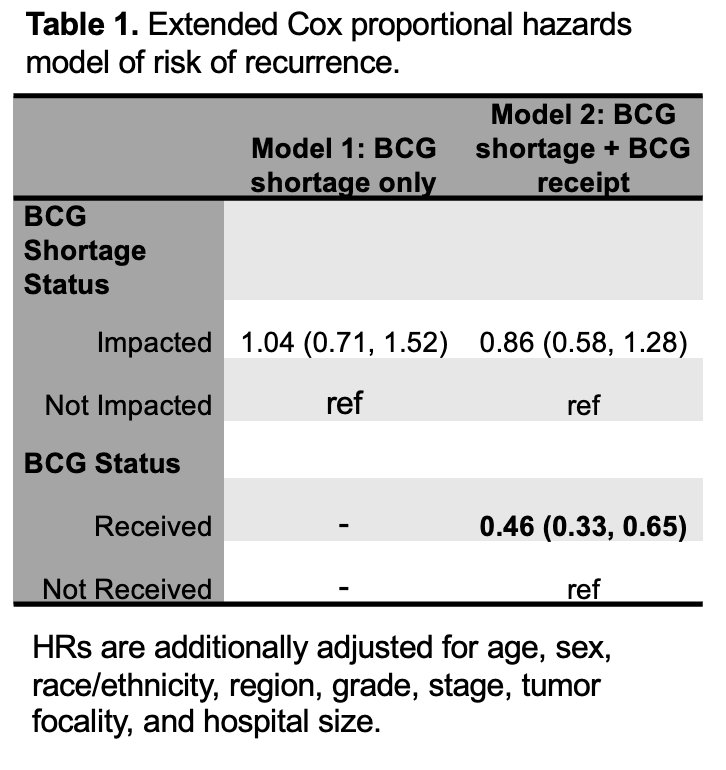
This poster presentation was concluded with the following messages:
- BCG shortages alone were not linked to an increased risk of recurrence in this SEER Patterns of Care study.
- Patients who received BCG experienced lower recurrence rates and a reduced hazard of recurrence.
- For those affected by BCG shortages, alternative treatment plans, including BCG dose reductions, may be preferable to regimens that exclude BCG entirely.
- Continuing risk-adapted BCG utilization is recommended.
Presented by: Madison M. Wahlen, University of Iowa, Carver College of Medicine, Iowa City, IA.
Written by: Julian Chavarriaga, MD – Urologic Oncologist at Cancer Treatment and Research Center (CTIC) Luis Carlos Sarmiento Angulo Foundation via Society of Urologic Oncology (SUO) Fellow at The University of Toronto. @chavarriagaj on Twitter during the 2024 Society of Urologic Oncology (SUO) annual meeting held in Dallas, between the 3rd and 6th of December, 2024.
References: