

(UroToday.com) The 2026 SNMMI annual meeting featured a discovery and translation scientific session and a presentation by Felicia Tang discussing the first-in-human CD46-targeted ImmunoPET imaging with 89Zr-DFO-YS5 in metastatic castration resistant prostate cancer (mCRPC). CD46 is a targetable cell surface antigen with high expression in prostate cancer in a lineage-independent manner. Dr. Tang and colleagues previously developed the YS5 antibody, which targets a cancer-specific epitope on CD46 and a cognate antibody drug conjugate, with promising preclinical therapeutic efficacy in prostate cancer models. A phase 1 clinical study of the YS5-based antibody drug conjugate FOR46/FG-3246 demonstrated encouraging preliminary activity and acceptable safety profile as the first clinical stage CD46-targeting therapy. Using the same YS5 antibody, they developed an immunoPET agent, 89Zr-DFO-YS5/FG-3180, and demonstrated its ability to detect prostate cancer in cell lines and patient-derived preclinical models, including those with absent PSMA expression. Thus, the aim of this prospective first-in-human phase I study of 89Zr-DFO-YS5 PET/CT (NCT05245006) presented at the SNMMI 2026 annual meeting was to establish its safety and its performance for lesion localization as a new prostate cancer imaging strategy.
89Zr-DFO-YS5 was prepared under GMP conditions with a mean specific activity of 2.3 mCi/mg. There were 30 participants with mCRPC prospectively enrolled between April 2022 to November 2025 who underwent imaging with 1-3 mCi 89Zr-DFO-YS5. Cohort A (n = 3) patients underwent multi-time point imaging for dosimetry, Cohort B (n = 3) patients underwent single time point imaging with an additional 20 mg infusion of unmodified YS5 antibody, and Cohort C (n = 24) patients underwent single time point imaging at 5-7 days post-injection. PET/CT images were reviewed by 2 nuclear medicine physicians who scored lesions on a semi-quantitative scale of 1-5. Lesions were considered positive if graded 4–5 and negative if graded 1–2. Lesions graded 3 were reviewed by consensus of 2 nuclear medicine physicians. A subset of patients were treated on the phase 1b/2b study of FOR46 in combination with enzalutamide (NCT050111188) following completion of baseline 89Zr-DFO-YS5 PET. For these 23 patients, PSA response was recorded from baseline to nadir. Tumor to blood ratios were compared between PSA50 responders and non-responders using the Mann-Whitney U test, with p <0.05 considered statistically significant.
Among the 30 participants (median age 71, range 56–93 years), they received a median dose of 2.58 mCi 89Zr-DFO-YS5. Analysis of Cohort A revealed optimal tumor to background and quality at 5-7 days post-injection. The highest absorbed doses of 89Zr-DFO-YS5were seen in the adrenal glands, spleen, liver, and kidneys with an effective dose of 0.430 mSv/MBq, comparable to other 89Zr-based PET pharmaceuticals. Non-radiolabeled YS5 administered in Cohort B did not improve image quality, but rather increased the incidence of infusion reactions. Following implementation of a premedication regimen in Cohort C, infusion reactions decreased substantially (1 in 24 patients). 89Zr-DFO-YS5 showed high uptake and superior ability to detect metastatic lesions compared to CT and bone scan (Figures 1 and 2):
Patient #1: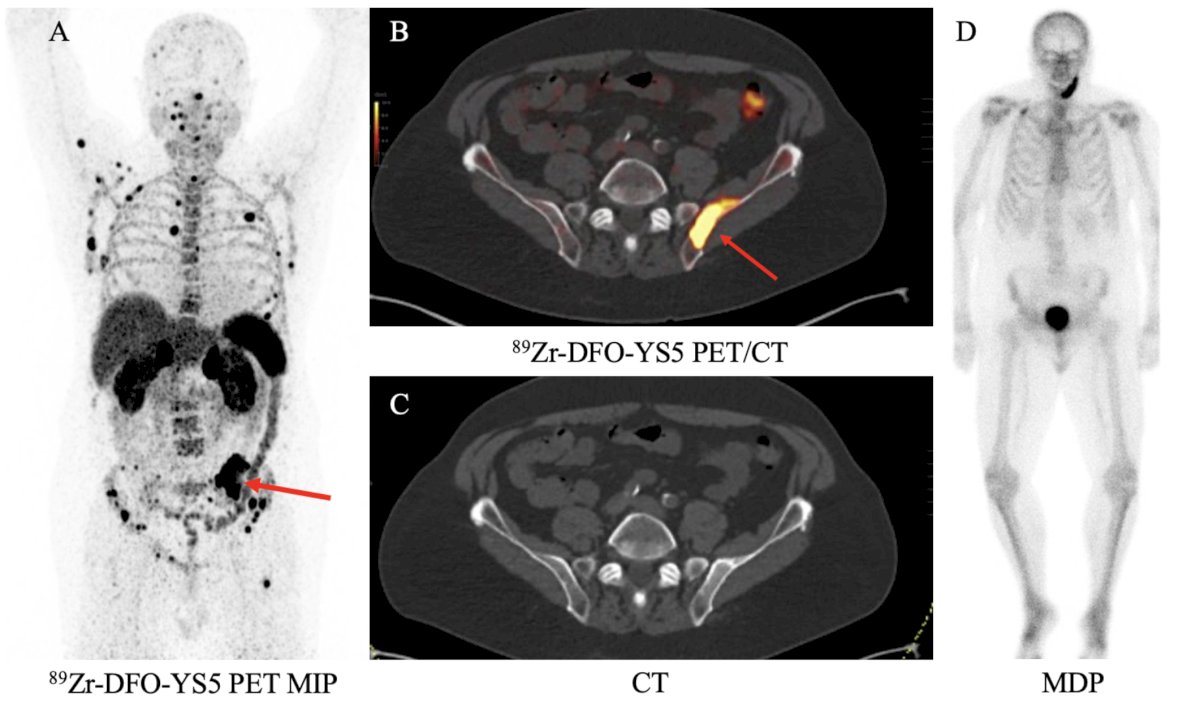
Patient #2:

89Zr-DFO-YS5 detected 144 osseous sites compared to 99 by bone scan, and 33 soft tissue sites (lymph node, liver, and lungs) compared to 14 by CT. Excellent uptake was observed in osseous and soft-tissue metastatic disease, with a mean SUVmax of 11.70 ± 4.95 and SUVmax-avg/SUVmean blood pool of 9.78 ± 5.55 across 30 patients. SUVmax-avg/SUVmean blood pool compared between PSA50 responders and non-responders treated with FOR46 plus enzalutamide showed a non-statistically significant trend towards an association, with a mean of 9.6 [IQR 9.24 – 11.9] in responders and 7.6 [IQR 6.7 – 9.8] in non-responders (p = 0.053).
Dr. Tang concluded her presentation discussing the first-in-human CD46-targeted ImmunoPET imaging with 89Zr-DFO-YS5 in mCRPC with the following take-home points:
- CD46-targeted PET imaging with 89Zr-DFO-YS5 was well tolerated and demonstrated high tumor uptake in men with mCRPC
- Compared to conventional imaging, 89Zr-DFO-YS5 PET identified additional lesions, supporting its potential clinical value
- Ongoing clinical trials will compare the detection efficiency of 89Zr-DFO-YS5 to PSMA PET and further evaluate the utility of 89Zr-DFO-YS5 as a predictive imaging biomarker in patients with mCRPC most likely to respond to CD46-targeted antibody drug conjugate therapy
Presented by: Felicia Tang, University of California – San Francisco, San Francisco, CA
Written by: Zachary Klaassen, MD, MSc – Urologic Oncologist, Associate Professor of Urology, Georgia Cancer Center, Wellstar MCG Health, @zklaassen_md on Twitter during the Society of Nuclear Medicine and Molecular Imaging (SNMMI) 2026 Annual Meeting, Los Angeles, CA, Sat, May 30 – Tues, Jun 2, 2026.