

(UroToday.com) The 2026 SNMMI annual meeting featured a clinical diagnosis and therapy session and a presentation by Dr. Kiflom Gebreslassea discussing a longitudinal analysis of estimated glomerular filtration rate (eGFR) and creatinine trends during and after 177Lu-PSMA-617 therapy. Radioligand therapy with 177Lu-PSMA-617 is an established treatment for metastatic castration-resistant prostate cancer (mCRPC), yet the kidneys remain a critical organ of concern due to radiotracer clearance through the renal system. Understanding renal function trends during successive cycles is clinically important for treatment planning and safety. This study, presented at the SNMMI 2026 annual meeting, evaluated renal function stability by examining longitudinal trends in eGFR and serum creatinine during and after therapy.
This was a retrospective analysis performed in 56 patients treated between 2022 and 2025. Renal function was assessed at baseline, throughout each 177Lu-PSMA-617 treatment cycle, and 6–8 weeks post-therapy. Patients were categorized into normal, mild, or moderate renal impairment groups at baseline based on Kidney Disease Improving Global Outcomes (KDIGO). Longitudinal changes were modeled using patient-level trajectory plots and multilevel linear regression, and significance was assessed for cycle-related trends. Renal toxicity was assessed using CTCAE criteria.
There were a total of 33.9% of patients that received 2 cycles, 12.5% that received 3 cycles, 14.3% that received 4 cycles, 7.1% that received 5 cycles, and 32.1% that received 6 cycles of 177Lu-PSMA-617. Among the 56 patients, 44.6% had normal renal function, 35.7% had mild impairment, and 19.6% had moderate impairment at baseline. The patient characteristics are as follows:
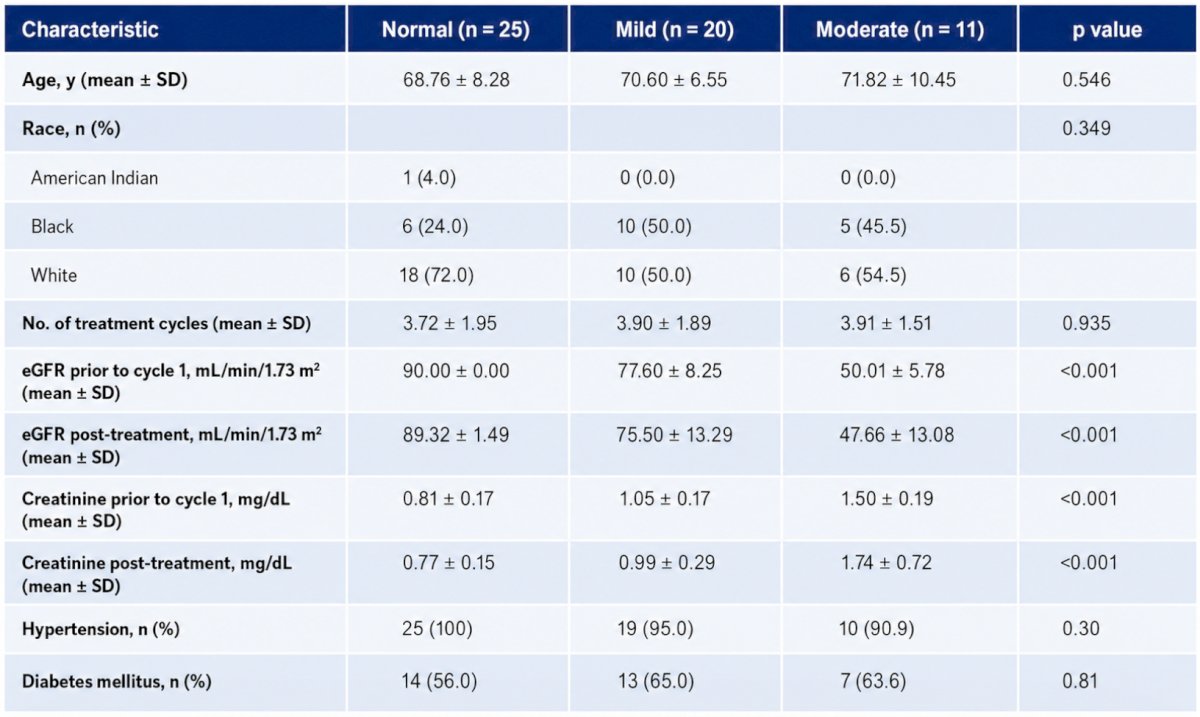
There were 4/20 (20%) of patients with mild impairment at baseline who progressed to grade 2 renal toxicity, and 1/11 (9.1%) of patients with moderate baseline impairment who progressed to grade 3. Across the cohort, eGFR remained stable, with no significant change per treatment cycle (β = -02.0; 95% CI -0.49 to +0.10; p = 0.2). Patients with normal or mild impairment showed no meaningful cycle-related change in eGFR, whereas patients with moderate impairment displayed a numerically greater decline (β = -0.53 per cycle), though not statistically significant (p = 0.2) (A – normal function, B – mild impairment, C – moderate impairment at baseline).

Creatinine trends were similarly stable overall (β = +0.0045 per cycle; p = 0.4), however patients with moderate renal impairment exhibited a statistically significant rise in creatinine over treatment cycles (β = +0.054; 95% CI: +0.025 to +0.083; p = <0.001):
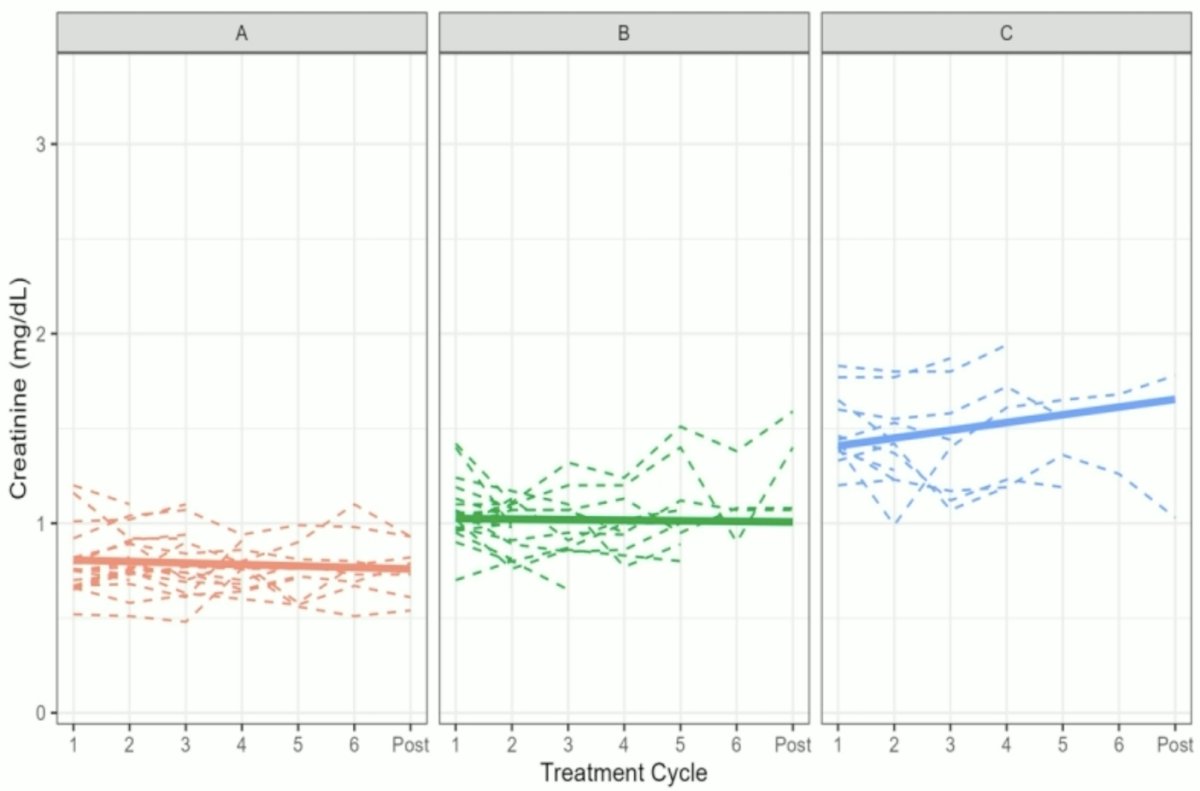
Reasons for a creatinine increase may include (i) PSMA-mediated proximal tubular injury, which leads to impaired active creatinine secretion, which leads to creatinine increases independent of eGFR, and (ii) the true GFR decline contributes to creatinine increase. Reasons why eGFR appears stable include (i) cancer-related sarcopenia, which leads to reduced creatinine production, which offsets the rise from GFR decline, and (ii) eGFR equations do not adjust for muscle mass, which may be falsely reassuring.
Dr. Gebreslassea concluded his presentation discussing a longitudinal analysis of eGFR and creatinine trends during and after 177Lu-PSMA-617 therapy with the following take-home points:
- 177Lu-PSMA-617 can be safely administered in most patients, even with moderate renal impairment at baseline
- Stable renal function was observed in patients with normal or mild impairment
- Moderate impairment may show a modest worsening over time
- There was an overall favorable renal safety profile with no significant variability in eGFR and creatinine during the treatment cycles
Presented by: Kiflom Gebreslassea, MD, St. Louis University, St. Louis, MO
Written by: Zachary Klaassen, MD, MSc – Urologic Oncologist, Associate Professor of Urology, Georgia Cancer Center, Wellstar MCG Health, @zklaassen_md on Twitter during the Society of Nuclear Medicine and Molecular Imaging (SNMMI) 2026 Annual Meeting, Los Angeles, CA, Sat, May 30 – Tues, Jun 2, 2026.