

(UroToday.com) The 2026 SESAUA annual meeting featured a kidney cancer session and presentation by Dr. Gianpaolo Carpinito discussing results from a national survey of urologic oncologists assessing the role of girentuximab PET/CT in clinical decision making. Girentuximab is a chimeric antibody targeting CAIX, which is an important target given that >94% of clear cell renal cell carcinoma (RCC) are CAIX-positive. Based on data from the ZIRCON trial,1 the girentuximab PET/CT can accurately identify localized and advanced clear cell RCC by targeting CAIX and is likely to become widely available.
Another diagnostic dilemma is accurately classifying node-positive and metastatic RCC. To better understand its potential use, Dr. Carpinito and colleagues conducted a case-vignette survey of urologists to explore and define ideal use cases for this promising diagnostic modality.
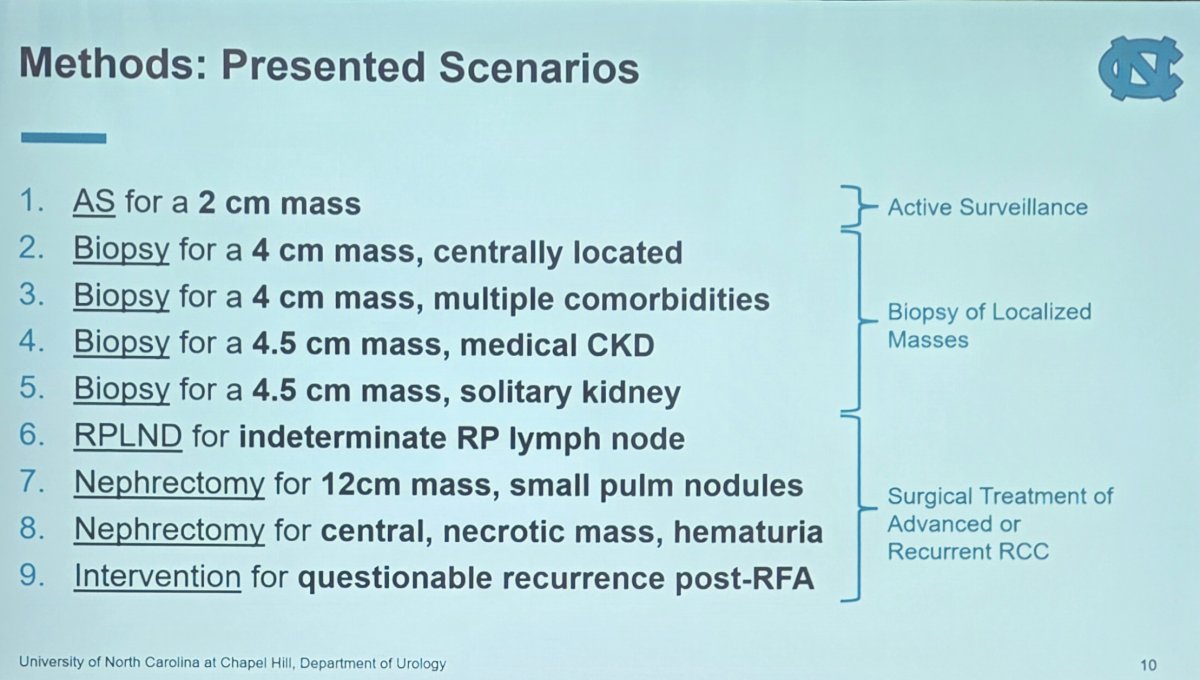
For this study, the investigators administered a uniform survey using Qualtrics Software, which included 9 clinical vignettes with related decision points (1 on active surveillance, 4 on biopsy, and 4 addressing uncertain stage/pathology) to urologists at two institutions. The details of the nine clinical scenarios are as follows:
Participants rated their likelihood of making specific clinical decisions given:
- Standard imaging
- A PET-avid Girentuximab scan
- A non-PET-avid Girentuximab scan
Responses were analyzed using paired-sample t-tests on coded Likert scale data to assess changes from baseline.
This study received 31 responses. For management shifts, the positive predictive value was 92.9% (95% CI 90.2-95.7), the negative predictive value was 75.2% (95% CI 71.2-79.3), and the accuracy was 86.0% (95% CI 85.0-87.0):
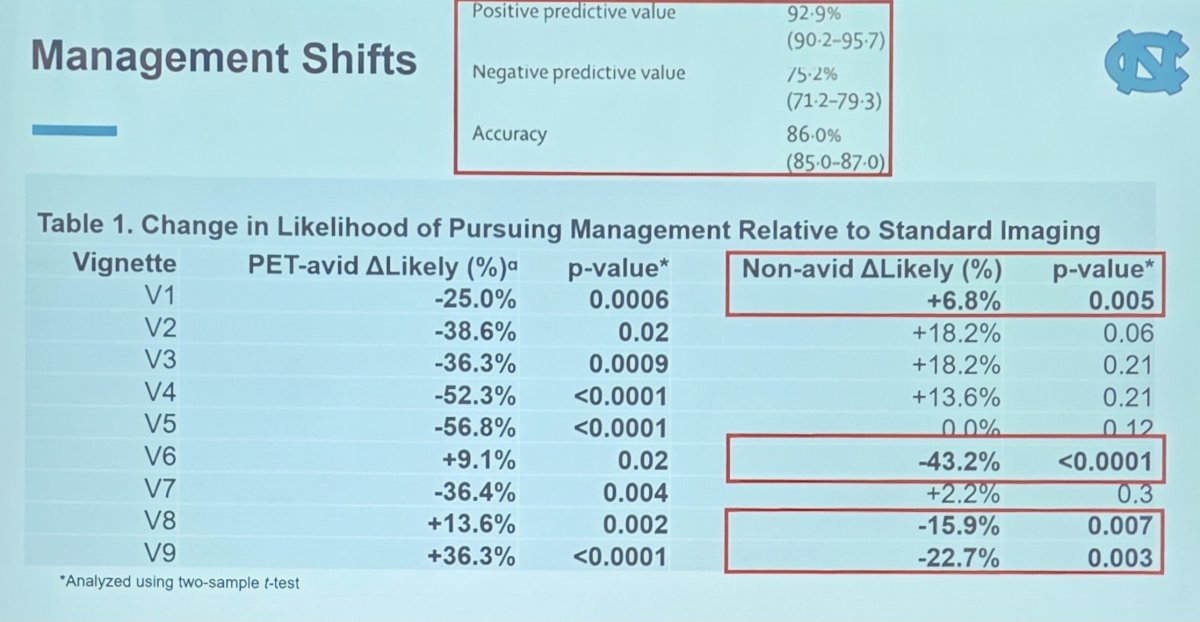
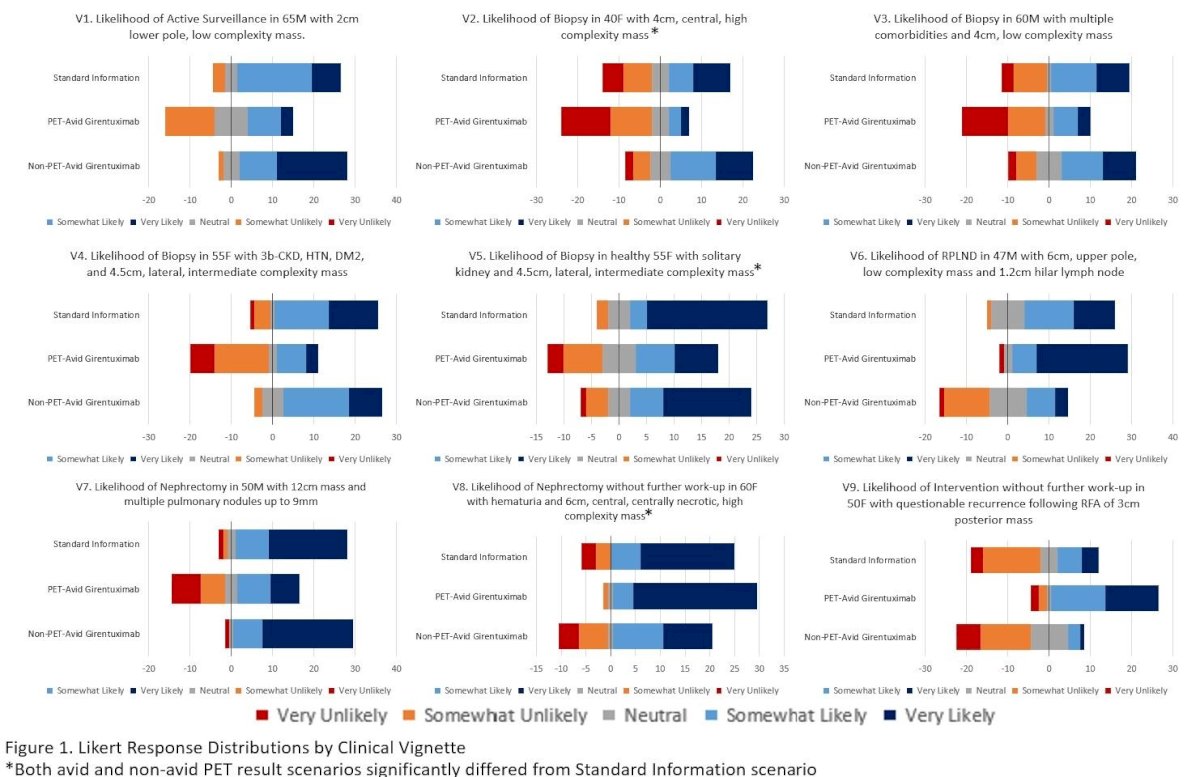
For the high complexity, central mass in a healthy patient (V2), 48% were somewhat/very likely to biopsy the mass based on standard imaging, but this decreased to 16% with PET-avidity (t(30) = 3.937, p = 0.0002) and increased to 64% with non-PET avidity (t(30) = -2.47, p = 0.001). Similarly, for a surgically solitary kidney with a mass (V5), biopsy was strongly favored with 80%, 71%, and 48% responding somewhat/very likely with standard imaging, non-avidity (t(30) = 1.98, p = 0.02), and avidity (t(30) = 3.81, p = 0.003), respectively. For a central, necrotic mass with hematuria (V8), 80% were somewhat/very likely to proceed straight to nephrectomy with standard imaging only, rising to 93.5% with PET-avid results (t(30) = -2.33, p=0.013) and decreasing to 64.5% with non-PET-avid results (t(30) = 2.33, p = 0.013):
Dr. Carpinito concluded this presentation discussing results from a national survey of urologic oncologists assessing the role of girentuximab PET/CT in clinical decision making with the following take-home points:
- Girentuximab PET/CT leads to significant management shifts when the results of the PET scan are avid
- There were limited scenarios leading to management shifts when the results are non-PET avid
- There was decreased concordance seen in advanced RCC scenarios, likely secondary to a lack of confidence in negative results versus a lack of robust data in this setting
- Post-treatment recurrence may represent the ideal case for using molecular imaging
Presented by: Gianpaolo Carpinito, MD, University of North Carolina, Chapel Hill, NC
Written by: Zachary Klaassen, MD, MSc – Urologic Oncologist, Associate Professor of Urology, Georgia Cancer Center, Wellstar MCG Health, @zklaassen_md on Twitter during the 2026 Southeastern Section of the American Urological Association (SESAUA) Annual Meeting, San Juan, PR, Wed, Mar 18 – Sat, Mar 21, 2026.Reference: