

(UroToday.com) The 2026 SESAUA annual meeting featured an artificial intelligence session and presentation by Dr. Mohamed Javid Raja Iyub discussing the application of machine learning models for predicting postoperative ileus after radical cystectomy. Postoperative ileus is a common complication after radical cystectomy that leads to delayed recovery and extended hospital stay. The objective of this study, presented at the SESAUA 2026 annual meeting, was to use machine learning to develop models that can predict patients with a high risk of developing postoperative ileus after radical cystectomy.
Data of patients who underwent radical cystectomy for bladder cancer at a single institution from 2017 to 2024 were retrospectively extracted for analysis and creation of the dataset. Baseline characteristics, demographic information, and perioperative data were collected. Descriptive analysis was applied, and various machine learning models, such as logistic regression, decision tree, random forest, XGBoost, support vector machine, and a simple neural network, were developed and compared. Evaluation of the models’ performance was done utilizing the area under the curve (AUC), F1 score, precision, sensitivity, and specificity.
Among the 307 patients included in the study, 30 patients (9.8%) developed postoperative ileus. Various machine learning models were constructed, and logistic regression (0.98) displayed the highest AUC, followed by random forest (0.97), support vector machine (0.97), XGBoost (0.95), simple neural network (0.87), and decision tree (0.84):
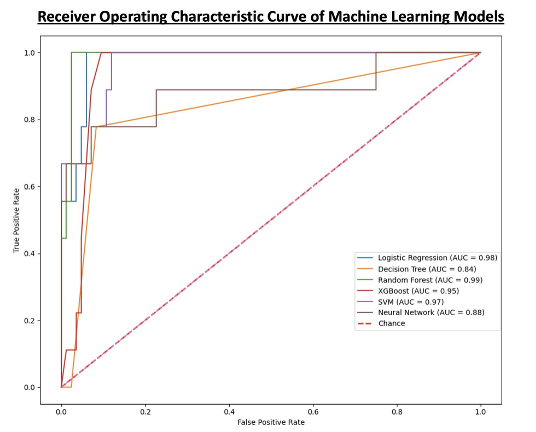
Furthermore, logistic regression and random forest also demonstrated high specificity (0.94 and 0.93, respectively). All models except for the decision tree and neural network achieved 100% sensitivity. In comparison with the other machine learning models, logistic regression (0.78) and random forest models (0.75) displayed higher F1 scores. Features such as age, body mass index, ASA class status, surgical approach, potassium level, and nasogastric tube placement were identified as key predictors of the outcome by the machine learning models.
Dr. Iyub concluded his presentation discussing the application of machine learning models for predicting postoperative ileus after radical cystectomy with the following take-home points:
- Machine learning models can be used in the prediction of postoperative ileus after radical cystectomy
- These results showed that logistic regression and random forest were the best-performing models
- The potential application of these machine learning models in risk stratification and personalized care is supported by the identification of clinically relevant predictors
Presented by: Mohamed Javid Raja Iyub, MD, Miami Cancer Institute, Baptist Health South Florida, Miami, FL
Written by: Zachary Klaassen, MD, MSc – Urologic Oncologist, Associate Professor of Urology, Georgia Cancer Center, Wellstar MCG Health, @zklaassen_md on Twitter during the 2026 Southeastern Section of the American Urological Association (SESAUA) Annual Meeting, San Juan, PR, Wed, Mar 18 – Sat, Mar 21, 2026.