

(UroToday.com) The 2025 SESAUA annual meeting featured a testicular cancer session and a presentation by Dr. Siddharth Marthi discussing the incidence of new mental health diagnoses in testicular cancer survivors. Following a new cancer diagnosis, patients are at risk of being diagnosed with a mental health disorder. The presence of a mental health disorder is associated with longer hospital stays, decreased adherence to treatment recommendations, and worse disease-specific survival. As testicular cancer is very curable, survivorship and quality-of-life considerations are of particular importance. The aim of this study presented at SESAUA 2025 was to evaluate the incidence of and risk factors for mental health disorders in patients after orchiectomy for testicular cancer.
Enrollment data and administrative billing claims were obtained from the Truven Marketscan Commercial Claims and Encounters database. Patients 18 years or older diagnosed with testicular cancer between 2009 and 2021 who underwent orchiectomy and maintained continuous insurance coverage spanning 6 months before and 12 months after diagnosis were included. Patients with mental health disorder diagnoses prior to orchiectomy were excluded, and chemotherapy, RPLND, and radiation were defined as advanced treatments. The primary outcome was any insurance claim associated with a new diagnosis of mental health disorder at 12 and 36 months after orchiectomy. Factors predicting the onset of mental health disorders were analyzed using multivariable logistic regression. Male patients with no lifetime cancer diagnosis and four years of continuous insurance coverage were identified as a control group and matched by age, insurance plan, and region.
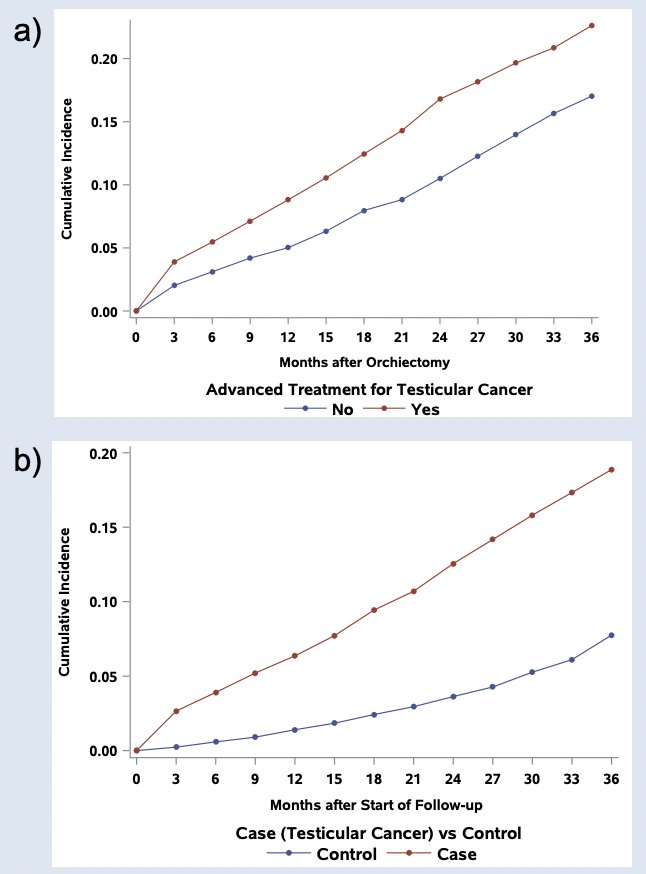
There were 5,946 patients that met inclusion criteria, and of these, 555 (9.3%) and 909 (15.3%) had a new diagnosis of mental health disorder within 12 and 36 months of orchiectomy, respectively. The cumulative incidence of new-onset mental health disorder was significantly different among cases and controls over 12 months (9.2% versus 2.2%, log-rank p < 0.0001) and 36 months (14.8% versus 7.3%, log-rank p < 0.0001) of follow-up. The incidence of mental health disorders at 36 months by (a) receipt of advanced treatment and (b) testicular cancer patients versus control is highlighted in the following figure:
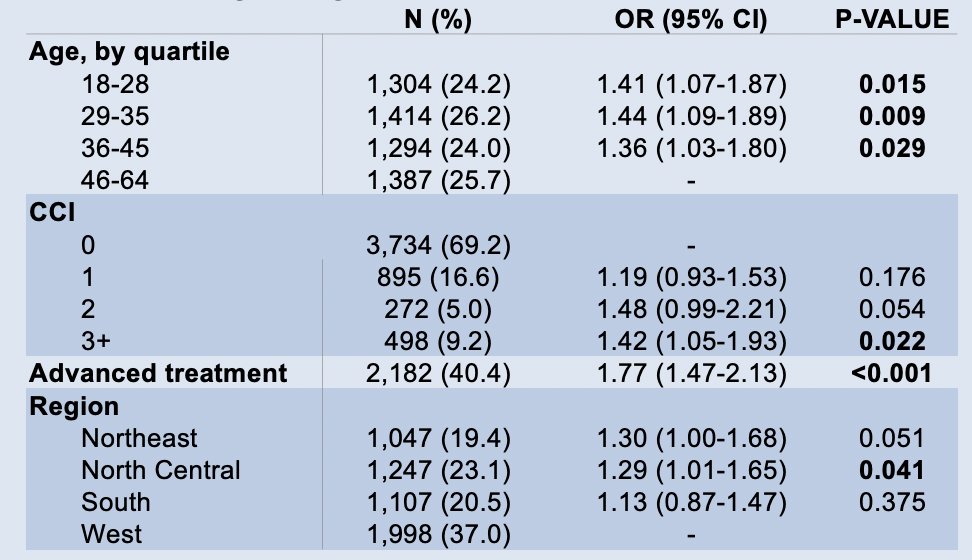
In the multivariate regression, younger age, higher Charlson comorbidity index score, receipt of advanced treatment and geographic location were associated with mental health disorder:
Dr. Marthi concluded his presentation by discussing the incidence of new mental health diagnoses in testicular cancer survivors with the following take-home points:
- Patients without prior mental health disorders who underwent orchiectomy had a higher incidence of developing a mental health disorder compared to matched controls
- Receipt of advanced treatments also increased the risk of developing new mental health disorder
- Physicians should counsel patients at initial evaluation for testicular cancer of the increased risk of developing a mental health disorder and refer patients to receive appropriate interventions in the post-diagnosis period
Written by: Zachary Klaassen, MD, MSc – Urologic Oncologist, Associate Professor of Urology, Georgia Cancer Center, Wellstar MCG Health, @zklaassen_md on Twitter during the American Urologic Association (AUA) Southeastern Section (SES) 89th Annual Meeting in Nashville, TN, March 12–15th, 2025