

(UroToday.com) The 2025 SESAUA annual meeting featured a bladder cancer session and a presentation by Dr. Meredith Bernhard discussing the oncologic efficacy of reduced versus standard-dose BCG for non muscle invasive bladder cancer. Intravesical BCG remains a mainstay of treatment for intermediate and high-risk non-muscle invasive bladder cancer, however, since 2012 there has been a global BCG shortage. Various management approaches have been recommended to navigate this shortage, including administering reduced doses, if feasible. With the global BCG shortage projected to last at least several more years, understanding if, when, and how to split BCG vials is crucial for practitioners to effectively treat patients with intermediate and high risk non-muscle invasive bladder cancer. The goal of this study presented at SESAUA 2025 was to compare the oncologic outcomes between patients receiving standard (50 mg) and reduced-dose (25 mg) intravesical BCG.
This was a retrospective review of all patients at UT-Memphis with intermediate or high risk non-muscle invasive bladder cancer who received intravesical BCG from 2014-2022. Dr. Bernhard noted that in 2019 their institution transitioned from standard dose to reduced dose BCG, thus patients were stratified based on receiving either dose. Kaplan-Meier analysis was used to determine differences in time to any recurrence and time to high-grade recurrence between dosing groups and univariate logistic regression to determine if clinical factors predict tumor recurrence.
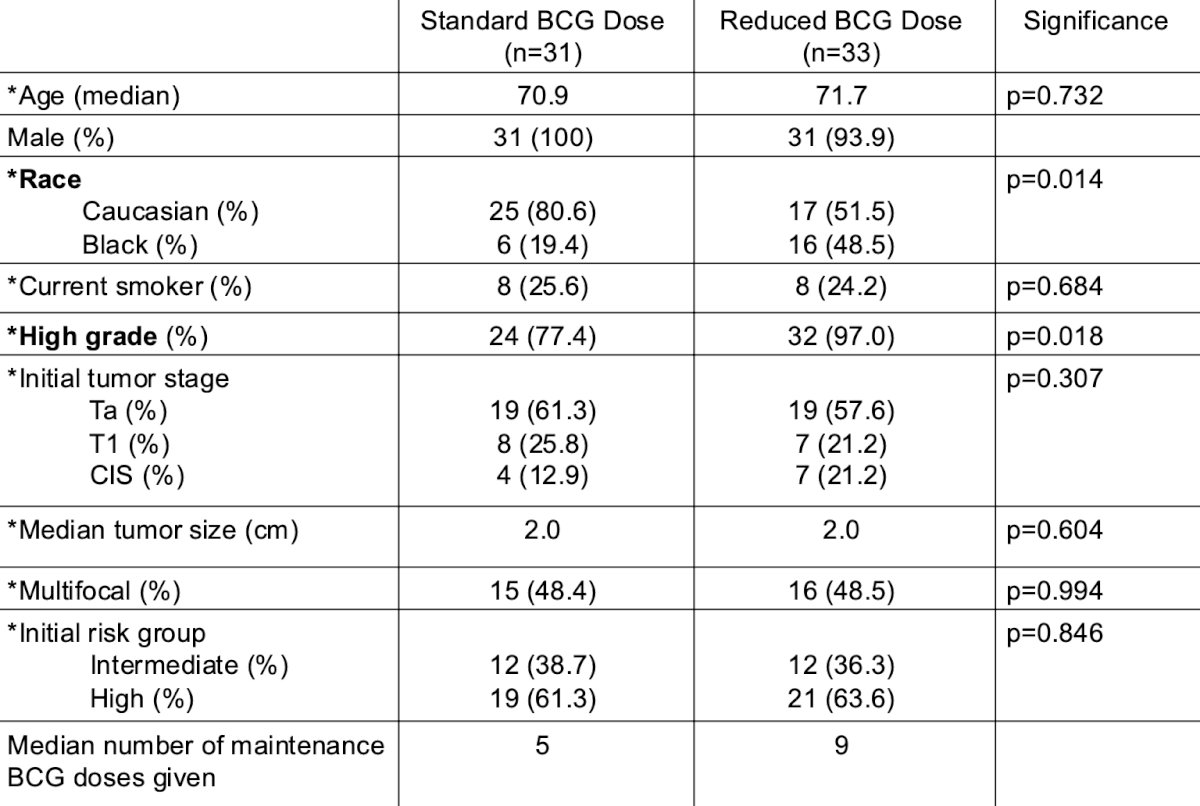
A total of 115 patients received BCG, and 64 met inclusion criteria. Thirty-one (48.4%) patients received standard-dose BCG, and 33 (51.6%) received reduced-dose. All patients received 6 doses of induction, the standard-dose cohort received a median of 5 doses of maintenance BCG, and the reduced-dose cohort received a median of 9 doses of maintenance therapy. The median follow-up was 42 months in the standard-dose cohort and 27 in the reduced-dose cohort. The baseline characteristics of the patients is highlighted in the following table:
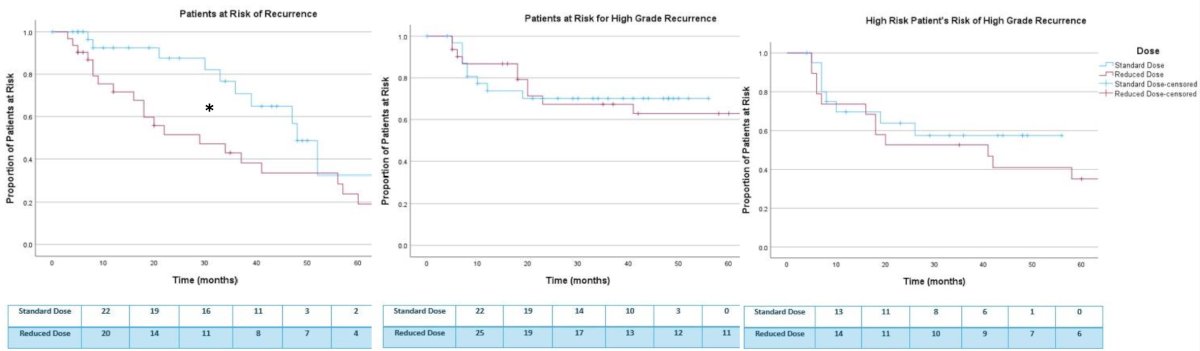
Those receiving standard-dose BCG showed higher rates of tumor recurrence overall (71.0% versus 30.3%, p = 0.001) and at 24 months (54.8% versus 27.3%, p = 0.025), though no statistically significant difference in high-grade recurrence overall (41.9 versus 27.3, p = 0.217) or at 24 months (29.0 versus 27.3%, p = 0.876). The median time to tumor recurrence was 14.9 months in the standard-dose group and 8.2 in the reduced-dose group, and the median time to high-grade recurrence was 21.2 months in the standard-dose group and 7.8 in the reduced-dose group. The following Kaplan Meier curves demonstrate the overall risk of tumor recurrence, risk of high grade tumor recurrence, and high risk patients at risk of high grade tumor recurrence between the standard dose and reduced dose cohorts:
Age, race, gender, initial tumor grade, stage, focality, and risk group showed no statistically significant correlation to tumor recurrence.
Dr. Bernhard concluded her presentation by discussing the oncologic efficacy of reduced versus standard-dose BCG for non muscle invasive bladder cancer with the following take-home points:
- Reduced-dose BCG did not demonstrate adverse oncological outcomes in a large cohort of patients receiving adequate BCG for intermediate- and high-risk non-muscle invasive bladder cancer when compared to standard dosing
- In an era of BCG shortage, this presents a reasonable alternative with clinical efficacy
Written by: Zachary Klaassen, MD, MSc – Urologic Oncologist, Associate Professor of Urology, Georgia Cancer Center, Wellstar MCG Health, @zklaassen_md on Twitter during the American Urological Association (SESAUA) 2025 Annual Meeting, Nashville, TN, Wed, Mar 12 – Sat, Mar 15, 2025.