

(UroToday.com) The 2025 SESAUA annual meeting featured a bladder cancer session and a presentation by Dr. Shreyas Josh discussing encore results of BOND-003 cohort C, a phase 3, single-arm study of intravesical cretostimogene grenadenorepvec for BCG-unresponsive high risk non-muscle invasive bladder cancer with CIS. A considerable unmet medical need exists for clinically effective, well-tolerated, and readily available bladder-sparing treatment options for patients with BCG-unresponsive high risk non muscle invasive bladder cancer with CIS. Cretostimogene is a conditionally replicating adenovirus that is highly immunogenic, with insertion of the human E2F-1 promoter, selectivity for RB-E2F pathway alterations, as well as encoding the GM-CSF transgene:

Furthermore, cretostimogene binds to the Coxsackie Adenovirus Receptor (which is expressed in all stages of bladder cancer) and is an oncolytic immunotherapy, with viral replication resulting in tumor lysis and stimulation of an immune response.
Cretostimogene has received both US FDA Fast Track and Breakthrough Therapy Designations for the BCG-unresponsive high risk non-muscle invasive bladder cancer with CIS indication.
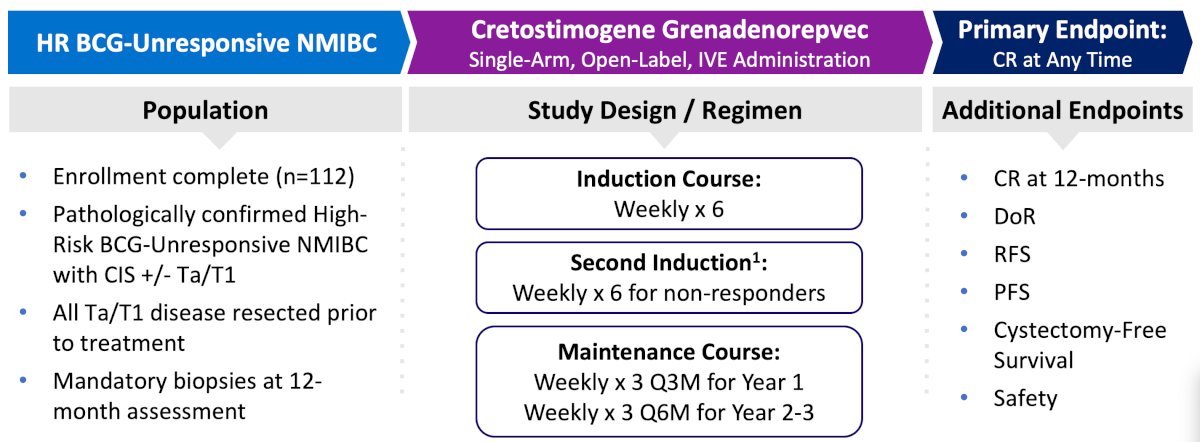
There were 112 adults with histologically confirmed BCG-unresponsive high risk non-muscle invasive bladder cancer with CIS enrolled in BOND-003 Cohort C. Participants had previously received adequate BCG and were BCG-unresponsive high risk non-muscle invasive bladder cancer by the FDA definition. Cretostimogene treatment consisted of 6 weekly doses during the induction phase, followed by 3 weekly maintenance cycles at months 3, 6, 9, 12, and 18. Participants were eligible for repeat induction therapy at month 3 if persistent high grade Ta or CIS was noted at biopsy. Response assessments included serial cystoscopy, urine cytology, axial imaging, and mandatory mapping biopsy at month 12, with centralized review of all pathology. The primary outcome measure was complete response at any time. Other secondary and exploratory endpoints were also assessed:
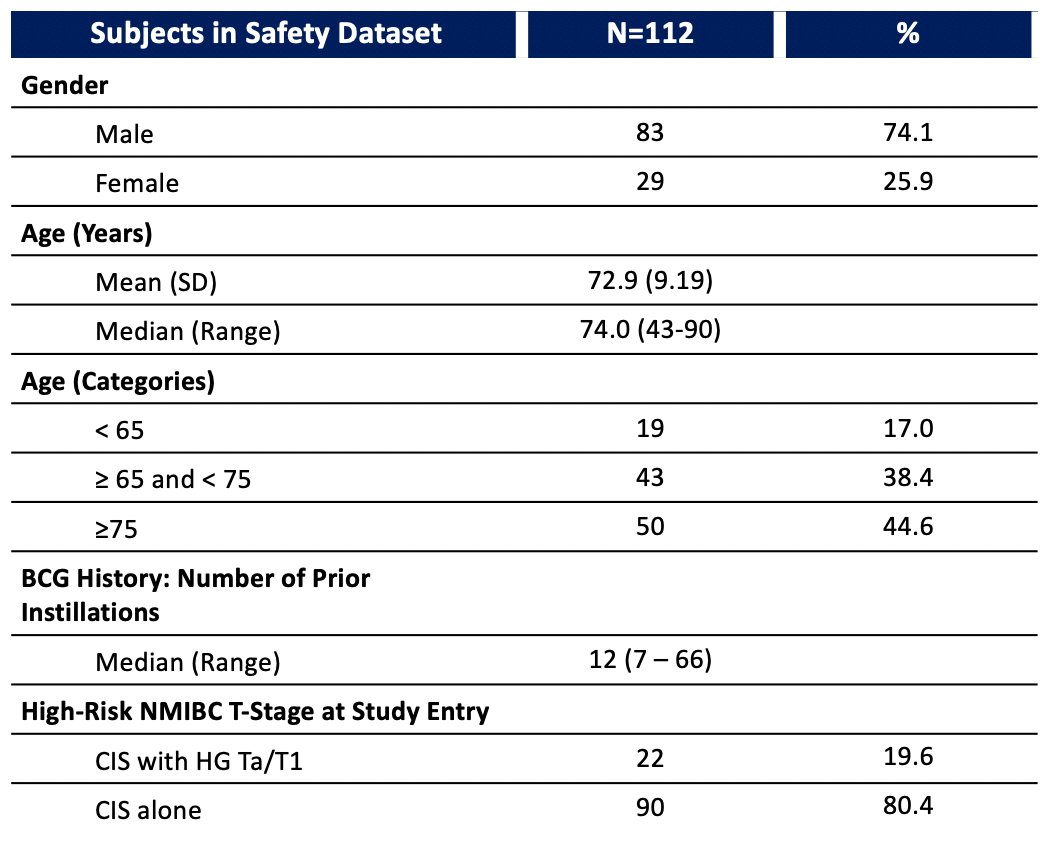
Among the 112 patients enrolled, the majority are male (74.1%), 61% are white, and 83% are >65 years of age. Overall, 63.4% of those enrolled are from the United States, with the overall population representing a very highly pre-treated population:
Currently, among 110 evaluable patients, the overall complete response rate is 74.5% at any time (95% CI 65.4-82.4%). The 12 month landmark complete response rate is 46% (95% CI 36.9-56.1%), with a 24 month complete response rate by Kaplan-Meier estimate of 41% (95% CI 30.4-50.8):

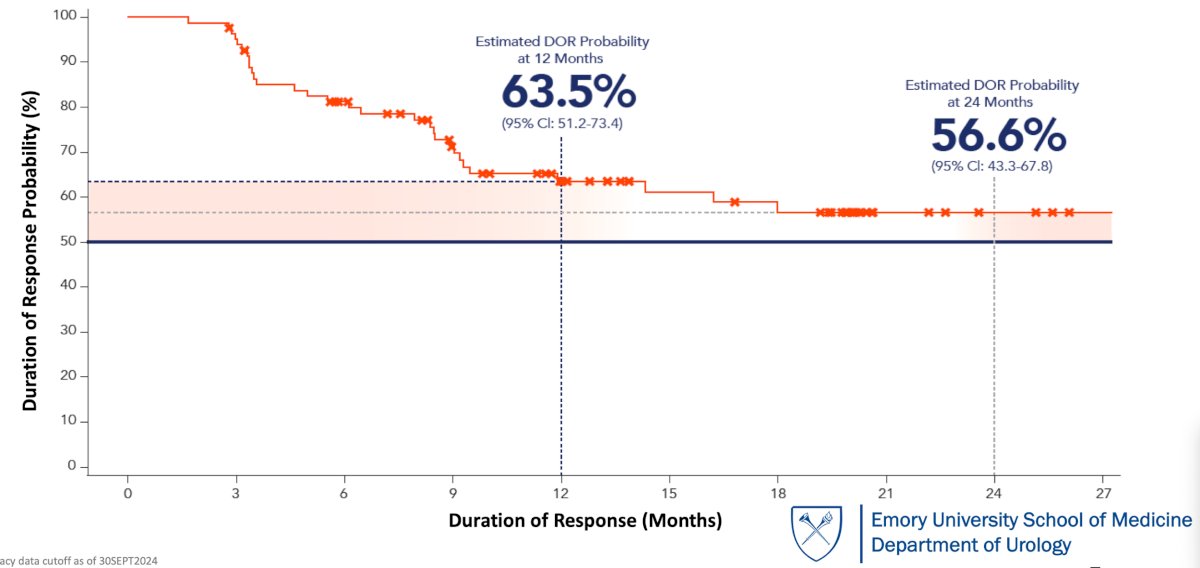
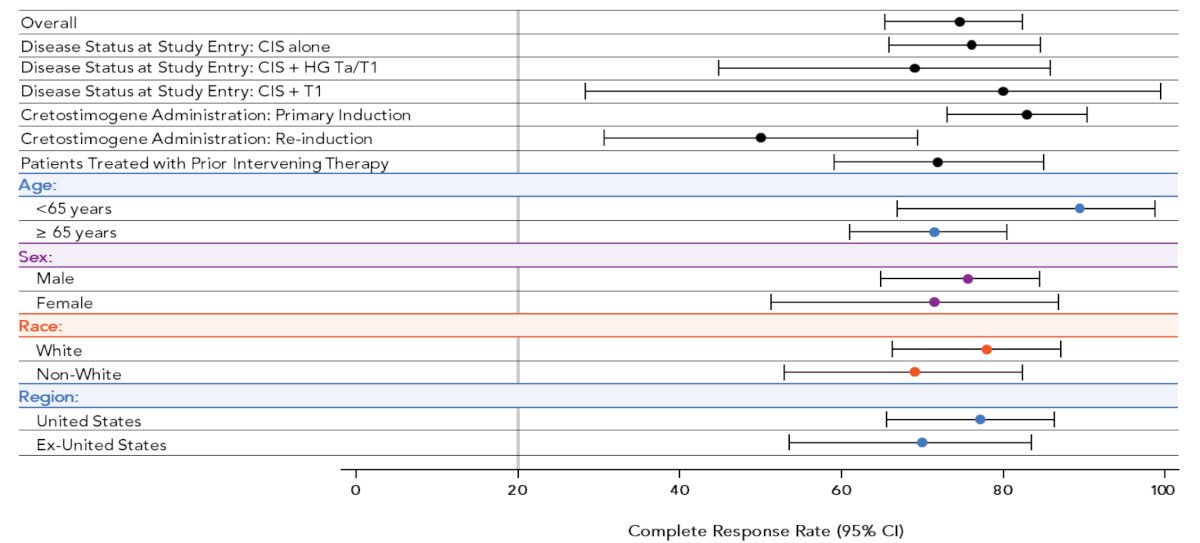
Overall, 97.3% were free from progression to muscle invasive bladder cancer at 12 months, 90.0% were cystectomy free at 12 months, there was consistency of complete response rate across all patient subgroups, and all complete responses were centrally confirmed. The median duration of response is not reached but exceeds 27 months. The median follow-up in responders is not yet reached but is at least 14.5 months, which suggests innate to adaptive switching with immunologic memory and a long IO tail. The estimated duration of response probability at 12 months is 63.5% (95% CI 51.2-73.4) and at 24 months is 56.6% (95% CI 43.3-67.8):
There were 50.0% of patients that were re-induced with oncolytic immunotherapy that converted to a complete response, of which 64.3% remain in durable response after conversion to a complete response. The Swimmers plot demonstrates sustained responses observed over 30 months:

Moreover, the complete response rate was consistent among patient subgroups, as highlighted in the following forest plot:
Cretostimogene demonstrated a favorable and well-tolerated safety profile, including no grade 3+ treatment related adverse events or deaths, most adverse events were grade 1-2, and there were no treatment related discontinuations. Overall, 97.3% of patients completed all protocol defined treatments, and 1.8% (n = 2) of patients had serious treatment-related adverse events (grade 2):

Dr. Joshi concluded his presentation by discussing the encore results of BOND-003 cohort C with the following take-home points:
- Cretostimogene grenadenorepvec provides a compelling complete response rate of 74.5%
- Durable responses include a median duration of response not reached, but exceeding 27 months, and 63.5% (95% CI 51.2%- 73.4%) remain in response at 12 months
- Cretostimogene is a very well-tolerated regimen, with no grade 3+ treatment related adverse events or discontinuations, and 97.3% completing all protocol defined treatments
- This regimen easily fits, and is scalable within existing clinic workflow, with treatment administered by MAs and RNs
- Future and ongoing clinical trials are evaluating cretostimogene monotherapy, and rational combinations, as a backbone therapy
Presented by: Shreyas Joshi, MD, MPH, Emory University, Atlanta, GA
Written by: Zachary Klaassen, MD, MSc – Urologic Oncologist, Associate Professor of Urology, Georgia Cancer Center, Wellstar MCG Health, @zklaassen_md on Twitter during the Southeastern Section of the American Urological Association (SESAUA) 2025 Annual Meeting, Nashville, TN, Wed, Mar 12 – Sat, Mar 15, 2025.