

(UroToday.com) The 2025 South Central AUA annual meeting included a session on urothelial cancer, featuring a presentation from Dr. Patrick Burnam discussing long-term outcomes of adjuvant UGN-101 in a real-world cohort. Kidney-sparing surgery in upper tract urothelial carcinoma (UTUC) is employed in patients with low-risk disease or imperative indications with the goal of preserving kidney function without compromising oncologic outcomes.
UGN-101 has been approved as an adjuvant therapy for patients with low-grade upper tract urothelial carcinoma based on results from the OLYMPUS trial.1-2 Real-world application of these strategies often includes higher-risk patients. At the 2025 South Central AUA annual meeting, Dr. Burnam and colleagues presented their experience with UGN-101 in treating upper tract urothelial carcinoma at their institution.
This study was a retrospective review to identify 13 patients at Tulane University School of Medicine who were diagnosed with upper tract urothelial carcinoma, initially managed with kidney sparing surgery, and received UGN-101 as an adjuvant therapy. Patient characteristics were extracted, and oncologic outcomes were calculated, including rates of recurrence, nephroureterectomy, and metastasis.
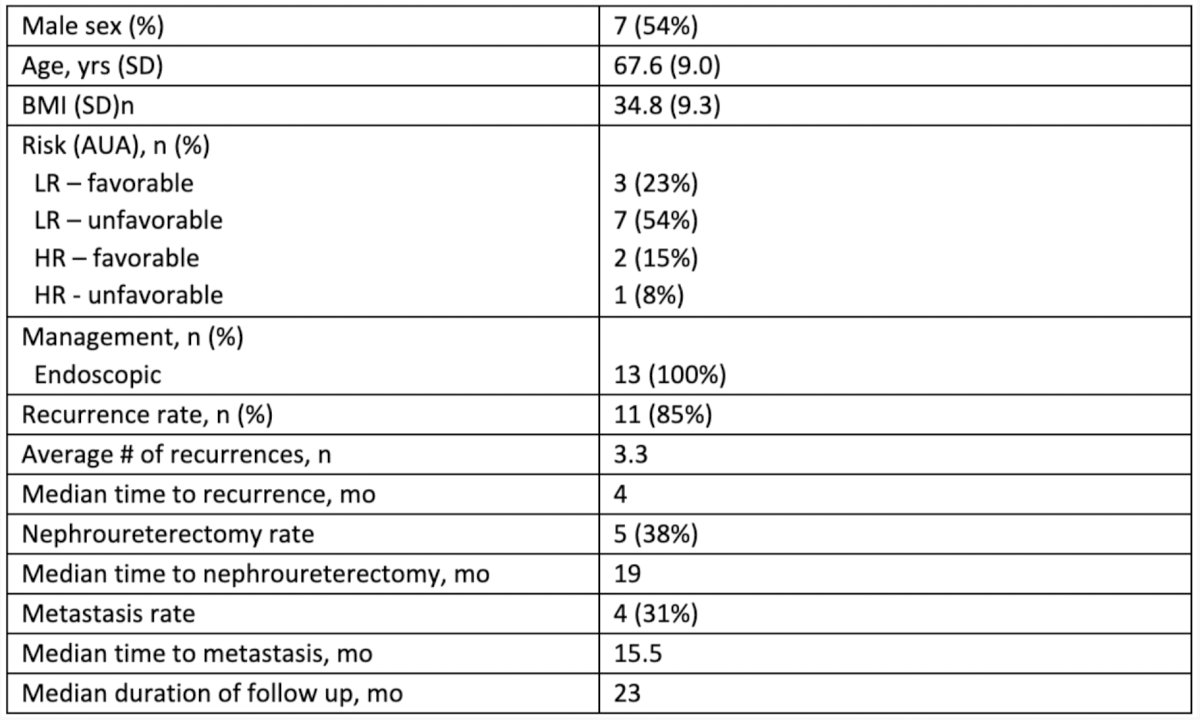
Of 13 patients in the cohort, 11 (85%) experienced at least one recurrence. For those who had a recurrence, the mean number of recurrences was 3.3. Five patients (38%) underwent eventual nephroureterectomy, and four patients (31%) developed metastatic disease. The median length of follow-up was 23 months. The full results are listed in the following table:
Dr. Burnam concluded his presentation discussing long-term outcomes of adjuvant UGN-101 in a real-world cohort with the following take-home points:
- Recurrence was high, and responses appeared less durable than reported in trial-based literature
- Evidence is limited by a single-center, retrospective design and small sample size
- Real-world data on adjuvant UGN-101 remain sparse, particularly in the high-grade/high-risk setting
- We need to use caution in extending UGN-101 beyond its approved low-grade indications without stronger evidence
- Prospective, comparative trials are needed to define effectiveness by risk group and treatment sequence
Presented by: Patrick Burnam, Tulane University School of Medicine, New Orleans, LA
Written by: Zachary Klaassen, MD, MSc – Urologic Oncologist, Associate Professor of Urology, Georgia Cancer Center, Wellstar MCG Health, @zklaassen_md on Twitter during the 2025 South Central American Urological Association (AUA) Annual Meeting, Orlando, FL, Wed, Sept 10 – Sat, Sept 13, 2025.
References:
- Kleinmann N, Matin SF, Pierorazio PM, et al. Primary chemoablation of low-grade upper tract urothelial carcinoma using UGN-101, a mitomycin-containing reverse thermal gel (OLYMPUS): An open-label, single-arm, phase 3 trial. Lancet Oncol 2020 Jun;21(6):776-785.
- Pierorazio PM, Kleinmann N, Shabsigh A, et al. Long-term outcomes of primary chemoablation of low-grade upper tract urothelial carcinoma with UGN-101, a mitomycin reverse thermal gel. J Urol. 2025 Mar;213(3):313-322.