

(UroToday.com) The 2025 South Central AUA annual meeting included a session on urothelial cancer, featuring a presentation from Dr. Mark Doss discussing oncologic outcomes of kidney-sparing surgery with or without adjuvant UGN-101 in upper tract urothelial carcinoma.
Kidney-sparing surgery in upper tract urothelial carcinoma is employed in patients with low-risk disease or imperative indications with the goal of preserving kidney function without compromising oncologic outcomes. UGN-101 has been approved as an adjuvant therapy for patients with low-grade upper tract urothelial carcinoma based on the OLYMPUS trial.1 Real-world application of these strategies often includes higher-risk patients. As there are no studies comparing the efficacy of adjuvant UGN-101 to no adjuvant therapy, the aim of this study was to evaluate the outcomes of kidney-sparing surgery with and without adjuvant UGN-101 in a real-world cohort.
This was a retrospective review of patients from 2015 to the present who were diagnosed with upper tract urothelial carcinoma and were initially managed with kidney-sparing surgery. Rates of recurrence, nephroureterectomy, and metastasis were calculated. Time to recurrence and number of recurrences were compared using a generalized linear model with a Poisson distribution.
There were 27 patients with 30 affected renal units identified, of which 13 renal units (43%) were treated with kidney-sparing surgery and UGN-101, and 17 renal units (57%) were treated with kidney-sparing surgery alone. Baseline characteristics and oncologic outcomes are outlined in the table:
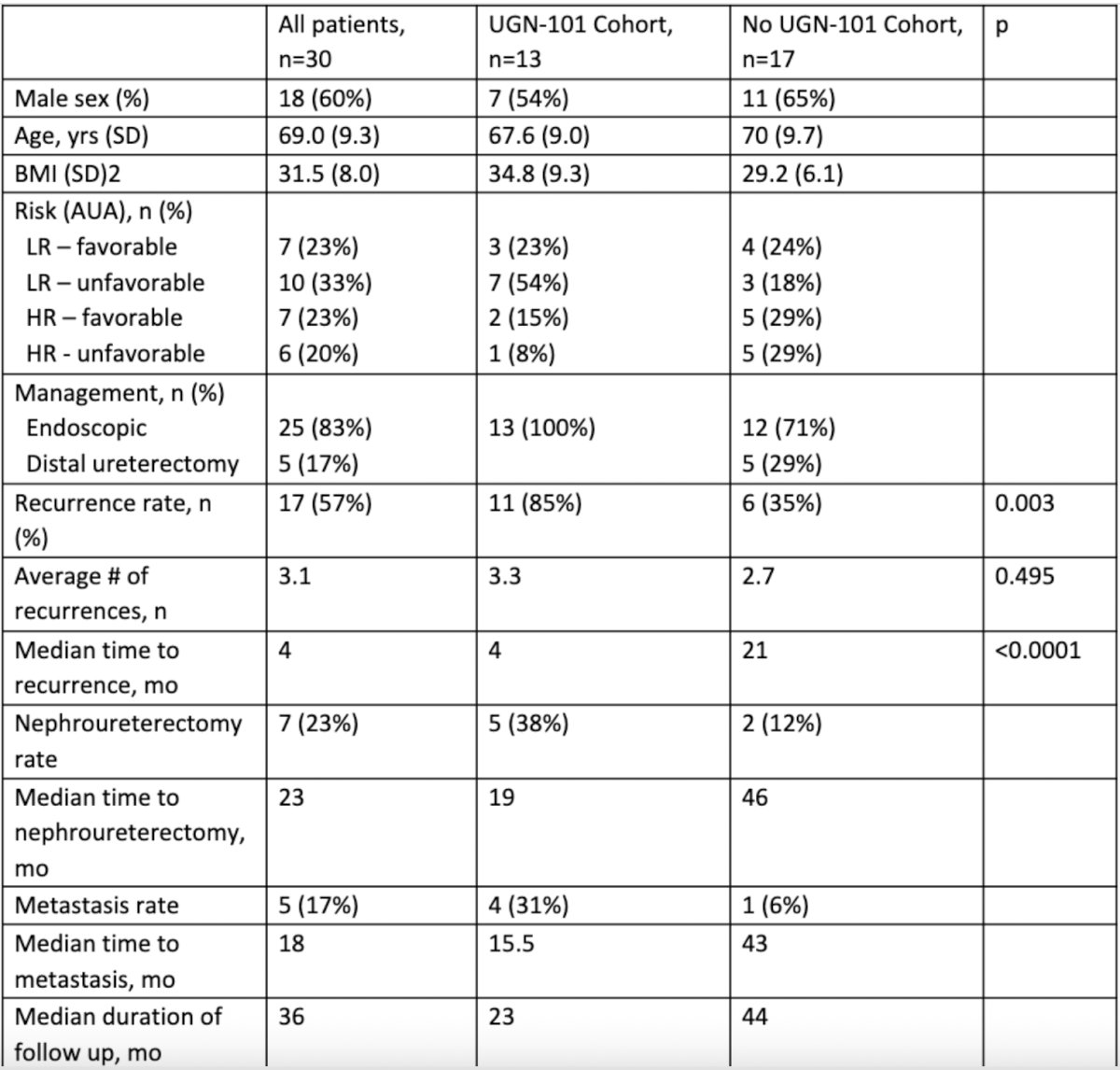
The two groups were well balanced with regard to baseline demographic characteristics. The non-UGN-101 cohort had more high-risk disease (10 versus 3 patients), and a subset of patients underwent a distal ureterectomy (n=5, 29%) as their kidney-sparing surgery. Recurrence rates were lower in the non-UGN-101 cohort (35% versus 85%, p = 0.003,) and median time to recurrence was longer (21 versus 4 months, p < 0.0001). For those patients who had a recurrence, there was no difference in the number of recurrences (2.7 versus 3.3, p = 0.495).
Dr. Doss concluded his presentation discussing oncologic outcomes of kidney-sparing surgery with or without adjuvant UGN-101 in upper tract urothelial carcinoma with the following take-home points:
- In this single institution analysis, adjuvant UGN-101 was associated with worse oncologic outcomes in patients
- UGN-101 treatment was associated with higher rates of recurrence, nephroureterectomy, and metastasis, and was also associated with shorter median time to recurrence, nephroureterectomy, and metastasis
- Despite the biases associated with a small, retrospective, single-institution study, additional comparative studies are needed to better understand the efficacy of UGN-101 in upper tract urothelial carcinoma
Presented by: Mark Doss, MD, University of Missouri, Columbia, MO
Written by: Zachary Klaassen, MD, MSc – Urologic Oncologist, Associate Professor of Urology, Georgia Cancer Center, Wellstar MCG Health, @zklaassen_md on Twitter during the 2025 South Central American Urological Association (AUA) Annual Meeting, Orlando, FL, Wed, Sept 10 – Sat, Sept 13, 2025.
References: